Showing posts with label winner. Show all posts

Monday, September 16, 2019

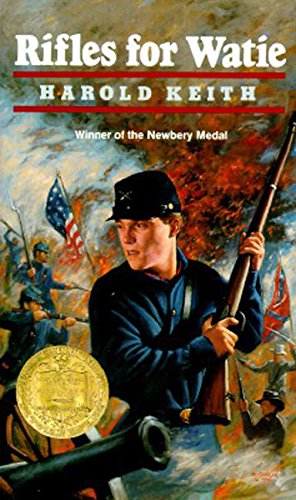
Rifles for Waitie, by Harold Keith

I feel like this book has been in every 4th-6th grade classroom ever. It was the sort of book that was always just . . . around. No one directly encouraged me to read it but the pressure was always there by its very presence. Looking at the cover with my inexperienced kid brain, it just looked like one more book about some young boy running off the join the Revolutionary War and with one notable exception (My Brother Sam Is Dead, I'm looking at you) boys-caught-up-in-war books did not appeal to me and were overused in the curriculum, so I intentionally ignored this one with a clear conscience.

Let it be said firstly that this is a book about the Civil War, not the Revolutionary. And it does have an interesting perspective, taking place around the Missouri/Kansas border. I did gain some interesting insights about how the war looked in that part of the country, as opposed to the East Coast as usual. However, this is just not my genre and I found myself skimming to get to the end. If this blog used a "coming of age" tag, it would be aptly applied here.

Monday, August 28, 2017

Last Stop on Market Street, by Matt de la Peña

Has it really been nearly three months since the last post on this blog?  It's seriously time to get moving.

I actually read this title last week with no intention of blogging it; my children borrowed it from the library and I just assumed from its dimensions that it was a Caldecott medalist and not a Newbery.  Silly me!

It's such a brief story that there isn't much to say that won't give away *everything*.  But here is the nutshell version.

CJ and his grandmother leave church on Sunday, and CJ starts to notice some differences between himself and others.  His friend gets to ride home in a car with his dad instead of waiting for the bus in the rain. He doesn't have an MP3 player like some of the older kids on the bus.  Every Sunday after church he doesn't get to go home; he has to go. . . to the location disclosed at the end of the book.  But  Nana's perspective on the things CJ complains of is completely different, and soon he starts seeing things her way, too.

My kids were a little young to appreciate this one, but it's a great story for kids who have a little more exposure to an urban environment than my own, or are old enough to stretch their imaginations just far enough to join CJ in his world.

Thursday, August 4, 2016

Secret of the Andes, by Ann Nolan Clark

Cusi, a young boy, lives high in the mountains of Peru.  With him live a herd of llamas, his faithful dog, and Chuto, an old Indian man.  It never occurs to him to question the nature of his isolated life until, peering into the valley below, he notices a new family camped there.  There are a mother, father, and two small children.  He sees the love and comfort that exists between them and wonders why he has neither mother, father, nor siblings, and longs to experience that sense of family for himself.

When circumstances show that Cusi is ready, he departs from Chuto with a small herd of llamas to find the ancient city of Cuzco, in hopes of finding a family of his own.  Along the way, though, he discovers that much in the city is foreign to him.  Raised in traditional Incan culture, he learns that most people speak an unfamiliar language (Spanish), have strange churches to a foreign God, and live in a way that he doesn't understand.

Nonetheless, he joins a family with many children (the parents' philosophy is generally "the more, the merrier") as they travel the city to trade before heading home.  But his Indian name doesn't fit (they rename him Nicho), and although they're happy and friendly, Cusi never really feels at home with them.  So he slips out in the night and heads back to the mountain.

Cusi learns over the course of his travels that he is descended from Incan royalty and, like Chuto before him, is charged with supporting the Indians of Peru from the background- remembering and teaching the traditional ways, keeping the language, and making gifts from his herd of llamas to keep the culture alive.  Because although the Incans were conquered, they will be part of Peru forever.

Thursday, December 10, 2015

Amos Fortune, Free Man, by Elizabeth Yates

This is a short biography encompassing the entire life of Amos Fortune.  Captured as a slave from Africa in the early 1700's, he lived a fascinating life and was fortunately purchased by kind and generous men who did not abuse him, but made his freedom attainable and taught him the trades by which he would support himself in his independence.

It's a great book for kids because it makes the injustice of slavery and racism abundantly clear, as well as the tragedies in Amos's life, without being heavy-handed.  The language is clear and things are well explained.

The only thing I would change about this book is how it more or less ignored the Revolutionary War.  I'm sure it must have impacted Amos's life directly, but it's only mentioned in passing.

Thursday, April 16, 2015

M. C. Higgins, the Great, by Virginia Hamilton

This one is practically a children's literature staple.  Even though I'd never read it, the title is familiar.  It's been reprinted numerous times and with numerous covers.  But somehow I never encountered it in my school curriculum.

So, the plot.  In brief:  M. C. Higgins lives with his parents and three younger siblings on the side of Sarah's mountain.  Both of his parents are day laborers who spend their day in the nearby town, so M. C. is usually responsible for keeping charge of his siblings in the hills.  Even when he's not with them, they can call back and forth through the hills, or he can watch them from atop a forty-foot pole that his father put in the mountainside for him.

A great portion of the mountain belongs to M. C.'s family, passed on from the time when his great-great grandmother Sarah, an escaped slave, settled there.  But above them, the mountain has been strip-mined for coal and a pile of leftover refuse threatens to eventually slide into their home, destroying it.  He knows his father will never leave the mountain, but he also knows that they'll have to leave to survive at all.  He hears that a man from the city is headed their way with a tape recorder to capture the songs and voices of the local people and it becomes M. C.'s hope that this man will become so enamored with his mother's voice that he can take them all away and she can become a famous singer.

I wish I was able to have a greater appreciation for Ms. Hamilton.  She has a wonderful talent for painting an atmosphere or a feeling with her words.  But there were also times that I was confused by her writing and wished for more clarity.  For example, M. C.'s pole has a bicycle seat on the top and is connected to wheels, which he pedals from the top to turn himself to see.  But the mechanism of how this works never sunk in for me.  Similarly, his neighbors, the Killburns, farm extensively on an adjacent hillside and connect their homes and gardens at various heights with a "web" of vines.  But I had trouble picturing it concretely in my mind.  This book would really have benefited from illustrations at times like these.

The last thing that left me hopelessly confused is the appearance of the Killburn family.  You'll have to excuse my lack of exposure on this one.  The Killburn children are described as freckled and red-headed.  Growing up in the great white north, in my mind these descriptions paint a picture of a pale child, probably of Irish or Scottish heritage.  So imagine my surprise when searching for cover images, when the matter was clarified for me.  Which now leaves me to wonder whether the Killburns are naturally readheaded (is this possible?) or they suffer from malnutrition by merit of their being vegetarians, like those poor starving kids in Three Cups of Tea?  Not something that the average child would wonder, I know.

Saturday, April 11, 2015

Up a Road Slowly, by Irene Hunt

So, I took a break from my usual method of reading for this blog.  Thus far I've made a real effort to read books in some sort of order from oldest to most recent.  But when I was at the library not long ago, I was in a bit of a hurry and just snagged a few with the Newbery Award sticker on the spine so I could get to reading.  1967 was quite a jump forward, and I have to admit that I found it pretty disorienting.  Because there was no mention of technology to speak of, it was very hard to place this coming-of-age novel in a timeframe.  I assumed that it was at some point after both World Wars, since there was no mention of absent or dead fathers.  But girls were still expected to wear skirts or dresses, there were annoying instances of previously-acceptable sexism, and a horse was a common mode of transportation.  Additionally, living a few miles out of town was sufficient to exile some one from a social life, and high school engagements were accepted.  Where and when does this book take place?!  I do not know.  That said, the experiences in the novel are very relatable because the author has a gift for pinpointing emotions.

The book follows Julie, our protagonist, from the age of seven through her high school graduation.  Julie has two older siblings: Christopher, who is three years older, and Laura, who is older by about six or seven years.  As the book opens, their mother has just died from an unspecified illness (although the death isn't stated explicitly, which made circumstances confusing to me for a while), and Julie is recovering from this illness herself.  Unable to cope and run the household single-handedly, their father sends Julie and Chris to live in the country with their unmarried aunt Cordelia (this book feels so dated that I almost referred to her as "maiden aunt" because the term makes sense in the context of the book).  Because Laura will be graduating from high school before too long, and she is assumed to be less adaptable due to her age, she remains in town with their father.  Only five miles or so away, this distance appears a very significant one to travel.

Julie feels the break in her family very acutely.  Although Chris is a close playmate, Laura has served as a second mother to Julie, so she naturally feels abandoned at the loss of affection.  Aunt Cordelia is difficult to get to know.  Although not unkind, she is firm and strict.  Cordelia also teaches the regional school single-handedly.  Julie makes a few friends locally, as well as the acquaintance of her spoiled uncle Haskell (supposedly an author, although he's more often found drinking than typing).

The reader is able to follow Julie as she matures into a young lady as she deals with numerous losses, disappointments, and periods of confusion in her life.  Many of the experiences are universal, but Julie's advantage is that she is under the mentorship of numerous understanding adults who deal with her patiently, compassionately, and honestly.   I don't know who, exactly, I'd recommend this book to- I'd really have to see what else they were reading, but most likely some one who likes realistic fiction and doesn't mind historical fiction, either (there's nothing distinctly historical here, but the lack of more modern conveniences is noteworthy).  It doesn't have a lot of action or earth-shattering consequences, as most current novels seem to, but it nonetheless holds interest well.

Saturday, December 20, 2014

The Bronze Bow, by Elizabeth George Speare


Yet another case of covers deceiving me.  My library's copy was one of those Permabound sorts of covers, with no dust jacket or summary.  So I assumed this was yet another dramatic Greek mythology volume.  Seriously, look at that cover over there to the left.  Those of you unfamiliar with this story, what do you think is happening here?

In any case, I was wrong.  You probably were, too.

Daniel lives in the mountains near Galilee with a rough band of men.  Drawn there for various reasons, they all follow Rosh, a tactful leader who is slowly amassing an army he hopes to use to overthrow the Roman rule of Israel.  In the meantime, the men live as best they can.  This usually involves helping themselves to sheep grazing nearby (the shepherds would no doubt be grateful of the opportunity to offer them for the cause, right?) and money from travelers.  Daniel found himself there after fleeing a cruel and oppressive blacksmith he had been apprenticed to.  He had nowhere else to go- his father had been executed by Romans in his childhood and his mother had died of grief soon afterward.  His grandmother, unable to feed him, had sent him along to the blacksmith.  She kept his sister, Leah, so traumatized by her parents' death that she is largely unable to function and never leaves the house.

One day on the mountain, Daniel runs into a prior acquaintance, Joel, and his sister, Malthace.  Although initially wary of each other (and nervously aware of the vast differences in their social standing, as Joel is the son of a rabbi and well-educated), they strike up a cordial conversation and begin to refamiliarize themselves.  When Daniel's old master dies, leaving no one to claim the debt of his remaining apprenticeship, Joel sends another former apprentice, Simon ('the Zealot") to tell him and encourage him to visit his family for the first time since leaving years ago.

Upon visiting his old home, Daniel immediately regrets it.  His grandmother's house is impoverished, with little food and most possessions long since sold.  Leah scarcely recognizes him and skittishly avoids him whenever possible.  He feels confined.  The next morning, the Sabbath, Simon returns to offer Daniel the opportunity to join him in listening to the man who is schedule to speak in the synagogue that day.  This man, Jesus, also preaches the coming of the kingdom of God, but stops disappointingly short of advocating revolution.

Daniel returns to the mountain and Rosh's band for a period of time, but when his grandmother dies, he is forced to return to the village to care for his sister.  Because Simon has chosen to follow Jesus in the long-term, he offers his blacksmith shop, tools, and adjoining home to Daniel so he can support himself and meet the smithing needs of his village as well.  He remains friends with Joel, and over time Malthace befriends Leah and she slowly becomes less timid (but still will not leave the house or meet strangers).  But even though he is forced to live in the village, Daniel maintains his loyalty to Rosh.  He builds his own small band of rebels who meet in secret, and carry out small acts of sabotage against the Romans and those who collaborate with them. 

But even he is striking small blows for Israel, Jesus is continuing to grow in popularity.  He is still preaching the kingdom of God.  They say he heals the sick, and raises the dead to life.  There is certainly something significant happening before his very eyes, but if this Jesus fancies himself the Messiah, he's certainly going about it the wrong way.  Even as Daniel is uncertain about what Jesus is up to, his faith in Rosh is also eroding over time.  He needs to figure out what his role will be in God's kingdom, and how he can be of most use.

Certainly a unique take on the time and people just going about their business in the time of Jesus, and how they may have been impacted.  A surprisingly good novel!

Tuesday, December 16, 2014

Maniac Magee, by Jerry Spinelli


I knew what I was getting myself into with this one.  I was fortunate enough to get my own copy of this from some one's yard sale shortly after it was published.  I really wasn't in a good frame of mind to reread it since I was especially predisposed to be weepy that week, but what the heck.  The blog needs me; it was time to step up.

The book tells the story of Jeffrey "Maniac" Magee.  Orphaned at three years, he spent the next eight being raised by an aunt and uncle who cared for him, but hated each other.  They lived together in a divided home, and when Jeffrey couldn't stand the tension and hostility any longer he took off running and didn't come back.  A year later finds him jogging through the town of Two Mills, Pennsylvania.

Jeffrey has a few interactions with kids there, mostly amazing them by blithely performing feats of athleticism or fearlessness which earn him his title nickname.  He doesn't aim to impress; he actually seems oblivious to how exceptional these acts are.  But as he's making friends with some of his peers, he's also making enemies of those who feel ridiculed by his skills.

As Jeffrey is trying to figure out his place in Two Mills, he slowly discovers that that the town is divided by race.  The East End is mostly black, and the West End mostly white.  He slowly becomes conscious of how his disregard of the understood barrier causes people on both sides to distrust him (and in some cases, be outright hostile).  But he also can't bring himself to avoid people that he has no legitimate reason to fear, either.  In some ways, the various parts of Two Mills are the closest thing to a home he's had in years.  But in other ways, he isn't completely safe there.  As he tries to find his way, he spends some time sleeping in the buffalo pen at the zoo until he's taken in by its elderly caretaker.

I feel like I'm doing a rotten job summarizing this well-written book.  It hit me right in the feels as a kid, and still has an emotional impact on me today.  But my feelings on the book are much more complicated than they were over 20 years ago, now that I've lived longer and seen more and the dialogue on race has been broadened and clarified (but not remotely simplified) by concepts like "white privilege" and "micro-aggressions" and #blacklivesmatter.  In Jeffrey's Two Mills, blacks and whites are living completely parallel lives on opposite ends of town with their only differences being the color of their skin.  But recent events in the news call up questions in my grown-up mind that are never addressed in descriptions of this imaginary town, like "What color forms the majority the Two Mills police force?" or "Is the balance of power between East and West end really equal?  Which end has the nicer houses?  The better schools?  Jobs?  Crime?"  Or questions about the book itself- "If Jeffrey were a black kid, could he have safely done the same things that white Jeffrey did?  How would his story have been different?"

The book really does a wonderful job getting a dialogue started for its target age group.  But that age group will soon be exposed to a much more complicated reality.  I wonder what books teachers are using for follow-up reading if this book is part of their curriculum.

Wednesday, November 12, 2014

Walk Two Moons, by Sharon Creech

This is one of the best children's books I've read in a while.  When I was working in a library, kids would come in for this one every year because it was assigned.  I was curious about it but never found the time to get it myself, so I was glad to have the opportunity to read it now.  The image shown to left is the most common cover and the somewhat abstract, looks like pieces cut out of a magazine and pasted together style really doesn't appeal to me at all, and I feel like it really fails to capture the mood of the story.  The ones I liked best after searching Google Images showed the protagonist's face (there were three), but one gets automatically taken out of the running for giving her brown hair.  And only one of the remaining two makes her look Indian (part of her heritage) but shows a landscape not really suited to the book either.  Some one please make this book the perfect cover it deserves?

Salamanca (Sal) Tree Hiddle has had a lot of changes to deal with in her 13 years.  Originally from Bybanks, Kentucky, she was living a charmed life.  She lived with both parents on a farm, with grandparents nearby.  She and her mother were very close, there was a new baby on the way, and Sal was happy and at peace.  But Sal's mother goes into preterm labor and loses the baby, and things become tense between Sal's parents.  Sal's mother feels like she doesn't know who she is anymore, and goes on a road trip to Idaho, sending postcards along the way.  Then the postcards stop, and she never returns.

Saddened by constantly being reminded of Sal's mother in everything he sees, Mr. Hiddle moves them to Euclid, Ohio.  Sal hates it there.  No farm, no animals, no space. . . and her father has been spending a lot of time with a local woman, Mrs. Cadaver (yes, this is apparently a real surname; I checked 411.com), which Sal sharply resents.  Once she has settled in and had an adventure of her own in her new town, Sal is invited on a road trip with her grandparents to retrace her mother's steps so that they can all reach Lewiston, Idaho by her mother's birthday.  I think we all know where this is going.  And Sal does, too, although she manages to put it conveniently out of her mind for much of the story.  As they drive, Sal entertains her grandparents with the story of her school year, and friend Phoebe (coincidentally Mrs. Cadaver's next-door neighbor).

From her first visit to Phoebe's house for dinner, it was obvious to Sal that Phoebe's mother was unhappy.  She was very taken for granted by the family, and seemed tired of living such a plain and routine life.  Then one day, without warning, she vanishes.  She left a note behind on the kitchen table and a month's worth of meals with instructions in the freezer.  She indicates that she plans to return, but says nothing of why she left.  Phoebe is understandably distraught, and when mysterious notes start appearing on the porch, she becomes convinced that her mother has been kidnapped by a lunatic and is in real danger.  Sal is unconvinced, but accompanies Phoebe on her investigation.  And their two stories have more in common than either girl would admit.

Sharon Creech, blast you for making me cry.  This book is amazing.

Friday, November 7, 2014

Dear Mr. Henshaw, by Beverly Cleary

Another classic here.  Beverly Cleary, how I love you.  It's amazing how much of this book I remembered without having picked it up since grade school.  I love how her characters are the sort of average kids who are generally utterly overlooked by mainstream fiction- they live in apartments (often in need of repair or upgrade) instead of homes with well-used furnishings, they don't have a lot of the accessories or fad items that their peers do, they eat leftovers and sale meats. . . It's a shame that the lovely Mrs. Cleary lives so far away because I'd gladly go all fangirl on her and beg her to sign my copy of "My Own Two Feet."  Anyway.

Leigh ("Lee") Botts lives with his mother, who works for a catering business.  They share a small apartment which they've just moved to after his parents' divorce (his father, a trucker, craved the open road too much to settle into a regular home life with a family).  Leigh is adapting to a new school where he doesn't know anybody, but he's a generally quiet fellow so he has a hard time making friends.

As part of a school assignment, he writes a letter to his favorite author (the titular Mr. Henshaw) with a list of questions for a report.  Mr. Henshaw replies with his own list of questions, to which Leigh grudgingly responds in parts while his television is broken.  So the book is composed as a series of letters to this author (and later, to Leigh's journal).  Mr. Henshaw occasionally writes back.  We don't see his end of the correspondence so we only hear of it secondhand from Leigh's perspective.  It's unclear to me whether Mr. Henshaw is somewhat hostile, or is a gigantic tease.  Maybe both.

The book follow's Leigh from his first letter in the second grade, through sixth grade.  We get to see him mature in his behavior and understanding as he figures out how to make friends in a new place, figure out who is stealing the best parts of his lunch, make peace with his parents' divorce, and come to terms with his fathers' inconsistency.  It's got a lot of happy and sad parts, but in a way that is realistic and not heavy-handed, which makes it a wonderful children's book.

Monday, September 8, 2014

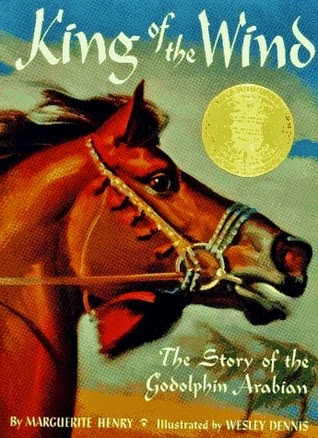
King of the Wind, by Marguerite Henry

ALRIGHT already.  I'm on my third Marguerite Henry book for this blog and I'm eating a hearty portion of crow for having disliked her books and refusing to read them in grade school.  The only reason I can think of is that when they were recommended to me, I didn't feel like they were really being recommended based on what the teacher knew of me and what I liked.  Rather, it was more of a "You're a girl, girls like horses, here you go" sort of reasoning.  Except I never really had a horse thing.  But I would have still liked the books.

The story of the horse in question begins in Morocco.  A mute boy named Agba, who works tending horses in the Sultan's stables, is present when his favorite mare gives birth to a new foal.   The golden coat of the foal inspires Agba to name him Sham, the Arabic word for "sun".  Sham's mother does not survive for long after his birth, and it is assumed that Sham will soon follow.  No one is especially concerned about this since he's small and has a pattern of hair on his chest that signifies bad luck.  But as Agba notices, he also has a marking that signifies swiftness.  Agba hopes that the good marking will overpower the bad, and is able to nourish the horse to health with camel's milk.

Sham grew until he was the swiftest horse in the Sultan's stables.  Agba is constantly caring for him, a substitute for the mother he lost.  One day, Agba and five other stable boys are bathed and prepared to meet the Sultan.  The Sultan wants the six best stallions from his stables, one of each color, to be selected.  Each boy will be responsible for one horse, and the entire party will be sent by boat to Versailles as a gift to Louis XV, the boy king of France.  Each horse bears a document describing its pedigree stretching back to the horses of Mohammed himself, as well as stones and amulets intended to ward off sickness and injury.  The boys are to remain with the horses and care for them as long as the horse lives before returning to Morocco.  The Sultan is hoping that such a lavish gift will make the kind look favorably upon him.

What the Sultan does not know is that the ship's captain kept the money intended for rich foods for his passengers and stocked hay for the voyage instead.  When they finally arrive at Versailles, horses and boys alike are emaciated and in poor condition.  The king and his officials laugh at such a gift, and sends them away from the stables to be sold for other purposes.  Here begins Sham's journey through multiple owners and households, some kind, others abusive.  Agba refuses to leave the horse, and is the only person Sham will gladly cooperate with.  Sham eventually does find his way to a kind owner who discovers his true potential (and that of his offspring).

So, without giving all of the details away, another great horse book.

Friday, February 7, 2014

Strawberry Girl, by Lois Lenski

My earliest memory of this book is from my early High School years.  It was below reading level, obviously, but I was still a fan of those Dell Yearling paperbacks and this one somehow found its way onto my bookshelf.  I had no idea until now that it was so old; I just knew that it read strangely.  But the book was intentionally written in a backwoods Florida dialect common for the time when the story took place.  Lois Lenski apparently did some pretty extensive research preparing to write this book, relying especially on WPA oral histories.  Many of the events from the book are based on them.

Our book's protagonist is Birdie Boyer, a young girl who has just relocated from the Carolinas to the backwoods of Florida with her family.  They have plans to farm the land successfully, having inherited an orange grove from the prior owners.  They also want to raise cattle and farm strawberries, which grow well in the Florida soil and bring in a nice profit.  However, things are made difficult from the beginning by inhospitable neighbors.  The Slaters have been living on the adjacent property for generations.  They believe that their animals are entitled to free passage through the woods, regardless of whose property they cross.  The Boyers soon have to contend with starving livestock let loose in the woods, stripping down their orange trees, wallowing in their strawberry fields, and digging under their fences (when the Slaters don't take it upon themselves to cut through the fences to escort their cows to the river, rather than going around).

Over time, things escalate between the two families.  Eventually, Mr. Boyer cuts the ears off of the Slater hogs he finds on his property as a warning.  The next time, he kills them and leaves them on the Slaters' porch.  The Slater men (and boys) set a fire in the woods and try to burn the Boyers out as retaliation, not realizing that some of their own children are playing in those very woods (and fortunately, emerge unharmed).  But eventually Mrs. Slater becomes slightly more friendly and sympathetic to the Boyers, although she's not able to make any overt gestures that her husband might hear about.

I won't spoil the ending, but I remember that even in High School I found it just a little too pat.  Did Ms. Lenski run out of conflict-resolution ideas?  Or is this something that really happened according to her research?  I'd love to have the answer to this one.

Tuesday, April 16, 2013

The One and Only Ivan

Ivan is the title character and narrator of this book.  He's a silverback gorilla, but not a fierce or angry one.  Ivan lives, with a number of other exotic animals, at the Exit 8 Big Top Mall and Video Arcade.  Taken as an infant from the jungle, he lived with the mall's owner, Mack, and his family until he became too large and strong and unpredictable. Now he's an attraction that is no longer attracting shoppers.

Ivan, understandably, isn't especially concerned with the shoppers.  His "domain" is small and his life is routine, eating and sleeping and watching television, and chatting with his neighbors.  One is Bob, a stray dog, who comes and goes as he pleases but enjoys sleeping on Ivan's belly.  The other is Stella, an aging retired circus elephant who uses her words as sparingly as Ivan does but always with purpose.

Ivan does have one other friend- Julia, the daughter of the mall's night custodian.  While her father works, she visits with the animals, does her homework, and draws.  Ivan likes to draw, too (although humans usually don't recognize his subjects), and Julia often smuggles extra supplies to him through a broken corner of his enclosure.

In an effort to draw new shoppers and keep his property from going out of business, Mack purchases Ruby, a baby elephant.  She is placed in Stella's enclosure and is confused and full of questions, and a bit skittish at first.  Ruby slowly becomes accustomed to her life at the mall, but her enthusiasm for life begins to wane when it becomes clear that Mack intends to train her for public performance, and he isn't opposed to physically harming her to force her to comply.

At the same time, Stella is succumbing to an injury incurred in her youth, as she was being trained in much the same way that Ruby is now.  Although she says very little about her time with the circus, it clearly pains her to think on it.  She is sadly resigned to her current state, but fears for Ruby's future since she is beginning on the same path.  Stella knows that she cannot help Ruby, and as she senses her life drawing to a close, she begs Ivan to promise that he will rescue Ruby.

Ivan is a bit baffled by the request, but he'd do anything for Stella.  But now he's in a quandary- how can he help Stella?  Does she even need helping?  After all, is life at the mall really that bad?  But before her death, Stella had been prompting Ivan to exercise his memory, and to think back about what he loved about his life before he was taken from his family and the jungle.  As things start to come back to him, he realizes that his domain really is a cage, and he has to get some one's attention to help all of them.

Katherine Applegate was inspired to write this novel after learning about the story of the real Ivan, a shopping mall attraction in Washington state who spent nearly 3 decades enclosed indoors before public outrage and the mall's financial troubles facilitated his placement in a more lifelike habitat at Zoo Atlanta.  The real life Ivan passed away recently and was one of the zoo's most popular family members.  You can read more about him here.

Saturday, March 16, 2013

Adam of the Road, by Elizabeth Janet Gray

Adam of the Road marks Elizabeth Janet Gray's final appearance on the Newbery list, and she's had several!

1943 was definitely a good Newbery year, and the winner doesn't disappoint.  Adam is our title character, the son of Roger the Minstrel.  Adam has likewise learned the ways of the road, having traveled extensively with his father and learning his trade.  As the story begins, Adam is at a boarding school awaiting the return of Roger, who has gone to France to improve his skills and learn new stories and songs to bring back with him.  Adam's beloved spaniel, Nick, is also at boarding school with him (although in the care of a local widow, since he isn't permitted to stay in the dormitory).

When Roger returns, he, Adam and Nick leave their friends behind and join a wagon convoy headed to the estate of  Sir Edmund de Lisle, who has become Roger's patron.  Roger's prior performances had pleased de Lisle so much that he had given Roger a retired war horse named Bayard, whom Roger and Adam are able to ride on their long journey.  Roger and Nick settle in nicely at the estate, and Adam makes friends with the children there.  They, and several other minstrels, are also permitted to perform at a wedding, and Adam is proud to receive, along with the adults, a small purse of pennies in recognition of his performance.

The following morning, it is time to leave.  De Lisle doesn't have need of his minstrels all the time, so once again, Roger, Adam and Nick will make their home along the road until they are needed in the future.  Unfortunately, Bayard does not join them- Roger had spent the night playing dice with the other minstrels and lost his pennies, and then the horse trying to get them back.  Jankin, a fellow minstrel, has won the horse.  When they encounter him later, Jankin offers Roger the chance to gamble Nick to win him back, but Roger firmly declines.  Nick does not belong to him, and he's had his fill of gambling.

Further on, at an inn, the encounter Jankin again.  He has lamed Bayard through rough riding.  The next morning, they awake to find that Jankin is gone, as is Nick!  A stable hand is questioned and we learn that Jankin claimed that Roger traded Nick for Bayard, and snuck out in the early hours of the morning.  This is where our story really begins- Roger and Adam pursue Jankin to a large fair, but Adam follows his own leads and is separated from his father.  The remainder of the book follows Adam as he learns to be a minstrel in his own right, while following clues and desperately trying to find both his dog and his father.

Nick is an extremely likeable character!  He's also mature for his age (at least by today's standards) but genuine and kind.  This would be a great book for young readers who have an interest in medieval England- the perspective of the minstrel isn't one that's often considered!

Monday, November 12, 2012

Daniel Boone, by James Daugherty

I've never known anything about Daniel Boone.  Honestly, I didn't know if he was a real historical figure, like Davey Crockett, or if he was folklore, like Paul Bunyan.  The old-timey legends part of my brain kept it pretty ambiguous.  So it turns out, he was real!  But I had a hard time staying with this book.  The illustrations were great, but the text varied between folksy storytelling dialect and historical narration, so I never quite knew how to feel while reading it.  Also, the book failed to drive home for me what made this fellow so special compared to all the other men of the period who must have been doing similar things as he was described as doing.  So I didn't really enjoy this one, but multiple some ones on the Newbery committee must have, seeing as it won the medal for that year.

Tuesday, October 30, 2012

The Giver, by Lois Lowry

Classic! I'm so excited that I get to review this one.  I'm a huge fan of dystopian YA fiction, but at the time this one came out, it was a pretty unexplored topic for this age group (but hat tip to A Wrinkle in Time for some of the concepts, I'm sure).  One of the things I really loved about reading this when I was younger was that it was so fresh.  Now that I've read so much dystopian sci-fi, I know exactly where I'm supposed to feel foreboding and get suspicious of the established culture.  But you weren't really handed books like that when I was a teenager, and they certainly weren't recommended reading in schools.  And Lowry does a fabulous job of telling her own creepy story, and then making you look for creepiness where it doesn't exist, and sympathize with those who feel like the creepiness serves a necessary social good, and then get mad at yourself.  But I digress.  Here's your plot summary.

Jonas lives a happy life in a very regulated community.  There are many regulations that everyone is expected to abide by, and willingness to admit mistakes (and receive forgiveness) are pretty much the norm.  Each person's life is very laid out, and everyone's career and spouse and even children (bred elsewhere) are carefully selected for them.  Each year from 1-12, everyone born in a certain calendar year advances (at one age, every child receives jackets which button in the back, to teach interdependence; at another, haircuts to show maturity, at 9, everyone receives their bicycle).  But Jonas is 12, and 12 is the last year for ceremonies.  After having been carefully observed, each 12 will be given their assignment.  After the ceremony, they will leave friends behind and dedicate themselves to studying for and learning to be successful in their assigned careers, and will cease to mark age after that time.

Jonas can see that some of his classmates will be easy to assign, based on where they've most enjoyed spending their (mandatory) volunteer hours.  But Jonas doesn't feel any sort of inclination.  He's always been successful in school, but doesn't see himself as having any exceptional talents or skills.  At the ceremony, Jonas watches in panic as his classmates are called forward to receive their folder of instructions and their assignment, but he is skipped until the very end.  The Elders announce that he has not been assigned to a career, but rather, he has been selected to be the community's next Receiver.  None of his peers, nor Jonas, have any idea what the position is or what it entails, but Jonas is nonetheless relieved to find out that he hasn't disappointed his parents with an infraction so large that he would instead be Released from society and sent Elsewhere (the worst consequence for those who don't conform, or voluntary in the case of the ill or elderly).

Upon returning home that evening, Jonas eagerly opens his folder to find that he has only a single sheet of instructions, the most interesting of which are: "From this moment you are exempted from rules governing rudeness.  You may ask any question of any citizen and you will receive answers."  "Do not discuss your training with any other member of the community, including parents and Elders." "You may lie."  Jonas is stunned.  He's certain he won't need to take advantage of these exemptions from common courtesy.

As he begins his lessons with the former Receiver (now the Giver), whom he will eventually replace, he begins to learn more about how his society is constructed and why.  The Receiver's role is to hold the collective memory of humanity, so that he can advise the Elders when a change in the accepted order is proposed.  When the Giver passes memories on to Jonas, initially they're pleasant (such as a ride on a sailboat, the feel of sunshine, or the experience of sledding in snow).  Jonas is excited by these new experiences.  The community lives in a state of Sameness- level roads, climate control, absence of color and music, in order for everything to function as smoothly as possible, and these experiences are like highs for him.  But the Giver eventually shares unpleasant ones as well- wars, starvation, and neglect.  Jonas begins to realize that the Receiver's task is also an immensely burdensome one, and the more he learns, the more he finds he can't relate to the people he lives among.  He's frustrated that these memories really belong to everyone, but they've lived such a shallow existence that they wouldn't be able to bear them.  He needs to do something to improve society, but with all his knowledge, he just doesn't know how.

And I'm not spoiling the ending, so go get a copy!

I hadn't planned on reading this one for the blog; I had seen that Lowry had just published a fourth book intended to wrap up the The Giver/Gathering Blue/Messenger series and I thought I was high time I get myself caught up.  How nice to see a Newbery Medal on the cover!  If these last two entries seem somewhat quick to you, it's because we lost power for a while so I had lots of time to read (hey, I can't be expected to clean the bathroom if there's not enough light, right?)

Friday, July 6, 2012

Thimble Summer, by Elizabeth Enright

Thimble Summer is, I think, a victim of poor book cover summarizing. It was billed as a story about a girl who finds a silver thimble, after which everything seems to be going her way - could it be a magic thimble?! While technically an accurate summary, it completely misses the nuance of the story, let alone the thimble. The summary would not have led me to pick it up as a kid, but I think I would have liked it if I'd given it a chance.
Garnet is 10, and lives on a family farm in depression-era Wisconsin. Her friend Citronella lives on a farm nearby, and this is the story of their adventures over the course of a summer. In the beginning of the book, there is a drought, and everyone is struggling. Realities of the depression are knocking at the door, but Garnet's world is still relatively stable. She has a loving family, neighbors who are basically part of the family too, and good friends.

There is a silver thimble at the beginning of the book - Garnet finds it in a dried up riverbed. But after that, you forget about the thimble, because the rain comes and ends the drought, she and Citronella have an adventure (locked in the library, Arthur-style!), an orphan boy turns up in the neighborhood and ends up living with her family, and her piglet wins a prize at the fair - among other small summer adventures. At the end, Garnet looks at the thimble, and thinks back over the summer, and declares that she will always remember it as the Thimble Summer - in a sort of treasure it in her heart kind of way.

One of the critics on the book jacket says that this is a book about a contemporary child going about everyday life, and I agree - while not contemporary anymore, it is a clear, honest look atan ordinary girl's life, a bit like a 1930s Ramona. Happily recommended, although you will need to talk to your kid about why hitch-hiking is NOT a good idea these days!


Monday, April 9, 2012

Dead End in Norvelt, by Jack Gantos

I didn't at all know what to expect from this one; it was on the display shelf when I visited the library and when I saw the Newbery Medal on the cover, I just snagged it. I was familiar with Jack Gantos only indirectly- his YA memoir Hole in My Life has been on the local high school's summer reading list. But I hadn't actually read anything of his (clearly a failure on my part, since this isn't the first award he's won). [edit: upon doing my homework, I realize that I have read one of his books- Rotten Ralph!]

In any case, Dead End is the fictionalized account of one summer of Gantos's childhood. However, the line between the fiction and the reality is impossible for the reader to distinguish, since so many things that come up in this book sound too insane and incredible to be true, and yet they are. Norvelt is an actual town in Pennsylvania, named for Eleanor Roosevelt (and Jack Gantos really grew up there). It was constructed during the depression to provide homes for laid off coal miners and their family, and each home had a plot of land sufficient for each family to have a garden to feed itself. A great deal of fascinating local history is given over the course of the book, most of which is probably true as well.

In the book, Jack ends up grounded for the entire Summer because he shoots off a Japanese firearm that his father had brought back from World War II and kept in the garage (to be fair, he didn't load it, nor did he expect it to be loaded), and because he plowed down his mother's cornfield (also, to be fair, at his father's bidding) to make way for a runway for his father's recently-acquired airplane. His only escape from the constant digging (both to level the field for the runway and to dig a hole for a bomb shelter that his father promised his mother, but never actually intends to build) is to assist Miss Volker. Miss Volker is a retired lady who still writes columns for the local paper (namely, the obituaries and the this-week-in-history column). However, she gets stuck on the physical writing part- arthritis has crippled her hands. She gets occasional use out of them by dipping them in hot wax, but not nearly enough to handwrite (and then type for submission) her articles. She promised Eleanor Roosevelt that she would keep tabs on the original settlers of the town for as long as they live, so she takes these obituaries very seriously.

Because there is so much actual truth and history mixed in, you're also inclined to believe the craziest things about the residents of the town (for example, Jack has a problem with his nose bleeding like a faucet at the least sign of stress, or that Mr. Spizz, a member of local town government, makes his way around town on a giant tricycle to hand out tickets for property infractions). So a book that seems like it could be about the most boring summer ever actually has quite a bit of excitement in it! I also learned some interesting trivia, such as this story.

MacMillan audio has kindly offered us the following audio clip from the beginning of the book, read by Jack Gantos. Thank you very much!

Wednesday, March 21, 2012

The Twenty-One Balloons, by William Pène du Bois

This book got off to a slow start - at least for me - with a lot of philosophical talk about the benefits of slow vs fast travel, and the way the "atomic age" would soon be changing things entirely. But after a few pages of that, it really picked up, and I was as curious as the mobs in the book about how Professor Sherman could possibly have ended up in the Atlantic Ocean with twenty deflated balloons, when he had only a month before set off over the Pacific with just one!

The answer involves an immense diamond mine, a secret Utopian society on the island of Krakatoa immediately prior to its infamous explosion, many fantastic inventions, and a complicated restaurant-based economy. The inventions made me laugh, and you can tell du Bois enjoyed thinking them up - there is electrical furniture which raises up from the floor (and more importantly, sinks back to be flush with the floor, allowing easy cleaning), there is a bed with a continuous belt of sheet that rotates every morning so that a new section is on the bed and another section is washed in the basement, and there is a "balloon carousel" with twenty balloons connected in a circle, among many others.

In the end, a lot of fun! It would make a great read-aloud book (I'm saying that a lot lately, but it keeps being true!), and the author's illustrations fit the character of the story really well. They even *look* French (which the author was - I had to do a little bit of digging to figure out how this was eligible for a Newbery award, but it turns out he moved back to the US as a teenager).

An interesting tangent is the author's note at the front of the book, which I will quote here and allow you to enjoy in its entirety:
Just before publication of The Twenty-One Balloons, my publishers noted a strong resemblance between my book and a story by F. Scott Fitzgerald entitled "The Diamond as Big as the Ritz," published by Charles Scribner's Sons. I read this story immediately and discovered to my horror that it was not only quite similar as to general plot, but was altogether a collection of very similar ideas. This was the first I had heard of the F. Scott Fitzgerald story and I can only explain this embarrassing and, to me, maddening coincidence by a firm belief that the problem of making good use of the discovery of a fabulous amount of diamonds suggests but one obvious solution, which is secrecy. The fact that F. Scott Fitzgerald and I apparently would spend our billions in like ways right down to being dumped from bed into a bathtub is altogether, quite frankly, beyond my explanation. William Pene du Bois, 1947 
I haven't read Fitzgerald's story yet (though I do intend to!) but other reviews point out that although there are strong similarities on the face, the two stories' tones differ significantly. It does make one wonder, though, if there are certain things, both fantastic and fantastically mundane, that naturally come to mind when one thinks of diamonds and diamonds and diamonds...

Wednesday, March 7, 2012

Dobry, by Monica Shannon

This book follows Dobry, our title character, as he grows from a boy into a young man in his village in rural Bulgaria. He lives a typical peasant's life with his mother and grandfather, his father having been killed "in the war". The book occasionally references the unhappy times of Turkish occupation, so one can only assume that that war was one against the invaders, although this was never explicitly stated. The book observes the regular village and household chores that occur throughout the year- baking bread, stringing peppers from the autumn harvest, the migration of the storks, the coming of the gypsies in the spring, caring for the farm and animals.

We also meet Dobry's neighbors- the mayor, the widowed shoemaker and his daughter, Nena (who, in time, becomes Dobry's love interest), the schoolteacher, the miller, etc. Of special importance is Dobry's grandfather, who is known far and wide as the best storyteller. Throughout the book he shares many tales with Dobry and the villagers. Dobry also has his own art- he has become skilled at drawing, an unheard of skill in a rural village where more practical skills are needed to earn a living. Over time he also teaches himself to sculpt and carve. At the end of the book it is decided that he will go to Sofia to study to become a professional artist.

While this book was reasonably simple and Dobry is a charming character, I have to admit that I found it overall pretty bland. I know that there are readers who will find this one simply enchanting; it just didn't speak to me.