This children's book tells the tale of young Tien Pao. He lives with his parents and baby sister at the time that China is being invaded by the Japanese army. When his village is attacked and burned to the ground, his family is able to escape in a sampan with a few ducklings in a pan and their piglet. The adults take turns rowing against the tide of the river for several days until they reach the village of Hengyang.
Not far from the village, a massive airfield is being built for the American army. Tien Pao's parents go there to find work, leaving him in the boat with the piglet and the ducklings. One day, an American soldier come to the bank of the river looking for a boat to ferry him across. Since Tien Pao is the only person not screaming and vying for the job, the soldier chooses his boat to be his ferry. Tien Pao has been told by his parents that he must not leave the riverbank, because the rushing river would carry him right back into the arms of the Japanese. But the soldier's blond hair and blue eyes make Tien Pao think that he is a river god, and a neighbor convinces him that he *must* carry the soldier. He ends up being too weak to cross the river, but the soldier helps him row the boat, and back to the bank after his errand is complete. Tien Pao's parents are furious when they return in the pouring rain to find their son and boat missing, but forgive him when he explains (and hands over the very generous pay that the soldier provided).
Not many days afterward, wallowing water buffalo upset the sampan and loosen it from its moorings while Tien Pao is waiting for his parents to return from work, and he doesn't realize it until he's nearly back where they began. The remainder of the book chronicles his long, hungry journey back to Hengyang to try to find his parents again, staying just one step ahead of the Japanese army as it presses inland. He does eventually re-encounter the American soldier and receives assistance from his unit (the titular sixty fathers). The portion of the book Tien Pao spends in the soldiers' camp is surprisingly short. Especially disappointing when you've read the rear bookflap:
What? WHAT?? This is the story that I want to hear! Tell me more about this! Alas, there is nothing more to be known. I hope that poor little guy is alright.
Showing posts with label based on a true story. Show all posts
Monday, March 11, 2019
Wednesday, October 31, 2018
Carry On, Mr. Bowditch, by Jean Lee Latham
I was at a bit of a loss to tag this book. It's a somewhat-fictionalized biography of Nathaniel Bowditch. Since all of the dialogue, however plausible, must have come from the author's imagination, I'm tagging it as nonfiction and based on a true story; take your pick!
The story starts with Nathaniel as a young boy, a few years after the start of the Revolutionary War. He lives with his parents, grandmother, and siblings in Salem, Massachusetts. His father was once a famous sea captain, but after losing his ship he lost his taste for sailing. Now he works as a cooper, but struggles (and sometimes fails) to make ends meet. Nathaniel is a talented student and excellent at mathematics, and the community has high hopes for him to attend Harvard and be a credit to Salem.
However, fate has other plans for him. Unable to feed his family, twelve-year-old Nathaniel's father apprentices him to a Ship's Chandler as a bookkeeper for nine years. Nat is devastated, but he knows that he has a responsibility to take care of his sisters, and part of that responsibility is to never let them worry. During his time in the warehouse, he learns all about the various tools and parts that go into outfitting a ship. He also makes use of his apprenticeship to study navigation. But in order to learn thoroughly, he needs to study volumes that were written in other languages. And the only way to do that is to actually learn the languages (primarily Latin and French). Although he never makes it to Harvard, he is invited to be an honorary member of the Salem Philosophical Library (in other words, he is permitted to make use of the library without paying the subscription cost). Many of the quality volumes were taken as a prize by a privateer during the war.
After completing his apprenticeship, Nathaniel is offered a position as a clerk on a ship captained by an old friend. Having no other obligations or options, he decides to go, as well as invest his savings in freight that he can hopefully sell at a profit. During his time on the Henry, Nathaniel is able to put his theoretical knowledge of navigation to practical practice. And thus begins the fascinating story of the man who wrote one of the most foundational books in ocean navigation, hand-checked many of the numerical tables used at the time, and created new methods for more easily calculating longitude. He did an amazing job of using every talent he was given to create a fascinating career, and to help others benefit from his knowledge through his publications and in-person instruction.
The story starts with Nathaniel as a young boy, a few years after the start of the Revolutionary War. He lives with his parents, grandmother, and siblings in Salem, Massachusetts. His father was once a famous sea captain, but after losing his ship he lost his taste for sailing. Now he works as a cooper, but struggles (and sometimes fails) to make ends meet. Nathaniel is a talented student and excellent at mathematics, and the community has high hopes for him to attend Harvard and be a credit to Salem.
However, fate has other plans for him. Unable to feed his family, twelve-year-old Nathaniel's father apprentices him to a Ship's Chandler as a bookkeeper for nine years. Nat is devastated, but he knows that he has a responsibility to take care of his sisters, and part of that responsibility is to never let them worry. During his time in the warehouse, he learns all about the various tools and parts that go into outfitting a ship. He also makes use of his apprenticeship to study navigation. But in order to learn thoroughly, he needs to study volumes that were written in other languages. And the only way to do that is to actually learn the languages (primarily Latin and French). Although he never makes it to Harvard, he is invited to be an honorary member of the Salem Philosophical Library (in other words, he is permitted to make use of the library without paying the subscription cost). Many of the quality volumes were taken as a prize by a privateer during the war.
After completing his apprenticeship, Nathaniel is offered a position as a clerk on a ship captained by an old friend. Having no other obligations or options, he decides to go, as well as invest his savings in freight that he can hopefully sell at a profit. During his time on the Henry, Nathaniel is able to put his theoretical knowledge of navigation to practical practice. And thus begins the fascinating story of the man who wrote one of the most foundational books in ocean navigation, hand-checked many of the numerical tables used at the time, and created new methods for more easily calculating longitude. He did an amazing job of using every talent he was given to create a fascinating career, and to help others benefit from his knowledge through his publications and in-person instruction.
Labels:
1956,
based on a true story,
nonfiction,
sea voyage
Saturday, October 13, 2018
The Golden Name Day, by Jennie D Lindquist
I have to start by saying that the copy of this book that I read was a red-orange Permabound library edition, so I didn't realize until starting this blog that the picture chosen for the cover is, unfortunately, the least attractive one from the entire book and actually makes it seem less appealing to read (and it's especially unfortunate because it's meant to depict one of the most beautiful scenes in the book, and is a letdown compared to my own imagination). My first impressions were quite different. Because of the blank cover I had no expectations until opening the book, and then I immediately felt comfortable within it because it looks *so much* like a Little House book- the typeface and layout are exactly the same, the illustrations are by Garth Williams, and it takes place in an indistinct time before technology, when trains and horses were the most common means of transportation. So it made me feel like this family could have been teenage Laura's neighbors.
I also felt like this book was a great counterbalance to some of Ma's impressions. Like the author, the majority of the people in this book are of Swedish descent and truly relish their traditions. Far from being bizarre and foreign, as they seemed to be portrayed in Little House, they are beloved and anticipated joyfully, and explained well. If Laura could have read this book, I bet she would have envied them a little.
On to the summary! Nine-year-old Nancy's mother has fallen seriously ill, so she needs to be sent away for a few months while her mother receives treatment. She is staying with "Grandma" and "Grandpa," who aren't her biological grandparents, but are the parents of her mother's childhood best friends. These old best friends also have children around Nancy's age (Helga, Sigrid, and Elsa) who are looking forward to having another friend to enjoy the Spring and Summer seasons with.
When Nancy arrives, Grandma is baking and preparing for her name day. Nancy is unfamiliar with the idea, and Grandma explains that every Swedish name has its own day in an Almanac, and on that day the honoree makes a cake and invites her friends to celebrate, and decorates with flowers and gets to wear a flowered garland on her head. Nancy looks through the almanac and is devastated to learn that, because her name isn't Swedish, she doesn't have a name day at all, although the other girls all do.
"Aunt" Anna and "Aunt" Martha and the three "cousins" determine that they will somehow find a name day for Nancy. This thread is carried through all of the events in the book as they consider different ideas. But Nancy will accept no compromises; she doesn't want a fake name day.
The seasons pass with flowers and picnics and traditional events, and homesickness for Nancy as well. But at the end of the book, she does get her name day- two, actually! But I'm not going to spoil here. So go read it!
![]() |
| See? Just like Little House! |
On to the summary! Nine-year-old Nancy's mother has fallen seriously ill, so she needs to be sent away for a few months while her mother receives treatment. She is staying with "Grandma" and "Grandpa," who aren't her biological grandparents, but are the parents of her mother's childhood best friends. These old best friends also have children around Nancy's age (Helga, Sigrid, and Elsa) who are looking forward to having another friend to enjoy the Spring and Summer seasons with.
When Nancy arrives, Grandma is baking and preparing for her name day. Nancy is unfamiliar with the idea, and Grandma explains that every Swedish name has its own day in an Almanac, and on that day the honoree makes a cake and invites her friends to celebrate, and decorates with flowers and gets to wear a flowered garland on her head. Nancy looks through the almanac and is devastated to learn that, because her name isn't Swedish, she doesn't have a name day at all, although the other girls all do.
"Aunt" Anna and "Aunt" Martha and the three "cousins" determine that they will somehow find a name day for Nancy. This thread is carried through all of the events in the book as they consider different ideas. But Nancy will accept no compromises; she doesn't want a fake name day.
The seasons pass with flowers and picnics and traditional events, and homesickness for Nancy as well. But at the end of the book, she does get her name day- two, actually! But I'm not going to spoil here. So go read it!
Wednesday, August 30, 2017
The Inquisitor's Tale, or, the Three Magical Children and Their Holy Dog, by Adam Gidwitz
Ok, it is really time for me to get on the ball and read the 2017 winner, because I can not FATHOM why this is not it. I have not enjoyed a children's book this much in a very long time. If we had a *favorite* favorite tag, I'd be applying it right now.
The author spent six years researching and writing this book, part of which was spent in Europe with his Medieval-scholar-wife, researching history and poking around in ruins. Although the story is completely fictional, the characters are all based on actual historical figures (Joan of Arc, Guillaume d'Orange, Guinefort, and many religious and political figures).
I really hesitate to even try to summarize this book because it was published to so much acclaim that I could scarcely begin to do it justice. Set in 1200's France, it follows the journeys of three very special children (and one holy dog) who discover that they have special gifts which, unfortunately, make them targets of the Church. They meet quite randomly and form a close bond as they seek sanctuary and safety.
Beyond the fantastic story, the book addresses (and not in a heavy-handed way) gender roles and classes, as well as religious conflict and race relations (all anchored in this time period). This book is so crazily well-rounded and engaging that I finished it in about 24 hours. Go read it.
The author spent six years researching and writing this book, part of which was spent in Europe with his Medieval-scholar-wife, researching history and poking around in ruins. Although the story is completely fictional, the characters are all based on actual historical figures (Joan of Arc, Guillaume d'Orange, Guinefort, and many religious and political figures).
I really hesitate to even try to summarize this book because it was published to so much acclaim that I could scarcely begin to do it justice. Set in 1200's France, it follows the journeys of three very special children (and one holy dog) who discover that they have special gifts which, unfortunately, make them targets of the Church. They meet quite randomly and form a close bond as they seek sanctuary and safety.
Beyond the fantastic story, the book addresses (and not in a heavy-handed way) gender roles and classes, as well as religious conflict and race relations (all anchored in this time period). This book is so crazily well-rounded and engaging that I finished it in about 24 hours. Go read it.
Thursday, June 1, 2017
Davy Crockett, by Constance Rourke
I don't have too much to say about this book. It covers what is known of Davy Crockett's life, from his birth through his death at the Alamo, and all of his journeys in between. It is peppered throughout with a number of legends about his feats, and often gives probable explanations for their sources.
I found it a pretty dry read and a struggle to get through, but the detailed illustrations were very well done.
Tuesday, April 25, 2017
Red Sails to Capri, by Ann Weil
So I noticed that this one had a logo on the back cover indicating that it was published by Sonlight Curriculum, which, I discovered upon further research, is a Christian homeschooling publishing company. I'm curious as to how this was selected and why (it doesn't have religious overtones of any kind), but I can't object to the content, either. They have this one indicated for second grade.
Fourteen-year-old Michele lives on the island of Capri with his parents. They tend a small inn together but can barely make ends meet. At the beginning of the book, a boat with beautiful red sails, unlike any seen before, approaches the island and three foreigners depart. Because it is the off season, Michele's family would be beyond thrilled to host them. Michele's fisherman friend, Angelo, agrees to intercept the visitors and make sure they don't go to the competitor, while Michele races home to warn his parents so they can prepare the vacant hotel.
When the guests arrive, the Pagano family learns that they are foreigners from three different countries, each pursuing a different passion. Lord Derby, from England, has come to seek beauty and to paint. Herre Erik Nordstrom, from Denmark, is a student of Philosophy and seeks truth. Monsieur Jacques Tiersonnier, a Frenchman, is a writer in search of adventure.
The three guests, and the Paganos, find their source of adventure soon enough. Monsieur Jacques brings Michele and his best friend, Pietro, for a sail in his fabulous red-sailed boat. They pass a cove that the visitors would like to explore, but it is forbidden among the islanders to even discuss the cove, let alone the reasons it is off-limits to visit the cave there. But the visitors, new to the strange social stigma of discussing this topic in this far-flung locale, are having none of it. Once they hear the legend, they make plans to return to discover the truth of the cove and the cave.
This was a light and fun read. It's also fortunate that the book was reasonably short since none of the reveal about the cave actually happens until very close to the end. But it is reasonably firmly based on a true story, which I would have liked a brief summary of at the end.
Fourteen-year-old Michele lives on the island of Capri with his parents. They tend a small inn together but can barely make ends meet. At the beginning of the book, a boat with beautiful red sails, unlike any seen before, approaches the island and three foreigners depart. Because it is the off season, Michele's family would be beyond thrilled to host them. Michele's fisherman friend, Angelo, agrees to intercept the visitors and make sure they don't go to the competitor, while Michele races home to warn his parents so they can prepare the vacant hotel.
When the guests arrive, the Pagano family learns that they are foreigners from three different countries, each pursuing a different passion. Lord Derby, from England, has come to seek beauty and to paint. Herre Erik Nordstrom, from Denmark, is a student of Philosophy and seeks truth. Monsieur Jacques Tiersonnier, a Frenchman, is a writer in search of adventure.
The three guests, and the Paganos, find their source of adventure soon enough. Monsieur Jacques brings Michele and his best friend, Pietro, for a sail in his fabulous red-sailed boat. They pass a cove that the visitors would like to explore, but it is forbidden among the islanders to even discuss the cove, let alone the reasons it is off-limits to visit the cave there. But the visitors, new to the strange social stigma of discussing this topic in this far-flung locale, are having none of it. Once they hear the legend, they make plans to return to discover the truth of the cove and the cave.
This was a light and fun read. It's also fortunate that the book was reasonably short since none of the reveal about the cave actually happens until very close to the end. But it is reasonably firmly based on a true story, which I would have liked a brief summary of at the end.
Wednesday, March 23, 2016
The Apple and the Arrow, by Mary and Conrad Buff
I see that this book has been reissued in more of a shorter-height book format and I think that's a good call on the part of the publisher. This particular edition has the size and shape of a chapter book, with a few full-page color illustrations. But that leaves entire giant pages with nothing but text on them. That makes for a rough read!
This book is, obviously, about the legend of William Tell and the beginnings of Switzerland's independence. What makes it somewhat unique is that it's told from the perspective of William Tell's son, so you learn about the everyday life of the village and what independence (or lack thereof) would mean to a boy in the mountains.
Labels:
1952,
based on a true story,
medieval,
quick,
world
Monday, January 4, 2016
Better Known as Johnny Appleseed, by Mabel Leigh Hunt
Yet another historical figure I knew little to nothing about! I'm going to admit my ignorance. Here's what I thought I knew about Johnny Appleseed: I envisioned him as a stereotypical Appalachian man- worn pants with a frayed rope belt, bare feet, straw hat, walking around the country tossing apple seeds as he went. Thanks, children's picture books, for making that kind of impression on me. I'd also assumed he was a folk tale character, not an actual human being. Color me corrected.
Johnny Appleseed (born John Chapman) was, to be fair, shoddily dressed in his adult years. He took only what he needed, and when given more he would cheerfully give it to some one else. He wore no shoes, and traveled everywhere by foot. Johnny made numerous friends on his travels, largely in Ohio and Indiana. He collected seeds whenever possible, and kept them (with saplings) in the bag he always carried with him.
Johnny's dream was to create orchards of apples in territory yet to be settled, so that new homesteaders would have food waiting for them. He would often sow orchards on occupied land for the owners as well, with a portion set aside for people he would send to collect trees later. If people were willing to pay for the trees, he would accept the money and put most of it toward publishing tracts and literature about the Swedenborgians, a small Christian sect that he wholeheartedly followed.
I was glad to have had the opportunity to have my history corrected with regard to this fascinating figure.
Johnny Appleseed (born John Chapman) was, to be fair, shoddily dressed in his adult years. He took only what he needed, and when given more he would cheerfully give it to some one else. He wore no shoes, and traveled everywhere by foot. Johnny made numerous friends on his travels, largely in Ohio and Indiana. He collected seeds whenever possible, and kept them (with saplings) in the bag he always carried with him.
Johnny's dream was to create orchards of apples in territory yet to be settled, so that new homesteaders would have food waiting for them. He would often sow orchards on occupied land for the owners as well, with a portion set aside for people he would send to collect trees later. If people were willing to pay for the trees, he would accept the money and put most of it toward publishing tracts and literature about the Swedenborgians, a small Christian sect that he wholeheartedly followed.
I was glad to have had the opportunity to have my history corrected with regard to this fascinating figure.
Thursday, August 27, 2015
Turtle in Paradise, by Jennifer Holm
Eleven-year-old Turtle has had a rough go of things. Raised by her single mother and her various short-term boyfriends, she's never been in one place for very long. She's taken enough abuse at the hands of the kids of her mother's various employers to know to expect the worst of most anyone. But her mother's new boyfriend, Archie, seems different. He makes their little unit feel like more of a family, buying Turtle a new pair of much-needed shoes over flash gifts that other boyfriends gave to impress her mother. And they have plans. They've picked out a prefab house from the Sears Roebuck catalog and once enough money has been saved, they'll be able to be a family forever.
There's a catch.
Turtle's mother has taken a new job as a housekeeper, and the homeowner won't welcome a child with her new employee. So Turtle is sent to the Florida Keys to live with her mother's sister, Minnie, and her family. Turtle has never seen this kind of poverty before. No one wears shoes at all, clothes are ragged, homes are shacks. No one has money. Her cousins work for candy, babysitting the neighborhood infants and treating diaper rash with a secret formula.
Turtle is slowly accepted by the neighborhood, children and adults alike. She also learns that her mother's mother is still living, despite what her mother had told her. The victim of a stroke, Nana Philly is a mean and grumpy old lady. Nonetheless, Turtle eventually becomes the one responsible for bringing her grandmother's lunch every day. During one of these visits, she accidentally collapses the termite-eaten piano and finds a treasure map inside. She decides to enlist the Diaper Gang as comrades to set out for it on their own.
This was a fun read which introduced me to a people, lifestyle, and a time that I wasn't especially familiar with. I enjoyed getting to know the community along with Turtle, and seeing the results of her adventure. I just wish that the ending hadn't come on so suddenly!
There's a catch.
Turtle's mother has taken a new job as a housekeeper, and the homeowner won't welcome a child with her new employee. So Turtle is sent to the Florida Keys to live with her mother's sister, Minnie, and her family. Turtle has never seen this kind of poverty before. No one wears shoes at all, clothes are ragged, homes are shacks. No one has money. Her cousins work for candy, babysitting the neighborhood infants and treating diaper rash with a secret formula.
Turtle is slowly accepted by the neighborhood, children and adults alike. She also learns that her mother's mother is still living, despite what her mother had told her. The victim of a stroke, Nana Philly is a mean and grumpy old lady. Nonetheless, Turtle eventually becomes the one responsible for bringing her grandmother's lunch every day. During one of these visits, she accidentally collapses the termite-eaten piano and finds a treasure map inside. She decides to enlist the Diaper Gang as comrades to set out for it on their own.
This was a fun read which introduced me to a people, lifestyle, and a time that I wasn't especially familiar with. I enjoyed getting to know the community along with Turtle, and seeing the results of her adventure. I just wish that the ending hadn't come on so suddenly!
Saturday, January 24, 2015
The Blue Cat of Castle Town, by Catherine Cate Coblentz
An interesting modern folk tale based on actual historical events and people in a small Vermont town in the mid-1800's. Zeruah Guernsey, resident of Castleton, embroidered a carpet so noteworthy that it was added to the collection of the Metropolitan Museum of Art in New York City. The book's author has created a story to explain the origin of the blue cat that it features at the bottom.
A blue cat born during a blue moon has a destiny, as all such cats do, to learn the river's song and teach it to the people who need to hear it. In this case, the blue cat must go to Castleton so the beauty, peace and content[ment] that the song can bring will drive back an evil enchantment that is spreading through the town through greed and haste.
Wikipedia has a pretty thorough summary of the book so I won't invent the wheel by doing it again here. The book in its entirety is also available in the public domain for those who are curious. At 123 pages, it isn't exceptionally long. The author certainly did her research into primary sources to add important townspeople to the narrative. Although from some quick research I've done, I am sorry that the book was so unfair to Mr. Arunah Hyde- he's feared and reviled in the book as a man who values profit over everything and produces shoddy products in his haste. Accounts I've found of him seem to indicate that he was very invested in the town's prosperity and gave generously of both his time and his money and resources to promote its progress. Sorry, Arunah! I hope that somewhere there is another contemporary account that recalls you favorably.
A blue cat born during a blue moon has a destiny, as all such cats do, to learn the river's song and teach it to the people who need to hear it. In this case, the blue cat must go to Castleton so the beauty, peace and content[ment] that the song can bring will drive back an evil enchantment that is spreading through the town through greed and haste.
Wikipedia has a pretty thorough summary of the book so I won't invent the wheel by doing it again here. The book in its entirety is also available in the public domain for those who are curious. At 123 pages, it isn't exceptionally long. The author certainly did her research into primary sources to add important townspeople to the narrative. Although from some quick research I've done, I am sorry that the book was so unfair to Mr. Arunah Hyde- he's feared and reviled in the book as a man who values profit over everything and produces shoddy products in his haste. Accounts I've found of him seem to indicate that he was very invested in the town's prosperity and gave generously of both his time and his money and resources to promote its progress. Sorry, Arunah! I hope that somewhere there is another contemporary account that recalls you favorably.
Monday, September 8, 2014
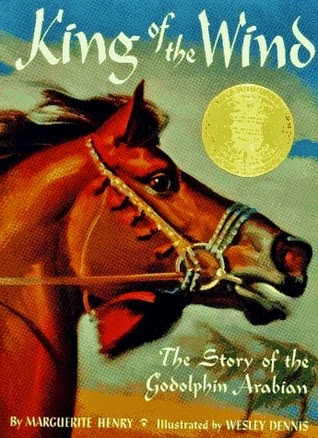
King of the Wind, by Marguerite Henry
ALRIGHT already. I'm on my third Marguerite Henry book for this blog and I'm eating a hearty portion of crow for having disliked her books and refusing to read them in grade school. The only reason I can think of is that when they were recommended to me, I didn't feel like they were really being recommended based on what the teacher knew of me and what I liked. Rather, it was more of a "You're a girl, girls like horses, here you go" sort of reasoning. Except I never really had a horse thing. But I would have still liked the books.
The story of the horse in question begins in Morocco. A mute boy named Agba, who works tending horses in the Sultan's stables, is present when his favorite mare gives birth to a new foal. The golden coat of the foal inspires Agba to name him Sham, the Arabic word for "sun". Sham's mother does not survive for long after his birth, and it is assumed that Sham will soon follow. No one is especially concerned about this since he's small and has a pattern of hair on his chest that signifies bad luck. But as Agba notices, he also has a marking that signifies swiftness. Agba hopes that the good marking will overpower the bad, and is able to nourish the horse to health with camel's milk.
Sham grew until he was the swiftest horse in the Sultan's stables. Agba is constantly caring for him, a substitute for the mother he lost. One day, Agba and five other stable boys are bathed and prepared to meet the Sultan. The Sultan wants the six best stallions from his stables, one of each color, to be selected. Each boy will be responsible for one horse, and the entire party will be sent by boat to Versailles as a gift to Louis XV, the boy king of France. Each horse bears a document describing its pedigree stretching back to the horses of Mohammed himself, as well as stones and amulets intended to ward off sickness and injury. The boys are to remain with the horses and care for them as long as the horse lives before returning to Morocco. The Sultan is hoping that such a lavish gift will make the kind look favorably upon him.
What the Sultan does not know is that the ship's captain kept the money intended for rich foods for his passengers and stocked hay for the voyage instead. When they finally arrive at Versailles, horses and boys alike are emaciated and in poor condition. The king and his officials laugh at such a gift, and sends them away from the stables to be sold for other purposes. Here begins Sham's journey through multiple owners and households, some kind, others abusive. Agba refuses to leave the horse, and is the only person Sham will gladly cooperate with. Sham eventually does find his way to a kind owner who discovers his true potential (and that of his offspring).
So, without giving all of the details away, another great horse book.
The story of the horse in question begins in Morocco. A mute boy named Agba, who works tending horses in the Sultan's stables, is present when his favorite mare gives birth to a new foal. The golden coat of the foal inspires Agba to name him Sham, the Arabic word for "sun". Sham's mother does not survive for long after his birth, and it is assumed that Sham will soon follow. No one is especially concerned about this since he's small and has a pattern of hair on his chest that signifies bad luck. But as Agba notices, he also has a marking that signifies swiftness. Agba hopes that the good marking will overpower the bad, and is able to nourish the horse to health with camel's milk.
Sham grew until he was the swiftest horse in the Sultan's stables. Agba is constantly caring for him, a substitute for the mother he lost. One day, Agba and five other stable boys are bathed and prepared to meet the Sultan. The Sultan wants the six best stallions from his stables, one of each color, to be selected. Each boy will be responsible for one horse, and the entire party will be sent by boat to Versailles as a gift to Louis XV, the boy king of France. Each horse bears a document describing its pedigree stretching back to the horses of Mohammed himself, as well as stones and amulets intended to ward off sickness and injury. The boys are to remain with the horses and care for them as long as the horse lives before returning to Morocco. The Sultan is hoping that such a lavish gift will make the kind look favorably upon him.
What the Sultan does not know is that the ship's captain kept the money intended for rich foods for his passengers and stocked hay for the voyage instead. When they finally arrive at Versailles, horses and boys alike are emaciated and in poor condition. The king and his officials laugh at such a gift, and sends them away from the stables to be sold for other purposes. Here begins Sham's journey through multiple owners and households, some kind, others abusive. Agba refuses to leave the horse, and is the only person Sham will gladly cooperate with. Sham eventually does find his way to a kind owner who discovers his true potential (and that of his offspring).
So, without giving all of the details away, another great horse book.
Friday, July 4, 2014
Misty of Chincoteague, by Marguerite Henry
Oh, Marguerite Henry, I have been twice proven wrong. What on earth did I have against you and your horse books when I was little? These are really solid, fun, appealing books. I stand corrected.
Based on a true story, this book follows Paul and Maureen, two siblings who live on Assateague Island off the coast of Virginia. Wild horses live on neighboring (and unsettled) Chincoteague Island, and every year the people on Assateague Island have an event where the men round up as many horses as they can and swim them across, so they can be penned and sold (the proceeds benefiting the fire department). The most desired horse is the Phantom, a mare who is so fast and unruly that she has never been caught. Because this is such a tradition, the townspeople also have events and raffles and a big community dinner. This year will be Paul's first assisting with the roundup, and he is sure that he will be able to catch Phantom. Not only that, but he and Maureen would like to own her. They spend the summer digging clams and performing odd jobs for the neighbors, until they've collected a full $100.
On the day of the roundup, Paul finds himself left behind on Chincoteague Island while the more experienced riders race ahead without him. Alone in the trees, he comes across Phantom who, to his astonishment, is with a colt and allows him to round them up. During the swim, the colt begins to sink because he is too young to swim the distance alone, but Paul jumps from the boat and swims with him, holding his head out of the water. Paul and Maureen realize that they will have to buy both Phantom and the colt, who Paul names Misty. They plan to get to the pony sale the first day to ask the fire chief to reserve the two horses for them, leaving their $100 as a deposit and planning to earn the remainder through the rest of the Summer.
Due to circumstances outside their control, Paul and Maureen are unable to reach the sale in time and they find that Misty has already been sold. Fortunately, a turn of events works out in their favor and she eventually does become theirs. The remainder of the book concerns their raising her and teaching her to love her new home.
Misty eventually became the author's own horse, and lived with her in Illinois. Although many of the events in the novel are stretched or outright fictionalized, it paints a picture of the region and the origin of the horses that bear the island's name.
Based on a true story, this book follows Paul and Maureen, two siblings who live on Assateague Island off the coast of Virginia. Wild horses live on neighboring (and unsettled) Chincoteague Island, and every year the people on Assateague Island have an event where the men round up as many horses as they can and swim them across, so they can be penned and sold (the proceeds benefiting the fire department). The most desired horse is the Phantom, a mare who is so fast and unruly that she has never been caught. Because this is such a tradition, the townspeople also have events and raffles and a big community dinner. This year will be Paul's first assisting with the roundup, and he is sure that he will be able to catch Phantom. Not only that, but he and Maureen would like to own her. They spend the summer digging clams and performing odd jobs for the neighbors, until they've collected a full $100.
On the day of the roundup, Paul finds himself left behind on Chincoteague Island while the more experienced riders race ahead without him. Alone in the trees, he comes across Phantom who, to his astonishment, is with a colt and allows him to round them up. During the swim, the colt begins to sink because he is too young to swim the distance alone, but Paul jumps from the boat and swims with him, holding his head out of the water. Paul and Maureen realize that they will have to buy both Phantom and the colt, who Paul names Misty. They plan to get to the pony sale the first day to ask the fire chief to reserve the two horses for them, leaving their $100 as a deposit and planning to earn the remainder through the rest of the Summer.
Due to circumstances outside their control, Paul and Maureen are unable to reach the sale in time and they find that Misty has already been sold. Fortunately, a turn of events works out in their favor and she eventually does become theirs. The remainder of the book concerns their raising her and teaching her to love her new home.
Misty eventually became the author's own horse, and lived with her in Illinois. Although many of the events in the novel are stretched or outright fictionalized, it paints a picture of the region and the origin of the horses that bear the island's name.
Wednesday, July 2, 2014
Big Tree, by Mary & Conrad Buff
This book summarizes the life of the oldest Redwood tree in the American northwest, from sprouting thousands of years ago until conservation of the area began to protect this tree and others like it from being cut down for human use.
I was not the proper audience for this book. Because the story spans thousands of years, it is told as short vignettes from different times- the lives of animals living nearby, fire passing through, Indians hunting nearby. . . because Wawona (the tree) is immobile, his perspective is limited and his voice is slow and generally passive. Honestly, I was bored. But this one may have more appeal for wildlife lovers or conservationists. It does have some accurate and well-done black-and-white illustrations.
Sunday, April 20, 2014
The Hidden Treasure of Glaston, by Eleanore M. Jewett
The story begins on a dark and stormy night. In the midst of a storm, the residents of the monastery in Glaston are awakened in the middle of the night. A nobleman, clearly fleeing something, asks to leave his son in their care. In exchange, he offers several rare and valuable books which will be treasured by the residents. Rather than staying to rest, he then ventures back into the storm to continue his journey.
The young man, Hugh, is lame in one leg and knows that a future as a knight or nobleman is probably not feasible. So he resigns himself to an apprenticeship, although he soon grows fond of the men who he works with. During a walk outdoors on his own, he also encounters another young man his age: Dickon, an oblate, whose tasks keep him elsewhere in the monastery. The two become fast friends. Dickon would like for them to become sworn brothers, but Hugh refuses to disclose his origins.
When Hugh suddenly encounters a man from his past fleeing an angry crowd, he steals a horse and cart to speed the man to the sanctuary of the church. The man, Jacques, was a member of the staff in Hugh's household, and it is revealed at that time that Hugh is the son of Hugh de Morville, who was fleeing the country due to his role in the murder of the Archbishop Thomas Beckett. Hugh can then be reconciled to Dickon- he had only maintained secrecy because he had sworn an oath to his father to do so for his own protection. With no secrets between them, Dickon takes Hugh to his secret hideaway- a cavern underground which may have once allowed the monastery's residents to flee from Vikings. There appears to be no entrance besides an opening in the rocks too small for a grown man to enter. And some treasures still remain there- a sword, a jeweled altar, and a number of loose pages written in ancient Latin.
When Hugh, working with the monks to clean old, useless parchments for reuse, discovers similar writing hidden underneath the surface, he realizes that they (and the secret pages from the cavern) relate stories of the Holy Grail. He knows that Joseph of Aramithea had carried the Grail to this region and established the church here. With Dickon's help he resolves to translate the pages secretly so that they can solve the mystery of the location of the missing Grail themselves and present it to the church.
It's evening and I'm tired and I'm somehow feeling as if I've never written a more dry description of a novel. But I really, really, loved this one. It had mystery, folklore, and a bit of adventure to it. And it's written in such a way that it's timeless- it's a book that a child today could enjoy just as easily as one sixty years ago when it was first published.
The young man, Hugh, is lame in one leg and knows that a future as a knight or nobleman is probably not feasible. So he resigns himself to an apprenticeship, although he soon grows fond of the men who he works with. During a walk outdoors on his own, he also encounters another young man his age: Dickon, an oblate, whose tasks keep him elsewhere in the monastery. The two become fast friends. Dickon would like for them to become sworn brothers, but Hugh refuses to disclose his origins.
When Hugh suddenly encounters a man from his past fleeing an angry crowd, he steals a horse and cart to speed the man to the sanctuary of the church. The man, Jacques, was a member of the staff in Hugh's household, and it is revealed at that time that Hugh is the son of Hugh de Morville, who was fleeing the country due to his role in the murder of the Archbishop Thomas Beckett. Hugh can then be reconciled to Dickon- he had only maintained secrecy because he had sworn an oath to his father to do so for his own protection. With no secrets between them, Dickon takes Hugh to his secret hideaway- a cavern underground which may have once allowed the monastery's residents to flee from Vikings. There appears to be no entrance besides an opening in the rocks too small for a grown man to enter. And some treasures still remain there- a sword, a jeweled altar, and a number of loose pages written in ancient Latin.
When Hugh, working with the monks to clean old, useless parchments for reuse, discovers similar writing hidden underneath the surface, he realizes that they (and the secret pages from the cavern) relate stories of the Holy Grail. He knows that Joseph of Aramithea had carried the Grail to this region and established the church here. With Dickon's help he resolves to translate the pages secretly so that they can solve the mystery of the location of the missing Grail themselves and present it to the church.
It's evening and I'm tired and I'm somehow feeling as if I've never written a more dry description of a novel. But I really, really, loved this one. It had mystery, folklore, and a bit of adventure to it. And it's written in such a way that it's timeless- it's a book that a child today could enjoy just as easily as one sixty years ago when it was first published.
Labels:
1947,
based on a true story,
medieval,
mythology and folk tales,
world
Friday, February 14, 2014
Justin Morgan Had a Horse, by Marguerite Henry
You'd think by now I'd have learned not to judge a book by its cover. I went through a stage in 2nd-3rd grade where I really tried (I really tried, people!) to like the Marguerite Henry horse books because everyone liked them and they'd won awards and HORSES! Who doesn't like horses? I liked horses! But I didn't like the books, for whatever reason. So when this book came up next on my list I'll admit I was transported back into childhood with a sense of dread. Completely misplaced dread. This book was pretty awesome! I'm so sorry for having doubted you.
Although Justin Morgan was the owner of the "first" Morgan horse, he isn't our book's protagonist. The book actually follows Joel Goss, a student of Morgan's, who is present when Li'l Bub, the horse in question, is given to Morgan as partial payment on a debt owed. Although Li'l Bub is small and shows none of the signs that he'll ever be remotely useful, Joel takes to him immediately. Justin Morgan sees that Joel is smitten, and as he has neither time nor inclination to deal with the horse himself around his teaching schedule, he asks Joel to gentle the horse for him. Joel is apprenticed to the miller around this time and must attend school in the evenings, but after school lets out he has a few scarce hours of Vermont daylight remaining to work with Li'l Bub.
After Li'l Bub has been successfully gentled, much to Joel's dismay, he is rented out to a man to help him clear land. Li'l Bub soon proves himself as an able puller, and eventually gains a widespread reputation for both pulling and racing, even beating out two purebreds who had traveled from New York just to beat him. With this reputation firmly in hand (hoof?), Justin Morgan eventually sells Li'l Bub so that he is able to pay his outstanding debts and buy needed supplies (including a harpsichord) for his schoolhouse. The remainder of the story follows Joel through his apprenticeship into adulthood, trying to locate his beloved horse so that he can eventually purchase him for his own. Over the years the horse changes hands many times (and upon Morgan's death, his name as well) until he and Joel are eventually reunited.
A very well-told story!
Although Justin Morgan was the owner of the "first" Morgan horse, he isn't our book's protagonist. The book actually follows Joel Goss, a student of Morgan's, who is present when Li'l Bub, the horse in question, is given to Morgan as partial payment on a debt owed. Although Li'l Bub is small and shows none of the signs that he'll ever be remotely useful, Joel takes to him immediately. Justin Morgan sees that Joel is smitten, and as he has neither time nor inclination to deal with the horse himself around his teaching schedule, he asks Joel to gentle the horse for him. Joel is apprenticed to the miller around this time and must attend school in the evenings, but after school lets out he has a few scarce hours of Vermont daylight remaining to work with Li'l Bub.
After Li'l Bub has been successfully gentled, much to Joel's dismay, he is rented out to a man to help him clear land. Li'l Bub soon proves himself as an able puller, and eventually gains a widespread reputation for both pulling and racing, even beating out two purebreds who had traveled from New York just to beat him. With this reputation firmly in hand (hoof?), Justin Morgan eventually sells Li'l Bub so that he is able to pay his outstanding debts and buy needed supplies (including a harpsichord) for his schoolhouse. The remainder of the story follows Joel through his apprenticeship into adulthood, trying to locate his beloved horse so that he can eventually purchase him for his own. Over the years the horse changes hands many times (and upon Morgan's death, his name as well) until he and Joel are eventually reunited.
A very well-told story!
Friday, February 7, 2014
Strawberry Girl, by Lois Lenski
My earliest memory of this book is from my early High School years. It was below reading level, obviously, but I was still a fan of those Dell Yearling paperbacks and this one somehow found its way onto my bookshelf. I had no idea until now that it was so old; I just knew that it read strangely. But the book was intentionally written in a backwoods Florida dialect common for the time when the story took place. Lois Lenski apparently did some pretty extensive research preparing to write this book, relying especially on WPA oral histories. Many of the events from the book are based on them.
Our book's protagonist is Birdie Boyer, a young girl who has just relocated from the Carolinas to the backwoods of Florida with her family. They have plans to farm the land successfully, having inherited an orange grove from the prior owners. They also want to raise cattle and farm strawberries, which grow well in the Florida soil and bring in a nice profit. However, things are made difficult from the beginning by inhospitable neighbors. The Slaters have been living on the adjacent property for generations. They believe that their animals are entitled to free passage through the woods, regardless of whose property they cross. The Boyers soon have to contend with starving livestock let loose in the woods, stripping down their orange trees, wallowing in their strawberry fields, and digging under their fences (when the Slaters don't take it upon themselves to cut through the fences to escort their cows to the river, rather than going around).
Over time, things escalate between the two families. Eventually, Mr. Boyer cuts the ears off of the Slater hogs he finds on his property as a warning. The next time, he kills them and leaves them on the Slaters' porch. The Slater men (and boys) set a fire in the woods and try to burn the Boyers out as retaliation, not realizing that some of their own children are playing in those very woods (and fortunately, emerge unharmed). But eventually Mrs. Slater becomes slightly more friendly and sympathetic to the Boyers, although she's not able to make any overt gestures that her husband might hear about.
I won't spoil the ending, but I remember that even in High School I found it just a little too pat. Did Ms. Lenski run out of conflict-resolution ideas? Or is this something that really happened according to her research? I'd love to have the answer to this one.
Our book's protagonist is Birdie Boyer, a young girl who has just relocated from the Carolinas to the backwoods of Florida with her family. They have plans to farm the land successfully, having inherited an orange grove from the prior owners. They also want to raise cattle and farm strawberries, which grow well in the Florida soil and bring in a nice profit. However, things are made difficult from the beginning by inhospitable neighbors. The Slaters have been living on the adjacent property for generations. They believe that their animals are entitled to free passage through the woods, regardless of whose property they cross. The Boyers soon have to contend with starving livestock let loose in the woods, stripping down their orange trees, wallowing in their strawberry fields, and digging under their fences (when the Slaters don't take it upon themselves to cut through the fences to escort their cows to the river, rather than going around).
Over time, things escalate between the two families. Eventually, Mr. Boyer cuts the ears off of the Slater hogs he finds on his property as a warning. The next time, he kills them and leaves them on the Slaters' porch. The Slater men (and boys) set a fire in the woods and try to burn the Boyers out as retaliation, not realizing that some of their own children are playing in those very woods (and fortunately, emerge unharmed). But eventually Mrs. Slater becomes slightly more friendly and sympathetic to the Boyers, although she's not able to make any overt gestures that her husband might hear about.
I won't spoil the ending, but I remember that even in High School I found it just a little too pat. Did Ms. Lenski run out of conflict-resolution ideas? Or is this something that really happened according to her research? I'd love to have the answer to this one.
Tuesday, April 16, 2013
The One and Only Ivan
Ivan is the title character and narrator of this book. He's a silverback gorilla, but not a fierce or angry one. Ivan lives, with a number of other exotic animals, at the Exit 8 Big Top Mall and Video Arcade. Taken as an infant from the jungle, he lived with the mall's owner, Mack, and his family until he became too large and strong and unpredictable. Now he's an attraction that is no longer attracting shoppers.
Ivan, understandably, isn't especially concerned with the shoppers. His "domain" is small and his life is routine, eating and sleeping and watching television, and chatting with his neighbors. One is Bob, a stray dog, who comes and goes as he pleases but enjoys sleeping on Ivan's belly. The other is Stella, an aging retired circus elephant who uses her words as sparingly as Ivan does but always with purpose.
Ivan does have one other friend- Julia, the daughter of the mall's night custodian. While her father works, she visits with the animals, does her homework, and draws. Ivan likes to draw, too (although humans usually don't recognize his subjects), and Julia often smuggles extra supplies to him through a broken corner of his enclosure.
In an effort to draw new shoppers and keep his property from going out of business, Mack purchases Ruby, a baby elephant. She is placed in Stella's enclosure and is confused and full of questions, and a bit skittish at first. Ruby slowly becomes accustomed to her life at the mall, but her enthusiasm for life begins to wane when it becomes clear that Mack intends to train her for public performance, and he isn't opposed to physically harming her to force her to comply.
At the same time, Stella is succumbing to an injury incurred in her youth, as she was being trained in much the same way that Ruby is now. Although she says very little about her time with the circus, it clearly pains her to think on it. She is sadly resigned to her current state, but fears for Ruby's future since she is beginning on the same path. Stella knows that she cannot help Ruby, and as she senses her life drawing to a close, she begs Ivan to promise that he will rescue Ruby.
Ivan is a bit baffled by the request, but he'd do anything for Stella. But now he's in a quandary- how can he help Stella? Does she even need helping? After all, is life at the mall really that bad? But before her death, Stella had been prompting Ivan to exercise his memory, and to think back about what he loved about his life before he was taken from his family and the jungle. As things start to come back to him, he realizes that his domain really is a cage, and he has to get some one's attention to help all of them.
Katherine Applegate was inspired to write this novel after learning about the story of the real Ivan, a shopping mall attraction in Washington state who spent nearly 3 decades enclosed indoors before public outrage and the mall's financial troubles facilitated his placement in a more lifelike habitat at Zoo Atlanta. The real life Ivan passed away recently and was one of the zoo's most popular family members. You can read more about him here.
Ivan, understandably, isn't especially concerned with the shoppers. His "domain" is small and his life is routine, eating and sleeping and watching television, and chatting with his neighbors. One is Bob, a stray dog, who comes and goes as he pleases but enjoys sleeping on Ivan's belly. The other is Stella, an aging retired circus elephant who uses her words as sparingly as Ivan does but always with purpose.
Ivan does have one other friend- Julia, the daughter of the mall's night custodian. While her father works, she visits with the animals, does her homework, and draws. Ivan likes to draw, too (although humans usually don't recognize his subjects), and Julia often smuggles extra supplies to him through a broken corner of his enclosure.
In an effort to draw new shoppers and keep his property from going out of business, Mack purchases Ruby, a baby elephant. She is placed in Stella's enclosure and is confused and full of questions, and a bit skittish at first. Ruby slowly becomes accustomed to her life at the mall, but her enthusiasm for life begins to wane when it becomes clear that Mack intends to train her for public performance, and he isn't opposed to physically harming her to force her to comply.
At the same time, Stella is succumbing to an injury incurred in her youth, as she was being trained in much the same way that Ruby is now. Although she says very little about her time with the circus, it clearly pains her to think on it. She is sadly resigned to her current state, but fears for Ruby's future since she is beginning on the same path. Stella knows that she cannot help Ruby, and as she senses her life drawing to a close, she begs Ivan to promise that he will rescue Ruby.
Ivan is a bit baffled by the request, but he'd do anything for Stella. But now he's in a quandary- how can he help Stella? Does she even need helping? After all, is life at the mall really that bad? But before her death, Stella had been prompting Ivan to exercise his memory, and to think back about what he loved about his life before he was taken from his family and the jungle. As things start to come back to him, he realizes that his domain really is a cage, and he has to get some one's attention to help all of them.
Katherine Applegate was inspired to write this novel after learning about the story of the real Ivan, a shopping mall attraction in Washington state who spent nearly 3 decades enclosed indoors before public outrage and the mall's financial troubles facilitated his placement in a more lifelike habitat at Zoo Atlanta. The real life Ivan passed away recently and was one of the zoo's most popular family members. You can read more about him here.
Thursday, January 3, 2013
Our Only May Amelia, by Jennifer L. Holm
I took three classes last semester while also working full time, so sorry for the delay! But I did listen to a Newbery while I commuted to school, and I'm glad I did!
Our Only May Amelia was a charming book. Based on the diary of a relative of the author, we follow the semi-true adventures of a twelve-year-old girl living in Nasell, Washington in the 1890s. She is the only girl in town, and between that and having 7 brothers, it's hardly surprising that she's a tomboy extraordinaire!
I actually learned a lot from this book. There were some relatively obvious aspects of turn of the century Northwest culture, e.g. logging, and smuggling of Chinese immigrants, but some things I'd never heard about. The absence of roads until well into the 20th century being a prime example - in some parts of the Northwest, there were so many rivers and waterways that everyone traveled everywhere by boat. When the tide was too high and the river too rough, May Amelia and her brothers didn't go to school - the river was the road. Sending four children to Astoria, OR to stay with relatives seems straightforward enough, but I was shocked to hear that they were going by boat, all alone - miles and miles!
While most of the book is light-hearted, reflecting the boisterous and joyful personality of our protagonist, there is also a tragedy, and a clear-eyed view of true grief. This part was hard to listen to, but incredibly well handled and I think very valuable.
Our Only May Amelia was a charming book. Based on the diary of a relative of the author, we follow the semi-true adventures of a twelve-year-old girl living in Nasell, Washington in the 1890s. She is the only girl in town, and between that and having 7 brothers, it's hardly surprising that she's a tomboy extraordinaire!
I actually learned a lot from this book. There were some relatively obvious aspects of turn of the century Northwest culture, e.g. logging, and smuggling of Chinese immigrants, but some things I'd never heard about. The absence of roads until well into the 20th century being a prime example - in some parts of the Northwest, there were so many rivers and waterways that everyone traveled everywhere by boat. When the tide was too high and the river too rough, May Amelia and her brothers didn't go to school - the river was the road. Sending four children to Astoria, OR to stay with relatives seems straightforward enough, but I was shocked to hear that they were going by boat, all alone - miles and miles!
While most of the book is light-hearted, reflecting the boisterous and joyful personality of our protagonist, there is also a tragedy, and a clear-eyed view of true grief. This part was hard to listen to, but incredibly well handled and I think very valuable.
Wednesday, January 2, 2013
Inside Out & Back Again, by Thanhha Lai
Intended to be semi-autobiographical, this novel in verse tells the story of Hà, a young Vietnamese girl. She lives a happy, although somewhat deprived, life in Saigon with her two brothers and mother. Their father disappeared while on a military mission and hasn't been heard from since, but the family is hopeful that he will return.
As the Communist forces from the north approach, however, it becomes clear that their home is no longer safe. Because Hà's father was in the military, his family (with many others) is entitled to passage on one of several ships which will stealthily leave carrying refugees. The story follows their family to a camp in Guam, and then to another in the United States, before they are finally sponsored by a family who wants one of Hà's brothers to work in his auto garage.
Hà has a great deal of difficulty adapting to her new home in Alabama. She is only gradually learning English. No one in her school looks remotely like her. The neighbors avoid her family, and she is bullied by classmates. But with the help of her family and a few kind friends, she is able to carve out a home for herself, even though it will never be like the home she left.
Although I think this story could have been told equally well, and perhaps more fully, if not in verse, the sparse prose does seem to emphasize Hà's difficulty in finding the words to understand what is happening, and her inability to communicate with people.
As the Communist forces from the north approach, however, it becomes clear that their home is no longer safe. Because Hà's father was in the military, his family (with many others) is entitled to passage on one of several ships which will stealthily leave carrying refugees. The story follows their family to a camp in Guam, and then to another in the United States, before they are finally sponsored by a family who wants one of Hà's brothers to work in his auto garage.
Hà has a great deal of difficulty adapting to her new home in Alabama. She is only gradually learning English. No one in her school looks remotely like her. The neighbors avoid her family, and she is bullied by classmates. But with the help of her family and a few kind friends, she is able to carve out a home for herself, even though it will never be like the home she left.
Although I think this story could have been told equally well, and perhaps more fully, if not in verse, the sparse prose does seem to emphasize Hà's difficulty in finding the words to understand what is happening, and her inability to communicate with people.
Labels:
2012,
based on a true story,
quick,
sea voyage,
world
Wednesday, October 17, 2012
By the Shores of Silver Lake, by Laura Ingalls Wilder
Also known as, "The Ingalls Family Finally Catches a Break." Although you wouldn't know it from the beginning of the book. It starts off with the Ingalls family utterly exhausted and weak- they're barely recovering from a bout of Scarlet Fever, which left Mary blind. The family had barely managed to remain solvent until they were struck with illness, and now they have no idea how the doctor will be paid. But up the road comes good news- Aunt Docia, whom they haven't seen since they lived in Wisconsin in Little House in the Big Woods times. She and Uncle Hi are headed to Dakota Territory to work in the railroad camps, and are offering Pa a salary of $50/month to come and be their bookkeeper/storekeeper.
Since farming on Plum Creek has been more or less a failure for several years, Pa sells the house and ties up loose ends. And so the family heads west once again! Laura has a great time getting to know her cousin Lena, who teaches her how to ride (and race!) horses. And once the camp has disbanded for the winter, the Ingallses are offered the use of the Surveyor's house. It's been fully stocked with provisions, and this means the family wouldn't have to backtrack eastward before coming back to make a claim in the Spring.
Once Spring arrives, the settlers come, too. Before they know it, their house is full of boarders, since it's the only suitable shelter around and the next best thing to a hotel. Pa is out registering at the claim office, and Mr. and Mrs. Boast are able to help a bit, but otherwise, the women are on their own until the town suddenly springs up and the Surveyor's house is empty once again. Soon it's time to move out to Pa's tiny claim shanty, and begin their new life as homesteaders!
This book leaves me feeling a lot more optimistic about the future of this little family. Although it's tricky; Pa's main plan is usually farming, and farming is always a mixed bag. I hope I'm not being a spoiler when I mention here that later in the series, Laura states her strong conviction that she will never marry a farmer and spend her life in that kind of instability again, and I don't blame her in the least.
Since farming on Plum Creek has been more or less a failure for several years, Pa sells the house and ties up loose ends. And so the family heads west once again! Laura has a great time getting to know her cousin Lena, who teaches her how to ride (and race!) horses. And once the camp has disbanded for the winter, the Ingallses are offered the use of the Surveyor's house. It's been fully stocked with provisions, and this means the family wouldn't have to backtrack eastward before coming back to make a claim in the Spring.
Once Spring arrives, the settlers come, too. Before they know it, their house is full of boarders, since it's the only suitable shelter around and the next best thing to a hotel. Pa is out registering at the claim office, and Mr. and Mrs. Boast are able to help a bit, but otherwise, the women are on their own until the town suddenly springs up and the Surveyor's house is empty once again. Soon it's time to move out to Pa's tiny claim shanty, and begin their new life as homesteaders!
This book leaves me feeling a lot more optimistic about the future of this little family. Although it's tricky; Pa's main plan is usually farming, and farming is always a mixed bag. I hope I'm not being a spoiler when I mention here that later in the series, Laura states her strong conviction that she will never marry a farmer and spend her life in that kind of instability again, and I don't blame her in the least.
Subscribe to:
Posts (Atom)