Showing posts with label poetry. Show all posts

Thursday, April 14, 2011

The ABC Bunny, by Wanda Gág


A very fun alphabet book which follows the story of a bunny as he runs about during his day, and encounters other animals as well. Charming black-and-white illustrations recall Garth Williams. I knew this one would be a treat after my obsession with the author's other book, Millions of Cats.

The end pages of the book also include sheet music for a song based on the words, with the tune composed by Flavia Gág, Wanda's youngest sister. You can listen here. Apparently I'm not the only one who wanted to know, because there are a few versions on Youtube! However, the words have a fabulous rhythm all on their own so if you're not a pianist you're not missing too much (and really, I could do without the tra-la-las, but I'm also no longer four years old). But a fabulous read-aloud from the days when librarians and teachers were required to play piano.

Wednesday, November 24, 2010

The Pigtail of Ah Lee Ben Loo

I'm giving this one a poetry tag even though it's not strictly poetry. It's a collection of short stories and whimsical poems that take place in many places and times. Think "The Book of Virtues", but the stories are generally longer. Characters of all races are equally picked on, and there isn't any overt racism, just fun. The book itself is very large, and would be great to read aloud to a child.

Many thanks to the Bangor Public Library for the interlibrary loan. Many of my requests are routed from there and I can't help but think that if they'd hired me when I applied, they wouldn't have to keep mailing books to me ;)

Saturday, March 27, 2010

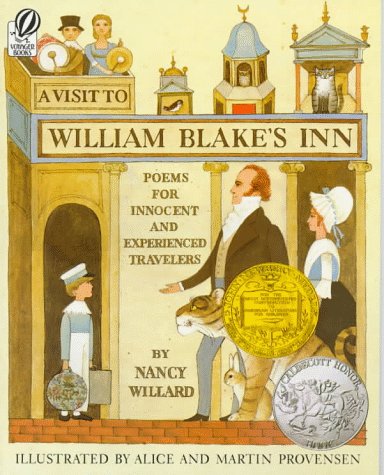
A Visit to William Blake's Inn, by Nancy Willard


This is a book of poems, written in tribute to the poetry of William Blake. I wasn't familiar with Blake's work beyond "Tyger, Tyger", and actually went back to the library to find a volume of his work to better understand how A Visit was related to its namesake's poems. In the end, I understand. The guests at William Blake's Inn are familiar characters from Blake's own work, and most importantly, your mind does the same kind of somersaults in each!

I'll admit I'm not a poetry person generally, so even with my extra research a lot of this book is probably lost on me. But I did have fun reading it, and I loved the illustrations. I should note that while the poems are clearly inspired by Blake's work, the illustrations are not related to his artwork at all - but they are charmingly done by Alice and Martin Provensen in Colonial style, and there's a reason the book also won the Caldecott Medal that year.

I think kids would enjoy this book, if they like word pictures; there are some wonderful ones. The Man in the Marmalade Hat, for example, who is the embodiment of spring (cleaning and all!), and the King of Cats ordering his breakfast (involving Brisket of Basilisk Treat - what's not to love?). The story line is very loose, and this might bother some readers, but I think the positives far outweigh the negatives. I give it an 8.5.

Fun thing: the jacket tells us that while writing this book, Ms Willard actually built a six-foot model of the Inn, complete with prints of Blake's work on its walls and the residents mentioned in the book, and kept it in her living room!

Tuesday, March 2, 2010

Good Masters! Sweet Ladies! Voices from a Medieval Village by Laura Amy Schlitz


I remember hearing about this book on public radio soon after it received the Newbery Award, and thought it sounded like a unique and fun idea for a book. I never got around to finding a copy, though, but when I visited my library's Newbery Award section for this project I found several copies proudly displayed on the top shelf. And with good reason; it's a beautiful book!

The book is designed to be a class project of sorts; there are twenty-three short essays or poems meant to be read/recited/performed, each from the point of view of a child in a medieval village. The collective performance, then, will give the audience a little view of the life of the falconer's son, the miller's son, the "half-wit" boy, the lord's daughter, and so on. Religion and class differences are explored, and you leave with the realization that while the details of life have changed a lot, there are also a lot of ways in which nothing has changed at all.

As a kid, I would have liked that you saw village life from the children's point of view. I would also have enjoyed the sidebars explaining parts of medieval culture that wouldn't be familiar to a modern child. They were frequent enough to help with context, but the text was not so full of asterisks that it became distracting. I would have loved it if my class had taken on the performance of this book as a project! I also think that two kids with time and inclination could have a good time with it, reading back and forth (or occasionally together - there are a couple of duet pieces). You could also read it with one or both of your parents. The entries are written in varying styles of poetry and occasionally prose, which was fun for me to read as an adult, and would make a good teaching point in a classroom setting. My only real issue with this book, in the end, is that it's not very friendly to the silent reader, a bit like reading a play on your own. It would be easy to be drawn to it, with its gorgeous format and interesting subject matter, and then find that it's not really meant for you to read to yourself.

I can definitely see the appeal of the book as a class activity, and why teachers would want to use it. My biggest regret, reading this now, is that it wasn't available for my own 5th grade class in 1990! I give it a 10 for a class or team project idea, and a 7 for reading alone.