Showing posts with label 1929. Show all posts

Sunday, December 19, 2010

The Boy Who Was, by Grace Hallock

This book is a volume of short stories throughout the history of Ravello, Italy, which are bound together by a common character. Nino, a young goatherd, was once a friend of a Siren named Parthenope. She would sing stories to him and paint pictures in his imagination of far-off places, and Nino was her playmate. One day, Odysseus and his men sail by, with Odysseus lashed to the mast. They escape unscathed, the first time the Sirens have ever failed to lure their target. Parthenope and her sister retreat, defeated, never to return. But before she leaves, Parthenope sings one last song for Nino. She blesses him with eternal youth, able to watch over the city and its comings and goings into all eternity.

Other chapters in the book focus on significant events that occur there, and how Nino (and his goats) pay a role in their successful resolution (volcanic eruption, invasions, etc.). Cute stories, but one has to wonder what happened to him eventually!

Sunday, December 5, 2010

The Runaway Papoose, by Grace Moon

The Runaway Papoose is the story of Nah-tee, a young Native American girl in the Southwest. The title isn't entirely accurate- "runaway" tends to conjure images of rebellious or abused children seeking greener pastures. Nah-tee, however, flees into the desert in fear one night when her father is ambushed and attacked as their family is traveling. She becomes lost in the dark and finds Moyo, a young shepherd, who takes pity on her and agrees to take her around the area on his pony in the hopes of locating her parents. Unfortunately, they have no luck.

Everyone in the area knows that a huge festival is coming up, and that everyone within a reasonable radius will try to attend. So Moyo and Nah-tee undertake the long journey to get there, in the hopes that her parents will be attending. Along the way they meet new friends who help them with food and places to rest, and they learn the ancient history of their people, which becomes significant once they reach the festival. And in the end, the evildoers receive what they deserve, as do the good and honest.

This one was a cute enough story, but I can't speak to its accuracy because the author is rather deliberate in her refusal to name the tribes in question. Many hints are dropped (pueblos and hogans, Katchinas, turquoise as a sacred stone) but my guess is that she kept it vague so that she wouldn't be held accountable for the facts.

I was unable to find any information about the author of the book so I don't have any information as to her background. Chandra's blog entry on the book more or less echoes my own sentiments about the unfortunate use of language in this book (very pidgin-y in places) so I'll link her up rather than reinvent the wheel.

Interestingly enough, I decided to do a quick Wikipedia look up for the word "papoose", not knowing whether it was an acceptable word, or one used more pejoratively (as in the case of that s-word-which-we-no-longer-use). Turns out that it has no negative connotations; it just refers to a Native child, or, alternately, to a cradle board used for carrying such. The word actually has its source in the Narragansett language, right here in Rhode Island. Local connection, hooray!

Wednesday, November 24, 2010

The Pigtail of Ah Lee Ben Loo

I'm giving this one a poetry tag even though it's not strictly poetry. It's a collection of short stories and whimsical poems that take place in many places and times. Think "The Book of Virtues", but the stories are generally longer. Characters of all races are equally picked on, and there isn't any overt racism, just fun. The book itself is very large, and would be great to read aloud to a child.

Many thanks to the Bangor Public Library for the interlibrary loan. Many of my requests are routed from there and I can't help but think that if they'd hired me when I applied, they wouldn't have to keep mailing books to me ;)

Monday, November 22, 2010

Clearing Weather, by Cornelia Meigs

I have to admit that I dreaded this one. My last experience with Cornelia Meigs was simply dreadful and I couldn't believe it when I saw that she was on the Newbery list a minimum of three times. But this one is infinitely better, and totally in keeping with the unmistakable bias toward seafaring-themed books that I've noticed in the 1920s.

As in The Great Quest, we have a nephew who lives in a coastal Massachusetts town (Branscomb) in the care of his uncle. Nicholas Drury is tending to the affairs of his uncle, Thomas, who is ill and unable to tend to his home, The Blackbird Inn, and his shipyard. Unfortunately, since the Revolutionary War (in the not so distant past), the demand for new ships has dropped. The town, which depends on the shipbuilding business, is in danger of becoming destitute, and Nicholas is in the unfortunate position of writing the notice declaring the business's bankruptcy. However, he becomes distracted noticing footprints in the frost on the grass in his yard and investigates.

Nicholas makes the acquaintance of Etienne Bardeau, a Frenchman, and his friend from the Carolinas, Michael. He's been in hiding on this side of the Atlantic because he possesses evidence that Darius Cortland, a local businessman, actively supported Britain and sabotaged the colonists during the Revolution. Unfortunately, Mr. Cortland is a very influential man and he has been pursuing Etienne to keep him silent. Before escaping on a ship, Etienne passes this evidence on to Nicholas.

Rather than letting down the town and his uncle, and letting the estate pass into the hands of Mr. Cortland, Nicholas and Michael create a plan. They decide to design and build the grandest ship ever produced in Branscomb. The townspeople will all participate by contributing materials, labor, and staff. The ship will then set sail in hopes of turning a profit.

The remainder of the book follows the progress of the town wondering when, or if, the Jocasta will ever return. It also chronicles the two-year voyage of the ship. Rather than head to Europe as most trading ships would have done, the crew headed to the Caribbean, up the west coast, and eventually to China.

This volume was *much* better than the author's previous book. It does have unfortunate instances of sexism/racism which were common for the times. But a great adventure story.

Wednesday, October 20, 2010

Tod of the Fens, by Elinor Whitney


I've had so many books piling up on me these days that Tod took me much longer to finish than it should have! Suffice it to say that it's a load of fun. It takes place in the town of Boston (England) in the 1400s. Tod and his band of men, known only by aliases to each other, live among the surrounding forests. When they get together, their amusement is had in one-upping the others by telling stories of the mischief they have created. But Tod meets a new man, whom he dubs Dismas, who runs the best prank of all! Unfortunately, his true identity prevents him from appearing in person to tell the story.

Dismas' prank sets off a series of events that cause a great deal of distress to Boston's residents, including Sir Frederick (recently beginning a new venture to export wool) and his daughter, Johanna.

I'm not giving away the plot, not because I'm lazy, but because the pranks are too funny to spoil. Unfortunately, this book is pretty rare and you may have trouble getting your hands on it.

Tuesday, June 1, 2010

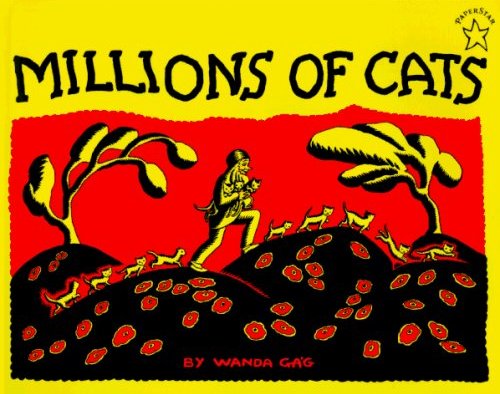
Millions of Cats, by Wanda Gág


With this book, the selection committee from the 1920s has completely redeemed itself. It was such a welcome change to find a picture book on the list, and such a charming one, at that!

A very old man and a very old woman live together in their home, but are lonely with no other company. The very old woman wishes for a cat, and her obliging very old husband sets out to find her one. After a long journey, he finds a hill where there are millions of cats. He tries to select the prettiest, but every time he finds another that seems just as pretty, until he has to just give up and bring the whole lot home.

The very old woman, very practical, insists that they only need one, because millions would eat them out of house and home. But how are they to choose just one from millions?

Very fun and very brief. This would be a great book for a beginning reader.

Sunday, March 14, 2010

The Trumpeter of Krakow, by Eric P. Kelly


The story takes place in 1461-1462, in Krakow, Poland. The main character is Joseph, a boy of about 15, whose family leaves their home in the Ukraine after a Tartar raid on their house. The raid turns out to have been because of a treasure that Joseph's family has guarded for generations; in the event that its hiding place was discovered, the family had sworn an oath to surrender it only to the king of Poland. So to Krakow they go; on the way they are confronted by a Tartar-Cossack named Peter of the Button Face who has guessed about their treasure. They make it safely, though, and there they meet a well-respected priest, a kindly alchemist, and his neice, Elzbeitka, who is just about Joseph's age, thus rounding out the cast of main characters. Joseph's father finds work as a tower watchman, and the story takes place around his hourly playing of a certain hymn, called the Heynal (or in Polish, Hejnał) from the guard tower.

I really enjoyed this book. It felt a little like King Arthur - a story involving magic, kings, treasure, good and evil. You don't get very close to any of the characters, but it felt like you weren't supposed to, the way it was told, and I didn't mind. There's a lot of alchemy talk, and hypnotism was clearly an interesting topic to the author (more than to this reader!), but it doesn't matter if you skim those parts, and if you've read Harry Potter the alchemy bits won't bother much.

The Heynal is real, and is a story of its own, which you can read about here (click here to hear it). Also worth noting is that the author clearly loved the city; Krakow has largely been off my radar, but I finished the book wanting to know what of the ancient city is still there, and considering it for the first time as a destination someday.

Today's kids might find the writing style somewhat dated, but the story is still solid - I give it an 8 for readability and overall enjoyment!