Showing posts with label 1969. Show all posts

Tuesday, March 13, 2012

When Shlemiel went to Warsaw, by Isaac Bashevis Singer

This book is (as the title suggests) a collection of short stories. They all take place in Eastern Europe in a Jewish cultural setting. I found myself wishing I had someone to read these out loud to - they're very much in a storytelling style, and beg for it. Enough that I did a little reading aloud to myself, when nobody was around! The stories are clever and entertaining, and it was a fun read. I think kids aged roughly 9-11 would enjoy it a lot, as they will feel smarter than a lot of the main characters in the stories (I mean, a man gets turned around on a journey and ends up back at his house, but he thinks he's ended up at a house exactly like his own somewhere else!) and have fun guessing what might happen.

I will say that the stories could be a bit confusing for a kid without much exposure to Jewish culture - I know, for example, roughly what a Golem is, and why candlesticks would be important for the Sabbath, but I really wouldn't have when I was a kid, and a lot of the details of these stories would have been entirely lost on me. Which is not to say the exposure wouldn't have been good for me - it certainly would have! But a certain degree of familiarity with the setting is taken for granted, and this might be worth addressing if your reader is completely new to the idea.

Overall, definitely worth picking up - an entertaining read for an adult, would make an excellent read-aloud book, and a great exposure to one of the 20th century's great storytellers. I enjoyed it so much that I plan on looking for some of the author's adult books after this.

Friday, January 20, 2012

To Be a Slave, by Julius Lester

The author begins this book by telling how he discovered two bodies of source material - narratives of escaped slaves written by Northern abolitionists in the first half of the 19th century, and interviews with former slaves collected as part of the Federal Writer's Project in the 1930s.

The rest of the book comprises short introductory text by the author (generally a paragraph or two) followed by one or two excerpts from the slave narratives or interviews. The text is loosely organized by topic: the auction block, the plantation, resistance, etc. and grouped further within those topics. This was especially fascinating to read within the context of its publishing date. In 1969 a lot of civil rights progress had been made, but the work was far from done, and the author leaves the reader with a lot of good, pointed questions.

Besides being an amazing resource on the subject matter at hand, this would also be an excellent book to use when talking about sources. There are primary and secondary sources in probably as literal a sense as you're ever going to find in one place. It's also an excellent book to get kids used to the idea of primary sources - I don't think we trust kids enough when it comes to this sort of thing - I don't think I read any primary source historical materials (outside of history textbooks) in the classroom until I was in high school. But here are real voices, talking about slavery, that a 9 or 10 year old could easily read on their own. I encourage it.

My only criticism would be that the author's introductory text sometimes felt a bit jarring as you finished a bit of interview text, and without a real break in the type, would find the matter-of-fact voice of the author. It might work well in a classroom setting, actually, but it was a little odd to my non-grade-school reading sensibilities.

I'd never seen this book until finding a copy for this blog, but it's still in print, and I hope it gets some classroom use. It should.

Monday, January 9, 2012

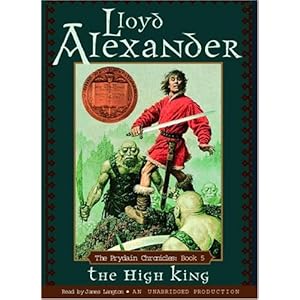
The High King, by Lloyd Alexander

I found my copy of this book a few weeks ago on the top of a neighbor's recycling bin on trash pickup day! The Newbery Medal caught my eye, and I decided it was fate.

I don't think I'll be hanging onto it, though (don't worry, I'll donate it rather than throwing it away!). It's a book with value, but not exactly my type.

This is the fifth and final book in Lloyd Alexander's "Chronicles of Prydain". It's the first one I read, and to be fair, I might have liked it better if I'd started at the beginning (the second, "The Black Cauldron" was the 1966 medal winner). For while the author uses the introduction to tell us that it is part of a series, but, like all the books in the series, it can be read perfectly well on its own, I found this not to be true. This was certainly its own story, but everyone in it seemed to have a backstory that I didn't know - it was like watching a reunion episode of a TV show that you never saw while the series was running.  The horseman we meet in the very beginning turns out to be an "Assistant Pig Keeper". Then it turns out that the pig he keeps is an oracular pig. These things are interesting, but I got the sense that I would have known a lot more about them had I read the other books. Instead, my experience was basically "okay, an oracular pig. Acting the part of Oracle." I think Hen Wen has a story, but it wasn't explained well. There are many more examples of this type of thing.

All of that said, I think I know why some like it. It's a little like Lord of the Rings Lite. There's magic, there's a quest, there are deeds of great bravery, characters redeem themselves or are shown to be treacherous... If that's your sort of thing, you'll like this one. But I'd recommend starting at the beginning of the series!

A little further research on the author, by the way, reveals that he is a local guy - he only died in 2007, and lived in Philadelphia. I think I'd have liked him - describing his first published book, he said it was "the story of a young person going out into the world for the first time and finding the world a very difficult place indeed. That's the story that all of us have to tell."

Indeed.