Showing posts with label world. Show all posts

Thursday, August 5, 2021

Chúcaro: Wild Pony of the Pampa, by Francis Kalnay


 This book is at an excellent reading level for a beginning chapter book reader. It's short, with short chapters, and illustrated.


That said, I found this book difficult to get through. It sat around my house for so long that the owning library has threatened to bill me for it. It simply wasn't telling the story that was begging to be told, in my opinion, and nearly every other chapter was incidental to the plot.  

I can summarize the entire plot for you (something I prefer not to do thoroughly, but I think I'm doing you a favor here).


Young Pedro lives on the plains of Argentina, an area populated by various sharecropping families. One day he catches sight of the most beautiful wild pony he has ever seen, and Juan (an adopted father to the boy) catches it for him tames it, and teaches Pedro to ride it.

One day the patrón sends word that he wants a good pony for his shiftless son upon their return, and the mayordomo has his eyes on Chúcaro (who was, after all, caught on the patrón's property). The sharecroppers figure out a solution: They will let the horse decide. If the patrón's son cannot lasso Chúcaro, he will remain with Pedro.

Of course, he can't, and is made a fool of. In a fit of anger he throws a set of bolas (think three bocce balls attached by a leather strap) at the pony's face, knocking it to the ground. When the boy approaches later, the pony gives him a good hard kick to the stomach. The boy accuses Juan of having ordered the pony to kick him, and when Juan defends himself, the patrón fires him for calling his son a liar and evicts him from the property.

Juan and Pedro ride off into the sunset forever to explore what other opportunities await elsewhere.

This is the story that took 127 pages to tell. You're welcome.

Wednesday, May 26, 2021

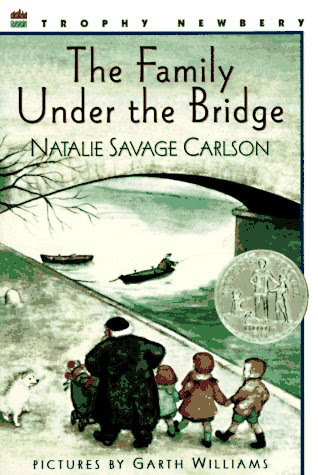
The Family Under the Bridge, by Natalie Savage Carlson


 This is a charming little story about Armand, a "hobo" in Paris, who loves his free life. But one day he returns to his usual spot under a bridge to find that another family has claimed it- three redheaded children whose mother is at work. After their father's death they could no longer afford their apartment, and are hiding so that they won't be put into an orphanage and be separated from their mother, and each other. Armand is a bit ruffled at having his spot taken, but the children seem more than happy to absorb him into "their" space and claim him as an unofficial grandfather. The children think that singing to earn change for treats and meeting Armand's friends the gypsies are a marvelous adventure, but their mother takes offense and tries to keep the children away from him. Nonetheless, it seems that they are meant to be family, and the story ends happily for all.

Wednesday, March 27, 2019

The Corn Grows Ripe, by Dorothy Rhoads

This book gives a brief introduction to the life of a twelve-year-old boy in a rural village somewhere in Central or South America (the specific location is never specified). Tigre and all of his neighbors are descended from the ancient Mayans, but much of that culture has been lost. They do follow many agricultural and religious traditions (of both Christian and Mayan origin). Much of their agricultural year is focused on corn- preparing a new field every year, awaiting the rains, planting the crops, and harvest.

At the beginning of the book, Tigre is somewhat lazy and babied by his parents. But when his father's leg is broken while clearing the field for the year's corn crop, Tigre has to grow up quickly. Feeling the weight of responsibility of feeding his growing family (parents, grandmother, young sister and newborn baby brother) he learns to push himself to finish tasks he would have abandoned in the past and complete the work his father would otherwise be doing.

This is a quick and reasonably pleasant read. However, I found myself curious about the aspects of the unusual religious blend in the village that weren't explained (for example, if the rain gods were offended and refusing to water the earth, why offer prayers in the Christian church?). But this likely falls outside the scope of such a short book written for a much younger audience.

Monday, March 11, 2019

The House of Sixty Fathers, by Meindert DeJong

This children's book tells the tale of young Tien Pao. He lives with his parents and baby sister at the time that China is being invaded by the Japanese army. When his village is attacked and burned to the ground, his family is able to escape in a sampan with a few ducklings in a pan and their piglet. The adults take turns rowing against the tide of the river for several days until they reach the village of Hengyang.

Not far from the village, a massive airfield is being built for the American army. Tien Pao's parents go there to find work, leaving him in the boat with the piglet and the ducklings. One day, an American soldier come to the bank of the river looking for a boat to ferry him across. Since Tien Pao is the only person not screaming and vying for the job, the soldier chooses his boat to be his ferry. Tien Pao has been told by his parents that he must not leave the riverbank, because the rushing river would carry him right back into the arms of the Japanese. But the soldier's blond hair and blue eyes make Tien Pao think that he is a river god, and a neighbor convinces him that he *must* carry the soldier. He ends up being too weak to cross the river, but the soldier helps him row the boat, and back to the bank after his errand is complete. Tien Pao's parents are furious when they return in the pouring rain to find their son and boat missing, but forgive him when he explains (and hands over the very generous pay that the soldier provided).

Not many days afterward, wallowing water buffalo upset the sampan and loosen it from its moorings while Tien Pao is waiting for his parents to return from work, and he doesn't realize it until he's nearly back where they began. The remainder of the book chronicles his long, hungry journey back to Hengyang to try to find his parents again, staying just one step ahead of the Japanese army as it presses inland. He does eventually re-encounter the American soldier and receives assistance from his unit (the titular sixty fathers). The portion of the book Tien Pao spends in the soldiers' camp is surprisingly short. Especially disappointing when you've read the rear bookflap:
Book flap text

What? WHAT?? This is the story that I want to hear! Tell me more about this! Alas, there is nothing more to be known. I hope that poor little guy is alright.

Saturday, October 20, 2018

Black Fox of Lorne, by Marguerite De Angeli

I wasn't familiar with this author before picking up this book.  But when researching her a bit after finishing it, it appears she's written one that I've at least heard of (The Door In the Wall) and the topics of her children's books sound like things that I'd be very interested to read. I'll have to come back to her after I finish the two books I'm currently in the middle of!

Brus and Jan are thirteen-year-old Norwegian twins, the youngest of four in their family. The eldest sons left to seek their fortunes and never returned. Due to overcrowding limiting the family's opportunity to prosper, their father, Harald, decides that the family should resettle in a part of England where his wife's Danish relatives have found a welcoming spot. They pack the family, goods, and some livestock into three ships, with the men (and the twins) in the first and strongest to defend the others should need arise.

During the voyage, a storm separates the twins' ship from the other two, and eventually sinks it. Most of the men wash up on the shore of Scotland. Because the land is unfamiliar and the mood of the natives unknown, Brus is advised to stay apart from everyone else, in case his likeness to his brother can be used to advantage. The wisdom of this soon becomes clear; the men are found by local Thane Bègan Mòr and "invited" to a feast celebrating his daughter's engagement to Gavin Dhu, Laird of Lorne (the titular Black Fox) that evening at the castle. Jan is taken to ensure their attendance.

The men have no choice but to attend, and as drink flows freely, the evening's mood turns sour. Bègan Mòr has all of the men, Harald included, slaughtered, their bodies thrown from the castle walls. Jan is held in a cell until the time of Gavin Dhu's departure and will be enslaved to him. Brus manages to locate his father, barely alive, and drags him to a cave for safety. But when he leaves to go find fresh water, he returns to find his father dead, and his heirloom jeweled brooch missing from his cloak. Brus is certain that Harald has been murdered, but is absolutely helpless. He has no choice but to follow "Black" Gavin's men, and his brother, and hope that he will somehow find a way to avenge his father's murder.

During the long travel, Brus is able to signal his presence to his brother, and they swap places several times during the journey, initially to ensure that both are equally well-fed. They vow to continue to keep their twin-ness a secret and hope that it will help them to someday avenge their father. Over time, they become invaluable in Black Gavin's castle, although only one can make an appearance at a time. And they discover that Black Gavin is their father's murderer as he frequently wears the dead man's brooch. Brus wants to kill him at the first opportunity, but Jan (whose name morphs into the Scottish Ian) has had numerous encounters with Christians and prefers to bide his time, not only because he knows that Gavin has many enemies and would prefer not to act in haste, but because he has also been cautioned that vengeance belongs to God alone. Brus, on the other hand, thinks his brother is going somewhat soft and is indignant that he has lost his allegiance to Thor, Freya, and the other gods his family venerated.

Suffice it to say that all more or less turns out as it should by the end of the story, and the twins make their peace with their new homeland and this curious new religion professed by so many.

I really enjoyed this book more than I expected. I'm really not a fan of adventure-y sorts of stories, but this one really held me (apart from the author's occasional tendency to narrate rather than show the reader what she wants him/her to know). I was also impressed that she did all of her own (very good) illustrations. I'm going to have to look into her other titles.

Saturday, October 13, 2018

The Golden Name Day, by Jennie D Lindquist

I have to start by saying that the copy of this book that I read was a red-orange Permabound library edition, so I didn't realize until starting this blog that the picture chosen for the cover is, unfortunately, the least attractive one from the entire book and actually makes it seem less appealing to read (and it's especially unfortunate because it's meant to depict one of the most beautiful scenes in the book, and is a letdown compared to my own imagination). My first impressions were quite different. Because of the blank cover I had no expectations until opening the book, and then I immediately felt comfortable within it because it looks *so much* like a Little House book- the typeface and layout are exactly the same, the illustrations are by Garth Williams, and it takes place in an indistinct time before technology, when trains and horses were the most common means of transportation. So it made me feel like this family could have been teenage Laura's neighbors.


See? Just like Little House!
I also felt like this book was a great counterbalance to some of Ma's impressions. Like the author, the majority of the people in this book are of Swedish descent and truly relish their traditions. Far from being bizarre and foreign, as they seemed to be portrayed in Little House, they are beloved and anticipated joyfully, and explained well. If Laura could have read this book, I bet she would have envied them a little.

On to the summary! Nine-year-old Nancy's mother has fallen seriously ill, so she needs to be sent away for a few months while her mother receives treatment. She is staying with "Grandma" and "Grandpa," who aren't her biological grandparents, but are the parents of her mother's childhood best friends. These old best friends also have children around Nancy's age (Helga, Sigrid, and Elsa) who are looking forward to having another friend to enjoy the Spring and Summer seasons with.

When Nancy arrives, Grandma is baking and preparing for her name day. Nancy is unfamiliar with the idea, and Grandma explains that every Swedish name has its own day in an Almanac, and on that day the honoree makes a cake and invites her friends to celebrate, and decorates with flowers and gets to wear a flowered garland on her head. Nancy looks through the almanac and is devastated to learn that, because her name isn't Swedish, she doesn't have a name day at all, although the other girls all do.

"Aunt" Anna and "Aunt" Martha and the three "cousins" determine that they will somehow find a name day for Nancy. This thread is carried through all of the events in the book as they consider different ideas. But Nancy will accept no compromises; she doesn't want a fake name day.

The seasons pass with flowers and picnics and traditional events, and homesickness for Nancy as well. But at the end of the book, she does get her name day- two, actually! But I'm not going to spoil here. So go read it!

Saturday, September 30, 2017

Magic Maize, by Mary and Conrad Buff

It took me a few books to figure it out, but our friends Mary and Conrad Buff definitely have a format that they enjoy.  Books too long for a conventional picture book, and long enough to be a short juvenile novel, but printed in a way that allows generous space for rich illustrations, many full-page.

This particular book takes place in Guatemala.  Fabian, our protagonist, lives with his family (parents, two sisters, livestock, and one parrot) at the foot of a hill that holds the CITY UP YONDER, the place that his Mayan ancestors once called home.  His family are largely subsistence farmers, but try to raise enough corn and animals each year to sell some at the market.  This money and the corn they harvest will last them the winter; without it, the entire family will have to hire themselves out to pick coffee berries to survive.

The book begins as the family prepares for the new growing season by burning last year's growth away from their fields and offering gifts to the various gods of their ancestors (and offering Christian prayers as well).  While his parents are away offering one such gift, Fabian's oldest sibling, his brother, Quin, returns.  Quin has vastly disappointed his father by not remaining home to continue the family's traditions.  Instead, he travels the country peddling food and objects from a pack on his back.  Before heading back to work, Quin gives Fabian a gift: 12 uniform kernels of yellow corn that the "gringos" developed from their own Indian corn.  He says that it is growing beautifully and enriching farmers in Mexico and elsewhere.  Fabian is excited about the potential of this "Magic Maize", but knows that his father distrusts the gringos and would sooner throw the corn to the chickens than plant it.

With the help of his friend Augustin, Fabian plants his corn in a secret place on the hillside.  He figures that if his father sees the results, he may be more willing to put his faith in this new corn.  While the friends are digging and sowing their seeds, Fabian finds an old jade earplug that may have once belonged to Mayan royalty.  Impressed by its novelty, Fabian saves it with his other treasures (the usual findings of a small child).

The days pass, and the family's corn grows.  And during the rains, gringos appear. Since his father is away traveling, Fabian's mother makes a judgment call and at the polite request of their Indian guide, allows them to come in until the rain stops.  Fabian realizes that these men are friends of Quin, and the ones who gave him the yellow corn.  They are on a mission from the President, who has commissioned them to dig artifacts from the CITY UP YONDER to preserve them for the people.  Fabian receives his mother's reluctant permission to assist them.

Fabian enjoys his time with the three men.  He quickly learns enough Spanish to converse easily with them, and adapts to their different foods (meat in a can!).  Then the gringos discover a jade ear plug.  Fabian shows them the one that he had found as well; it appears to be a match!  The gringos know that it belongs to him, and agree to buy it from him on behalf of the President.  This offer comes at a fortuitous time, because when they descent the hill together, they see that Fabian's father's corn has been destroyed in a cloudburst.  He can hardly believe that a piece of green rock from the dirt is worth so much money, but he is so relieved that he even agrees that Fabian can go to school (a privilege previously denied as unnecessary).  Fabian also has some of his corn's first healthy ears to show.  It looks like things are turning around for his family.

Wednesday, August 30, 2017

The Inquisitor's Tale, or, the Three Magical Children and Their Holy Dog, by Adam Gidwitz

Ok, it is really time for me to get on the ball and read the 2017 winner, because I can not FATHOM why this is not it.  I have not enjoyed a children's book this much in a very long time.  If we had a *favorite* favorite tag, I'd be applying it right now.

The author spent six years researching and writing this book, part of which was spent in Europe with his Medieval-scholar-wife, researching history and poking around in ruins.  Although the story is completely fictional, the characters are all based on actual historical figures (Joan of Arc, Guillaume d'Orange, Guinefort, and many religious and political figures).

I really hesitate to even try to summarize this book because it was published to so much acclaim that I could scarcely begin to do it justice.  Set in 1200's France, it follows the journeys of three very special children (and one holy dog) who discover that they have special gifts which, unfortunately, make them targets of the Church.  They meet quite randomly and form a close bond as they seek sanctuary and safety.

Beyond the fantastic story, the book addresses (and not in a heavy-handed way) gender roles and classes, as well as religious conflict and race relations (all anchored in this time period).  This book is so crazily well-rounded and engaging that I finished it in about 24 hours.  Go read it.

Saturday, December 3, 2016

The Defender, by Nicholas Kalashnikoff

This book is the story of Turgen, a man who lived alone high in the hills of Siberia.  He was of a different tribe than his nearest neighbors, who for superstitious reasons believed him to be in league with Satan, and therefore largely avoided him.

One winter, this solitary man noticed that the noble rams in the mountains were suffering from hunger and looking weak and thin.  Turgen decided to carry some hay up the mountain on a sled and leave it for them.  Over time the rams grew to accept his presence (although they did not completely trust him), and Turgen was delighted to see the herd slowly grow healthy and produce strong offspring.

In the wake of Turgen's gifts to the rams, he has a dream in which his deceased wife and son visit him, and lead him into the presence of the Great Spirit.  The Great Spirit tells Turgen that He is pleased with his care of the rams, which gives him confidence and joy in continuing this task.

During these months, Turgen is also slowly building a relationship with Marfa, a poor widow who lives down the hill, and her two children, Timofey and Aksa.  Marfa creates a comforting and cozy place for Turgen to rest and visit, and Turgen enjoys the companionship of the mother and the children alike, and helps provide the family with much-needed food in exchange for milk from their cow.

This is such an easy-to-read, gentle story that I enjoyed quite a bit.  The author was actually exiled to Siberia for several years before emigrating to the United States and becoming a citizen, so he speaks of the people there with kindness and affection.

Thursday, August 4, 2016

Secret of the Andes, by Ann Nolan Clark

Cusi, a young boy, lives high in the mountains of Peru.  With him live a herd of llamas, his faithful dog, and Chuto, an old Indian man.  It never occurs to him to question the nature of his isolated life until, peering into the valley below, he notices a new family camped there.  There are a mother, father, and two small children.  He sees the love and comfort that exists between them and wonders why he has neither mother, father, nor siblings, and longs to experience that sense of family for himself.

When circumstances show that Cusi is ready, he departs from Chuto with a small herd of llamas to find the ancient city of Cuzco, in hopes of finding a family of his own.  Along the way, though, he discovers that much in the city is foreign to him.  Raised in traditional Incan culture, he learns that most people speak an unfamiliar language (Spanish), have strange churches to a foreign God, and live in a way that he doesn't understand.

Nonetheless, he joins a family with many children (the parents' philosophy is generally "the more, the merrier") as they travel the city to trade before heading home.  But his Indian name doesn't fit (they rename him Nicho), and although they're happy and friendly, Cusi never really feels at home with them.  So he slips out in the night and heads back to the mountain.

Cusi learns over the course of his travels that he is descended from Incan royalty and, like Chuto before him, is charged with supporting the Indians of Peru from the background- remembering and teaching the traditional ways, keeping the language, and making gifts from his herd of llamas to keep the culture alive.  Because although the Incans were conquered, they will be part of Peru forever.

Wednesday, March 23, 2016

The Apple and the Arrow, by Mary and Conrad Buff

I see that this book has been reissued in more of a shorter-height book format and I think that's a good call on the part of the publisher.  This particular edition has the size and shape of a chapter book, with a few full-page color illustrations.  But that leaves entire giant pages with nothing but text on them.  That makes for a rough read!

This book is, obviously, about the legend of William Tell and the beginnings of Switzerland's independence.  What makes it somewhat unique is that it's told from the perspective of William Tell's son, so you learn about the everyday life of the village and what independence (or lack thereof) would mean to a boy in the mountains.

Thursday, January 28, 2016

The Moorchild, by Eloise McGraw

Moql loves her life among the Folk- the festivals, the daily routines, and the fun.  But at a crucial moment, she finds that she cannot hide herself from humans as her peers can.  It comes to light that her father was human, and because she is neither one race nor the other, she is a threat to the entire Band because she risks exposing them.

The Prince of the Folk has little sympathy for her.  She is led away from her home and switched with a human baby, and left on her own.  Helpless in her newborn body, she rages and screams and cannot be consoled, except with honey.  In time she grows in size and skill, but eventually forgets all about the Folk and her true origins.

The people of the town, however, have their suspicions.  Saaski, as she is now known, is unusual.  Her skin is dark, her eyes are slanted, her feet are long, and she has a number of unusual behaviors.  She runs up walls and perches in rafters.  And she spends hours roaming the moors alone, a place most of the townspeople avoid.  Eventually sicknesses and accidents begin to plague the town, and the villagers suspect Saaski as the source.  Where will she go if she cannot remain with her family, and the Folk also do not want her?

A really interesting take on the changeling myth from the perspective of the changeling itself.

Friday, March 13, 2015

Gandhi: Fighter Without a Sword, by Jeanette Eaton

OK, it's time for a bit of a confession.  My understanding of world history, and particularly that of Asia, is severely lacking.  It wasn't part of the school curriculum and, lacking exposure, it wasn't something that I explored myself, either.  So if you'd asked me a week ago who Gandhi was, I couldn't have told you much beyond the fact that he was some Indian guy who was really peaceful.  I couldn't have even told you roughly when he lived, beyond the general sense that he's not alive now.  Pretty embarrassing, I know.

Just the same, I wasn't sure whether I'd find this book interesting when I picked it up.  Jeannette Eaton and I have had our difficulties in the past.  The cover is not remotely exciting, although completely accurate.  So it was such a pleasant surprise to thoroughly enjoy this book from start to finish.  I know it sounds kind of hyperbolic to use a phrase like "a masterpiece of juvenile biography" but it's really the best one that comes to mind, having completed it.

The book is the perfect introduction to the life of a man who accomplished so much.  It touches on all aspects of his life- culture, family, religion, education, employment, social relationships, daily habits. . . all without overwhelming the reader or brain-dumping facts.  It's all handled very methodically at a reasonable pace.  At the same time, the book engages the reader and helps him develop a genuine interest in the things that concerned Gandhi himself.

The entire volume has just over 250 pages, but covers Gandhi's life beginning as a teenager, all the way through his eventual assassination.  It's a book that I'd sincerely recommend for young readers today, although it wants a newer edition to update some obsolete language.

Saturday, December 20, 2014

The Bronze Bow, by Elizabeth George Speare


Yet another case of covers deceiving me.  My library's copy was one of those Permabound sorts of covers, with no dust jacket or summary.  So I assumed this was yet another dramatic Greek mythology volume.  Seriously, look at that cover over there to the left.  Those of you unfamiliar with this story, what do you think is happening here?

In any case, I was wrong.  You probably were, too.

Daniel lives in the mountains near Galilee with a rough band of men.  Drawn there for various reasons, they all follow Rosh, a tactful leader who is slowly amassing an army he hopes to use to overthrow the Roman rule of Israel.  In the meantime, the men live as best they can.  This usually involves helping themselves to sheep grazing nearby (the shepherds would no doubt be grateful of the opportunity to offer them for the cause, right?) and money from travelers.  Daniel found himself there after fleeing a cruel and oppressive blacksmith he had been apprenticed to.  He had nowhere else to go- his father had been executed by Romans in his childhood and his mother had died of grief soon afterward.  His grandmother, unable to feed him, had sent him along to the blacksmith.  She kept his sister, Leah, so traumatized by her parents' death that she is largely unable to function and never leaves the house.

One day on the mountain, Daniel runs into a prior acquaintance, Joel, and his sister, Malthace.  Although initially wary of each other (and nervously aware of the vast differences in their social standing, as Joel is the son of a rabbi and well-educated), they strike up a cordial conversation and begin to refamiliarize themselves.  When Daniel's old master dies, leaving no one to claim the debt of his remaining apprenticeship, Joel sends another former apprentice, Simon ('the Zealot") to tell him and encourage him to visit his family for the first time since leaving years ago.

Upon visiting his old home, Daniel immediately regrets it.  His grandmother's house is impoverished, with little food and most possessions long since sold.  Leah scarcely recognizes him and skittishly avoids him whenever possible.  He feels confined.  The next morning, the Sabbath, Simon returns to offer Daniel the opportunity to join him in listening to the man who is schedule to speak in the synagogue that day.  This man, Jesus, also preaches the coming of the kingdom of God, but stops disappointingly short of advocating revolution.

Daniel returns to the mountain and Rosh's band for a period of time, but when his grandmother dies, he is forced to return to the village to care for his sister.  Because Simon has chosen to follow Jesus in the long-term, he offers his blacksmith shop, tools, and adjoining home to Daniel so he can support himself and meet the smithing needs of his village as well.  He remains friends with Joel, and over time Malthace befriends Leah and she slowly becomes less timid (but still will not leave the house or meet strangers).  But even though he is forced to live in the village, Daniel maintains his loyalty to Rosh.  He builds his own small band of rebels who meet in secret, and carry out small acts of sabotage against the Romans and those who collaborate with them. 

But even he is striking small blows for Israel, Jesus is continuing to grow in popularity.  He is still preaching the kingdom of God.  They say he heals the sick, and raises the dead to life.  There is certainly something significant happening before his very eyes, but if this Jesus fancies himself the Messiah, he's certainly going about it the wrong way.  Even as Daniel is uncertain about what Jesus is up to, his faith in Rosh is also eroding over time.  He needs to figure out what his role will be in God's kingdom, and how he can be of most use.

Certainly a unique take on the time and people just going about their business in the time of Jesus, and how they may have been impacted.  A surprisingly good novel!

Wednesday, August 27, 2014

Daughter of the Mountains, by Louise Rankin

The book begins with a brief foreword which describes the history of India and its role as a trade center.  The cover description doesn't mention the nationality of our protagonist, so imagine my surprise (and the required shifting of gears) to find myself in a book set in Tibet!

Momo lives in a small village with her father, who carries the mail across dangerous mountain passes, and her mother, who runs a tea house for the various traders and muleteers who pass through en route to bazaars and trade centers farther away.  Momo has seen dogs before, but when her eyes fall upon the lama's dog, a golden Lhasa terrier, she is smitten.  She can think of nothing but the dog, and wants nothing but to own one exactly like it.  But such dogs are nearly nonexistent in her part of the country, and much more expensive than her family could ever afford.

However, Momo is not easily redirected.  She directs all of her energy toward praying to receive a dog just like the lama's.  When she begs her parents for one, her father tells her that her uncle will bring her one when he comes from Lhasa.  As years pass, however, that refrain grows tiresome and Momo is understandably skeptical.  She decides to put more energy into prayers, leaving her most precious possession at Buddha's temple and determining to wear out his ears until he gives in.

Not long afterward, a familiar mule train stops at Momo's home for tea.  When updating the leader on what Momo has been up to in the last year, he pulls a red-gold Lhasa terrier puppy from his coat and presents it to her!  He was en route to sell it in the big city, but its mother died and he is now unable to care for it properly on the road.  Although this would usually be a very expensive dog, the muleteer strikes a bargain with Momo.  If she will care for it like a child and feed and train it well, and permit him to breed it for puppies when it is grown, Momo can keep the dog.

Because this was such an exceptional answer to prayer, the astrologist is immediately summoned to help name the dog and draw up its horoscope.  The dog is given the name Pempa, and Momo is told that the two of them will have a great adventure together, and that he will bring good fortune to the family.

In time, Pempa grows up fat and strong, and loves Momo, always answering her calls enthusiastically.  However, a simple quiet life isn't meant for the two.  One day, a team of muleteers steals the dog when Momo and her mother are distracted with duties in the tea house.  Momo doesn't realize that Pempa has been stolen until she goes outside to search for him and a local boy tells her how he saw the men carry him away with his legs bound and wool in his mouth to quiet him.

Pemma is horrified and doesn't plan to let her dog go so easily.  She runs in to tell her mother that Pempa has been stolen and she's going after him.  Her mother, busy caring for a sick child, nods absentmindedly, not having really heard.  Pemma's journey is set to be a long one- she learns that the leader of the mule train has been offered a large sum by a rich woman in India to deliver such a dog.  But Momo plans to catch up to them long before they reach Calcutta.

I don't plan to share the rest of the plot here lest I spoil it.  But suffice it to say that the author does a great job describing the people Momo meets and the villages she passes through on her way down the mountains.  And yes, she does get her dog back, and Pempa's horoscope does indeed come true!

Tuesday, July 8, 2014

The Cow-Tail Switch and Other West African Stories, by Harold Courlander and George Herzog

Hooray for fun folk-tales!  Narrated very matter-of-factly, these brief stories describe how landmarks were formed, or how animals received unique characteristics, or just tell stories of very wise or silly or lazy or greedy people.  And because the humor in the stories is somewhat dry (although not so dry that you'll miss it) I hear them in my head in Lisette Lecat's voice.  Generally an easy read but still fun for all ages.

Saturday, July 5, 2014

Li Lun: Lad of Courage, by Carolyn Treffinger

Imagine if Mafatu in Call It Courage had decided not to face his fear of the ocean, but instead refused to enter a boat.  This is the situation Li Lun finds himself in.  Li Lun lives with his family on Blue Shark Island.  All of the men are fishermen, but Li Lun is terrified of the open water and ocean waves.  The day he is old enough to join his father for his first sea voyage, he refuses, begging for another shore-based task.  So his father, in a fit of anger, gives his son an assignment intended to make him beg for the sea- to grow 49 grains of rice from seven on the top of the island's dry, mostly-naked mountain.

On his mother's advice, Li Lun goes to see Sun Ling, a very old man who knows how to grow rice.  He learns all he can from the old man before returning to his mother to gather his supplies and start his walk to the mountain.

After a difficult climb, Li Lun is able to find a small cave for shelter.  He then has to search for a suitable place to grow the rice- not easy because of the wind, exposure, and constant threat from sea gulls and rats.  Then he must find sources of water so he can hydrate his plants from a gourd he brought with him.  And because rice takes four months to completely ripen, Li Lun has many days ahead of him in which to face hardship and find his own source of courage.

I really enjoyed this book as a change from the boy-faces-greatest-fear book- it shows that an aptitude for another skill can be just as useful and require just as much work!

Tuesday, June 17, 2014

The Avion My Uncle Flew, by Cyrus Fisher

Johnny Littlehorn lives on his family's ranch in Wyoming during World War II.  Because his father is away, Johnny decides to help bring in the cattle one night.  Unfortunately, he sustains a serious leg injury on his horse.  He has it treated, but will need to see a specialist.  While trying to decide where they should travel to (New York City or San Francisco), his father unexpectedly returns.

Mr. Littlehorn was injured in the war, and as he was not fit to rejoin his unit, he was given a position as a liaison in Paris between the French and British governments.  The war has ended but he is still needed there; as his wife is French, Mr. Littlehorn proposes that the entire family relocate to France so they can be closer together, and so Johnny can get to know his uncle Paul, who still lives near the family's ancestral home.  As an added bonus, one of the specialists who would be qualified to treat Johnny's leg is in Paris, sealing the deal.

Once in Paris, the family befriends a porter, Albert, from the hotel.  He agrees to regularly wheel Johnny around the city for fresh air.  But during these excursions, when he's alone while Albert runs an errand a strange man keeps making conversation with Johnny in the park, asking pointed questions about his family and their home in St. Chamant.  The man seems suspicious and makes Johnny uncomfortable, but he can't communicate with Albert and his parents don't take him seriously.  Eventually, the man tries his utmost to convince Johnny not to go to St. Chamant to see his uncle Paul, but Johnny has little choice in where he goes.  Mr. Littlehorn is recalled to London, and Johnny's parents decide that to aid his recovery, Johnny should go to St. Chamant to stay with Paul.  To make it appealing, they promise him that during his three-month visit, if he is able to teach himself to walk again and learns enough French to write his mother a letter, he'll receive a bicycle with gears and a dynamo-powered light on the front (an item almost nonexistent in Wyoming, sure to be the envy of all of his peers).

Uncle Paul comes to Paris to retrieve him, and is a kind and friendly fellow.  Although poor, he is generous with Johnny, and confides his plans: he is attempting to invent and build a new type of glider plane so he can sell it to a bigger company.  With the proceeds, he will rebuild the family home, which was destroyed by Germans as they left the country following the occupation.  As they are traveling via train to the village, however, they see the suspicious man from the park.  Johnny is convinced that they are being followed.  Uncle Paul agrees to write to his friends in the police in Paris, but suspects that the man is an agent of the mayor of St. Chamant, who has made it clear that he'd like the property for himself.

Over the Summer, Johnny (now called Jean) becomes a part of the community and makes a few friends his own age, gradually learning the language.  But he still looks over his shoulder for Albert and the man from the park.  And his anxiety really kicks into high gear when he finds a German soldier's recently-abandoned back pack in the ruins of the family home, with a pistol inside!

Suffice it to say, this is a fun adventure-y sort of book for middle grade readers.  Additionally, the reader learns French vocabulary along with Jean (so some background in the language would help if for no other reason than to know how to pronounce it), and by the end of the book, if you've paid attention, you've got enough vocabulary to read the letter he writes to his mother.

Some interesting notes on the author (who wrote this book under a pseudonym) are here: http://www.enotes.com/topics/darwin-l-teilhet  A midwest resident like his protagonist, he also spent time in France as a teen.  He also worked for US Intelligence in Britain during the War, and wrote mystery novels and spy thrillers.  This book is a worthy extension of his talents!

Thursday, June 5, 2014

Pancakes-Paris, by Claire Huchet Bishop

In this short illustrated book, we find ourselves in post-war Paris.  Ten-year-old Charles lives with his mother and five-year-old sister, Zézette.  Mardi-Gras is approaching, but nothing is like "before," a time that Zézette cannot even remember when there was enough food, and soap, matches, oils, and hundreds of small necessities were abundant.  Above all, Charles misses crèpes, their annual tradition.

One day, he helps two lost American soldiers find their way.  Because his mother taught him to refuse money as payment for a kindness, the soldiers offer him a box of American pancake mix.  Charles examines the red box with the kind-looking lady privately and is excited to discover that it contains ingredients for fat American-style pancakes!  But the instructions on the box are in English.  Charles will have to figure out how to prepare them if he's going to surprise his mother and sister with Mardi-Gras pancakes.

This is a quick read, but the book does a very good job of conveying just how much culture and standard of living was lost in Paris after World War II, as well as how much responsibility children had to shoulder.  Since this book was published just two years after the end of the war, the author couldn't possibly have known how much better things would eventually get.  Both she and the illustrator, however, would surely have understood the war's impact- the author was born in France and the widely-traveled illustrator was born in Belgium.

Next up on the docket for me is another book by this author, "The Man Who Lost His Head."  Although not a Newbery book, it's illustrated by Robert McCloskey!

Sunday, April 20, 2014

The Hidden Treasure of Glaston, by Eleanore M. Jewett

The story begins on a dark and stormy night.  In the midst of a storm, the residents of the monastery in Glaston are awakened in the middle of the night.  A nobleman, clearly fleeing something, asks to leave his son in their care.  In exchange, he offers several rare and valuable books which will be treasured by the residents.  Rather than staying to rest, he then ventures back into the storm to continue his journey.

The young man, Hugh, is lame in one leg and knows that a future as a knight or nobleman is probably not feasible.  So he resigns himself to an apprenticeship, although he soon grows fond of the men who he works with.  During a walk outdoors on his own, he also encounters another young man his age: Dickon, an oblate, whose tasks keep him elsewhere in the monastery.  The two become fast friends.  Dickon would like for them to become sworn brothers, but Hugh refuses to disclose his origins.

When Hugh suddenly encounters a man from his past fleeing an angry crowd, he steals a horse and cart to speed the man to the sanctuary of the church.  The man, Jacques, was a member of the staff in Hugh's household, and it is revealed at that time that Hugh is the son of Hugh de Morville, who was fleeing the country due to his role in the murder of the Archbishop Thomas Beckett.  Hugh can then be reconciled to Dickon- he had only maintained secrecy because he had sworn an oath to his father to do so for his own protection.  With no secrets between them, Dickon takes Hugh to his secret hideaway- a cavern underground which may have once allowed the monastery's residents to flee from Vikings.  There appears to be no entrance besides an opening in the rocks too small for a grown man to enter.  And some treasures still remain there- a sword, a jeweled altar, and a number of loose pages written in ancient Latin.

When Hugh, working with the monks to clean old, useless parchments for reuse, discovers similar writing hidden underneath the surface, he realizes that they (and the secret pages from the cavern) relate stories of the Holy Grail.  He knows that Joseph of Aramithea had carried the Grail to this region and established the church here.  With Dickon's help he resolves to translate the pages secretly so that they can solve the mystery of the location of the missing Grail themselves and present it to the church.

It's evening and I'm tired and I'm somehow feeling as if I've never written a more dry description of a novel.  But I really, really, loved this one.  It had mystery, folklore, and a bit of adventure to it.  And it's written in such a way that it's timeless- it's a book that a child today could enjoy just as easily as one sixty years ago when it was first published.