Showing posts with label quick. Show all posts

Wednesday, May 26, 2021

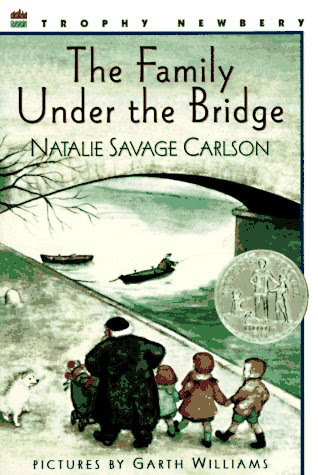
The Family Under the Bridge, by Natalie Savage Carlson


 This is a charming little story about Armand, a "hobo" in Paris, who loves his free life. But one day he returns to his usual spot under a bridge to find that another family has claimed it- three redheaded children whose mother is at work. After their father's death they could no longer afford their apartment, and are hiding so that they won't be put into an orphanage and be separated from their mother, and each other. Armand is a bit ruffled at having his spot taken, but the children seem more than happy to absorb him into "their" space and claim him as an unofficial grandfather. The children think that singing to earn change for treats and meeting Armand's friends the gypsies are a marvelous adventure, but their mother takes offense and tries to keep the children away from him. Nonetheless, it seems that they are meant to be family, and the story ends happily for all.

Wednesday, March 27, 2019

The Corn Grows Ripe, by Dorothy Rhoads

This book gives a brief introduction to the life of a twelve-year-old boy in a rural village somewhere in Central or South America (the specific location is never specified). Tigre and all of his neighbors are descended from the ancient Mayans, but much of that culture has been lost. They do follow many agricultural and religious traditions (of both Christian and Mayan origin). Much of their agricultural year is focused on corn- preparing a new field every year, awaiting the rains, planting the crops, and harvest.

At the beginning of the book, Tigre is somewhat lazy and babied by his parents. But when his father's leg is broken while clearing the field for the year's corn crop, Tigre has to grow up quickly. Feeling the weight of responsibility of feeding his growing family (parents, grandmother, young sister and newborn baby brother) he learns to push himself to finish tasks he would have abandoned in the past and complete the work his father would otherwise be doing.

This is a quick and reasonably pleasant read. However, I found myself curious about the aspects of the unusual religious blend in the village that weren't explained (for example, if the rain gods were offended and refusing to water the earth, why offer prayers in the Christian church?). But this likely falls outside the scope of such a short book written for a much younger audience.

Monday, August 28, 2017

Last Stop on Market Street, by Matt de la Peña

Has it really been nearly three months since the last post on this blog?  It's seriously time to get moving.

I actually read this title last week with no intention of blogging it; my children borrowed it from the library and I just assumed from its dimensions that it was a Caldecott medalist and not a Newbery.  Silly me!

It's such a brief story that there isn't much to say that won't give away *everything*.  But here is the nutshell version.

CJ and his grandmother leave church on Sunday, and CJ starts to notice some differences between himself and others.  His friend gets to ride home in a car with his dad instead of waiting for the bus in the rain. He doesn't have an MP3 player like some of the older kids on the bus.  Every Sunday after church he doesn't get to go home; he has to go. . . to the location disclosed at the end of the book.  But  Nana's perspective on the things CJ complains of is completely different, and soon he starts seeing things her way, too.

My kids were a little young to appreciate this one, but it's a great story for kids who have a little more exposure to an urban environment than my own, or are old enough to stretch their imaginations just far enough to join CJ in his world.

Tuesday, April 25, 2017

The Bears on Hemlock Mountain, by Alice Dalgliesh

I've had to break my own rule here.  Generally I try to include the cover images that matches the copy of the book I read, whether or not it's a first edition.  This time around, the library's copy of the book has a one-of-a-kind cover hand-drawn years ago by an 11-year-old back in the 1990's.  Her name was on the back.  I wrote her; she's in her 30's with a child now.  She was amazed that this is still in a library somewhere :-)

We've encountered our good friend Alice Dalgliesh twice before.  However, unlike the other youth novels we've covered in the blog, this is intended for much younger readers.  Although it's divided into chapters, this is definitely a one-sitting read.

Jonathan lives by the foot of a mid-sized hill, named (not especially accurately) Hemlock Mountain.  His family is planning to host a christening, but because they have such a large extended family they will need to borrow aunt Emma's giant soup tureen.  Because the adults are busy with preparations, Jonathan is sent over the hill to bring it back.  Although no bear has been seen there in recent memory, Jonathan is still concerned about heading out alone (he's never been before).  Not especially reassured by his parents' insistence that there are no bears on Hemlock Mountain, he heads out and reaches his destination safely.

Stomach full from aunt Emma's cookies, Jonathan naps in her chair and forgets that he was charged with returning with the soup tureen before dark.  He wakes up just in time to lug it back up the hill.  But as dusk falls, Jonathan sees two sets of eyes attached to two dark, hulking bodies, moving through the trees. . . what to do?

This book would make a fantastic read-aloud for younger children.  I may read it to mine before it goes back to the library!

Wednesday, September 14, 2016

Roller Girl, by Victoria Jamieson

Twelve-year-old Astrid and her best friend Nicole have been inseparable since first grade.  They do everything together, including getting dragged to "cultural enlightenment" events by Astrid's mother.  But it turns out that the newest event is actually kind of fun- they get to watch Roller Derby!  Astrid learns that there is a youth Roller Derby camp over the Summer and is immediately sold on the idea.  Nicole, however, isn't so much.  While Astrid is making plans for the two of them, Nicole is instead enrolling in the camp she actually wants to attend.  Ballet camp (eww).  With Astrid's arch-nemesis, Rachel.

Suddenly Astrid is left on her own at camp with girls who are more experienced and tougher than she is.  She can barely stand up on her skates.  And she can't tell her mother how she feels; she assumes that Astrid is catching rides home with Nicole, and she'd never be permitted to attend the camp otherwise.

Astrid stinks at Roller Derby, but she keeps coming.  She makes a new friend, and seeks some help by slipping anonymous notes into the locker of her favorite skater, Rainbow Bite.  She is just barely able to keep things together. . . until she overhears Nicole and Rachel talking about her at the amusement park.  And then her mother finds out that Nicole isn't actually attending camp with Astrid after all.  Will Astrid be able to redeem the Summer?

What a fun graphic novel!  I breezed through it in one sitting.  Highly recommend!

Monday, March 28, 2016

The Light at Tern Rock, by Julia L Sauer

If the author's name looks familiar, it's because we've encountered her before!

This is a very short book, just 63 pages (including chapters and full-page illustrations) so I won't be able to say too much without giving the plot away entirely.

Ronnie lives with his aunt (circumstances undisclosed), who used to be married to a lighthouse keeper and had lived with him at an isolated lighthouse, the titular Tern Rock, for decades.  The current keeper approaches her one day and asks if she would be able to take Robbie and man (woman?) the light for him for two weeks so he can visit family in Nova Scotia in early December.  He insists that he will return to relieve them well in advance of Christmas.  Aunt Martha loved her time at the lighthouse and, with Ronnie's agreement, makes plans to relieve Mr. Flagg.

Ronnie quickly learns the routines of the lighthouse, and finds his days full between caring for it with his aunt, keeping the house tended, and keeping up with his school lessons.  But when December 15th arrives, the promised homecoming date, Mr. Flagg is nowhere to be seen.  Ronnie becomes more and more bitter as he realizes that he may be stuck at the lighthouse for Christmas.  How can he and his aunt possibly celebrate properly so far from home?

This slim, quick read would be great for beginning readers.

Wednesday, March 23, 2016

The Apple and the Arrow, by Mary and Conrad Buff

I see that this book has been reissued in more of a shorter-height book format and I think that's a good call on the part of the publisher.  This particular edition has the size and shape of a chapter book, with a few full-page color illustrations.  But that leaves entire giant pages with nothing but text on them.  That makes for a rough read!

This book is, obviously, about the legend of William Tell and the beginnings of Switzerland's independence.  What makes it somewhat unique is that it's told from the perspective of William Tell's son, so you learn about the everyday life of the village and what independence (or lack thereof) would mean to a boy in the mountains.

Monday, September 8, 2014

My Father's Dragon, by Ruth S. Gannett

This humorous and somewhat silly story is very reminiscent of old folk tales and trickster tales.  The chapters are short and fun, and this would be a great book for young reluctant readers!

The author's father, Elmer Elevator, brings an alley cat in from the rain on a stormy day to dry by the furnace and have a saucer of milk.  But Elmer's mother will have none of it, and sends the cat away.  Elmer goes in search of the cat later, and out of appreciation the cat tells him about the Wild Island, off the coast of Tangerina.  It's full of dangerous wild animals, and no one (save the cat) has ever survived to describe it to outsiders.

Of most interest to Elmer is the young dragon kept captive by the animals of the island to ferry them across a wide river.  The cat tells him that the dragon would no doubt give him a ride in gratitude if Elmer could free him.  So Elmer packs himself a bag of food suitable for young boys and stows away on a vessel heading to deliver goods to Tangerina.

Elmer slips away at nighttime to Wild Island through the secret path the cat told him would be revealed at low tide.  Once there, he realizes that all of the animals can speak and that he won't be able to conceal his presence for long.  When Elmer finally encounters animals (who, of course, would all like to kill or eat him) he manages to cleverly outwit each one with an item from his backpack.  This part of the story is really fun.

I don't think I'm ruining the story to say here that he does manage to free the dragon and fly away on his back- this volume is first in a trilogy.  I can only assume that the subsequent volumes are just as silly as the first.

Tuesday, July 8, 2014

The Cow-Tail Switch and Other West African Stories, by Harold Courlander and George Herzog

Hooray for fun folk-tales!  Narrated very matter-of-factly, these brief stories describe how landmarks were formed, or how animals received unique characteristics, or just tell stories of very wise or silly or lazy or greedy people.  And because the humor in the stories is somewhat dry (although not so dry that you'll miss it) I hear them in my head in Lisette Lecat's voice.  Generally an easy read but still fun for all ages.

Wednesday, July 2, 2014

Big Tree, by Mary & Conrad Buff

This book summarizes the life of the oldest Redwood tree in the American northwest, from sprouting thousands of years ago until conservation of the area began to protect this tree and others like it from being cut down for human use.

I was not the proper audience for this book.  Because the story spans thousands of years, it is told as short vignettes from different times- the lives of animals living nearby, fire passing through, Indians hunting nearby. . . because Wawona (the tree) is immobile, his perspective is limited and his voice is slow and generally passive.  Honestly, I was bored.  But this one may have more appeal for wildlife lovers or conservationists.  It does have some accurate and well-done black-and-white illustrations.

Thursday, June 5, 2014

Pancakes-Paris, by Claire Huchet Bishop

In this short illustrated book, we find ourselves in post-war Paris.  Ten-year-old Charles lives with his mother and five-year-old sister, Zézette.  Mardi-Gras is approaching, but nothing is like "before," a time that Zézette cannot even remember when there was enough food, and soap, matches, oils, and hundreds of small necessities were abundant.  Above all, Charles misses crèpes, their annual tradition.

One day, he helps two lost American soldiers find their way.  Because his mother taught him to refuse money as payment for a kindness, the soldiers offer him a box of American pancake mix.  Charles examines the red box with the kind-looking lady privately and is excited to discover that it contains ingredients for fat American-style pancakes!  But the instructions on the box are in English.  Charles will have to figure out how to prepare them if he's going to surprise his mother and sister with Mardi-Gras pancakes.

This is a quick read, but the book does a very good job of conveying just how much culture and standard of living was lost in Paris after World War II, as well as how much responsibility children had to shoulder.  Since this book was published just two years after the end of the war, the author couldn't possibly have known how much better things would eventually get.  Both she and the illustrator, however, would surely have understood the war's impact- the author was born in France and the widely-traveled illustrator was born in Belgium.

Next up on the docket for me is another book by this author, "The Man Who Lost His Head."  Although not a Newbery book, it's illustrated by Robert McCloskey!

Wednesday, October 23, 2013

The Hundred Dresses, by Eleanor Estes

It's always a surprise for a Newbery medalist to be so slim, even when you've read it before!

This book is about Maddie, a young girl who is best friends with Peggy, the most popular girl in school.  Lately, Peggy has taken to teasing Wanda, the daughter of an immigrant single father.  Generally, Wanda flies under the radar- she sits unnoticed in the back of room 13 and participates as little as possible.  But one day she calls attention to herself by mentioning that she has one hundred dresses at home, all lined up in her closet.

Since Wanda appears at school every day in the same clean but tired dress, this claim is a ludicrous one.  She seems oblivious to how foolish this sounds coming from her, so Peggy makes a point to wait for her regularly on the way to or from school to ask her about them and praise their descriptions profusely in jest.  This makes Maddie uncomfortable, and she never joins in, but she also doesn't dare ask Peggy to stop, either.  After all, Wanda has never been brought to tears, so no real harm has been done, and Maddie certainly doesn't want to call attention to her own hand-me-down dresses.

Eventually, the girls notice that Wanda has been absent from school for several days (they have been made late to class by waiting to tease her, but she never passes by).  She doesn't even return in time to learn that she was her grade's winner for the girls' drawing contest- the winner was to design the most beautiful dress, and each of Wanda's 100 entries was better than any of the others.  Eventually, the teacher receives a letter from Wanda's father.  In his own awkward English, he narrates that Wanda and her older brother will no longer be attending school there.  Their family is moving to the city, where there are plenty of immigrants with unusual surnames, so they should no longer be mocked.  This makes Maddie feel much worse about never having stood up for Wanda, and Peggy is apparently also upset by her role.

The two girls decide to try to find Wanda and make amends, but her home is long since empty.  The best they can do is to write her a kindly letter (they can't quite find the words to express their apology) and hope that the post office is able to forward it to Wanda's new home.  Months later, at Christmastime, their teacher receives a letter from Wanda, telling that she likes her new home and school, and that she especially wishes for Peggy and Maddie to keep two of her drawings.  Upon hanging hers up at home and studying it in more detail, Maddie notices that she herself has been drawn as the wearer of the dress.  She rushes over to Peggy's house, and the same is true of Peggy's drawing.  They know then that Wanda was fond of them all along, and that their letter was received and all is forgiven.

This one was a great book for kids about the subtle impact of bullying, without getting too preachy or overdramatic.  Of course, it was written in a different time when a bully's access to a victim is not as pervasive as it is now.  But it allows a young reader to gain empathy under a simpler set of circumstances.  Definitely a keeper story.

That said, I know that this book won the Newbery Honor, and not the Caldecott.  And I know that Eleanor Estes and Louis Slobodkin appear to have a "thing" (he illustrated most, if not all, of her books in their original edition).  But if the main thrust of your book is the beauty of 100 hand-drawn dresses, wouldn't it have been in the publisher's best interest to select an illustrator who would effectively convey this?  The cover shown above reflects all of the book's illustrations.  They're hardly awe-inspiring.

Wednesday, August 21, 2013

Fog Magic, by Julia Sauer

Even though the main character in the book does not take a sea voyage, I'm labeling it anyway.  Fog Magic takes place in the small village of Little Valley, on the coast of Maritime Canada.  The village, and larger community, is supported by the sea voyages of the men.  Life is difficult but predictable, but what makes Little Valley unique is its frequent, long-lasting, thick fog.  Burdensome to the sailors and housewives alike (how can you dry clothes without mildew if the air is always wet?), it's generally considered a nuisance.  But not to young Greta Addington.  Greta has always loved the fog, being in it, wandering in the woods, and exploring the stone foundations of the long-gone homes of the original settlers along the old Post Road.

Although her mother can't begin to understand Greta's fascination, she is resigned to it.  After chores are completed, Greta is packed a lunch and permitted to disappear into the fog for the afternoon, provided she agrees to return at a reasonable hour.  She enjoys this time alone in the fog, although she wonders if it causes her to hallucinate- she once saw a house standing where she was certain that only a foundation had existed when she had passed before.  But one day in the fog, she is certainly not hallucinating when a woman dressed in fine silks drives by in a carriage and offers Greta a ride to Blue Cove, just over the mountain.

The mysterious woman drops Greta off at a cottage, where she meets Retha, a girl her own age.  She spends the afternoon getting a tour of Blue Cove and meeting Retha's family.  Some things she sees and hears seem vaguely familiar, as if from an old memory.  She is told that she is always welcome to visit and that they'll look forward to seeing her again, and send her on her way with a slice of fresh pie.  But when Greta arrives home, the pie has disappeared!  Retha's parents seem to have a sense of where Greta is from, but say nothing about it.  Greta doesn't quite understand how the fog is transporting her between two worlds, or what her role is, but she knows that she must never talk about one side while on the other.  But Greta knows that she can't wait to disappear into the fog again and learn more about Blue Cove.

Fog Magic is exactly what I expected from reading the back cover, both in tone and content, and I think that's fantastic.  I like to read a book with proper expectations!  It's a short novel, at barely 107 pages, but feels like a much longer book- the author does a great job bringing you completely into Greta's world .  Unfortunately, the book doesn't have broad appeal.  The reprinted copy I borrowed has been cataloged for  two years, but I'm clearly the first to borrow it.


Tuesday, April 16, 2013

The One and Only Ivan

Ivan is the title character and narrator of this book.  He's a silverback gorilla, but not a fierce or angry one.  Ivan lives, with a number of other exotic animals, at the Exit 8 Big Top Mall and Video Arcade.  Taken as an infant from the jungle, he lived with the mall's owner, Mack, and his family until he became too large and strong and unpredictable. Now he's an attraction that is no longer attracting shoppers.

Ivan, understandably, isn't especially concerned with the shoppers.  His "domain" is small and his life is routine, eating and sleeping and watching television, and chatting with his neighbors.  One is Bob, a stray dog, who comes and goes as he pleases but enjoys sleeping on Ivan's belly.  The other is Stella, an aging retired circus elephant who uses her words as sparingly as Ivan does but always with purpose.

Ivan does have one other friend- Julia, the daughter of the mall's night custodian.  While her father works, she visits with the animals, does her homework, and draws.  Ivan likes to draw, too (although humans usually don't recognize his subjects), and Julia often smuggles extra supplies to him through a broken corner of his enclosure.

In an effort to draw new shoppers and keep his property from going out of business, Mack purchases Ruby, a baby elephant.  She is placed in Stella's enclosure and is confused and full of questions, and a bit skittish at first.  Ruby slowly becomes accustomed to her life at the mall, but her enthusiasm for life begins to wane when it becomes clear that Mack intends to train her for public performance, and he isn't opposed to physically harming her to force her to comply.

At the same time, Stella is succumbing to an injury incurred in her youth, as she was being trained in much the same way that Ruby is now.  Although she says very little about her time with the circus, it clearly pains her to think on it.  She is sadly resigned to her current state, but fears for Ruby's future since she is beginning on the same path.  Stella knows that she cannot help Ruby, and as she senses her life drawing to a close, she begs Ivan to promise that he will rescue Ruby.

Ivan is a bit baffled by the request, but he'd do anything for Stella.  But now he's in a quandary- how can he help Stella?  Does she even need helping?  After all, is life at the mall really that bad?  But before her death, Stella had been prompting Ivan to exercise his memory, and to think back about what he loved about his life before he was taken from his family and the jungle.  As things start to come back to him, he realizes that his domain really is a cage, and he has to get some one's attention to help all of them.

Katherine Applegate was inspired to write this novel after learning about the story of the real Ivan, a shopping mall attraction in Washington state who spent nearly 3 decades enclosed indoors before public outrage and the mall's financial troubles facilitated his placement in a more lifelike habitat at Zoo Atlanta.  The real life Ivan passed away recently and was one of the zoo's most popular family members.  You can read more about him here.

Wednesday, January 2, 2013

Inside Out & Back Again, by Thanhha Lai

Intended to be semi-autobiographical, this novel in verse tells the story of Hà, a young Vietnamese girl.  She lives a happy, although somewhat deprived, life in Saigon with her two brothers and mother.  Their father disappeared while on a military mission and hasn't been heard from since, but the family is hopeful that he will return.

As the Communist forces from the north approach, however, it becomes clear that their home is no longer safe.  Because Hà's father was in the military, his family (with many others) is entitled to passage on one of several ships which will stealthily leave carrying refugees.  The story follows their family to a camp in Guam, and then to another in the United States, before they are finally sponsored by a family who wants one of Hà's brothers to work in his auto garage.

Hà has a great deal of difficulty adapting to her new home in Alabama.  She is only gradually learning English.  No one in her school looks remotely like her.  The neighbors avoid her family, and she is bullied by classmates.  But with the help of her family and a few kind friends, she is able to carve out a home for herself, even though it will never be like the home she left.

Although I think this story could have been told equally well, and perhaps more fully, if not in verse, the sparse prose does seem to emphasize Hà's difficulty in finding the words to understand what is happening, and her inability to communicate with people.

Friday, December 28, 2012

Blue Willow, by Doris Gates

The picture shown at left is the image on the cover of the copy I read.  One of the great things about this book is that, despite being so old, it keeps well and would still be enjoyable by a contemporary audience.  It has been reprinted numerous times with covers with current appeal, so I'm glad that this isn't one of the Newbery books that has fallen out of print!  On to the summary.

Janey Larkin's family is one of many dislocated by the Dust Bowl.  Former ranchers in Texas, they had to sell their property years ago and now live as migrant workers, living where they can (often in their car) and moving as often as every few weeks.  Janey's biological mother died when Janey was almost too young to remember her, but she loves her stepmother, and never refers to her as anything but "Mom".  Similarly, Mom doesn't resent Janie in any way and they are a completely whole and happy family together.  This shouldn't necessarily be unusual in a children's book, but I feel like it is.

The one memento that Janey has from her biological mother's family is a blue willow china plate, depicting a Chinese house, a bridge over a stream, and a willow tree.  Because she has been essentially homeless for years, the picture on the plate takes on a special significance for her.  If she ever, finally, has a real home again, she wants it to be just like that image.  The blue willow plate is also the one nice item that the family has remaining from their former life.  Although it is treasured by the entire family, it belongs to Janey, who keeps it carefully packed away (Mom won't let such a nice item be displayed until they have a proper home to show it in).

This season, work has brought the Larkin family into the San Joachin valley in California.  Dad has taken work picking cotton, and the family decides to occupy a shack they found abandoned by the side of the road.  They figure that even if they are discovered and asked to pay rent (the shack is, after all, on the property of the man owning the cotton fields and more besides), as long as it's a reasonable price it would be preferable to staying in the laborers' camp.  Once they have moved in, a little Mexican girl of Janey's age drops by to visit.  Lupe Romero lives across the street with her parents, younger brother and baby sister.  Janey is skeptical at first- frequent moves don't really lend themselves to developing friendships or social skills- but Lupe's sincerity and good manners win her over.  She and Lupe quickly become close friends, and Janey is amazed to learn that Lupe has lived in her house for an entire year!  She hopes that she will have the luxury of remaining in one place for so long, too.  Then she might get to attend a proper school, instead of learning math on the fly from her father, and reading from the pages of the family Bible, the only book she has ever had access to.

Despite eventually having a monthly rent of a steep $5 demanded of them by Mr. Anderson's grouchy foreman Bounce, the Larkins settle in happily.  Janey is able to attend the fair in Fresno with the Romero family (children are admitted free!) and she learns that sometimes friends offer things out of kindness, not pity.  They enjoy fishing for catfish in the local river, and Dad gets to participate in the annual cotton picking competition.  And best of all, Janey is able to attend school and read real books under the care of a teacher that she loves.

At the end of December, however, circumstances change.  The cotton harvest ends and there will be no more work for farm laborers.  Also, Mom becomes ill with pneumonia, and they have no money with which to pay for a doctor or medicine, or the rent that will come due mid-January.  Additionally, Mom is too sick to be moved.  Janey decides to use her blue willow plate and try to exchange it for a miracle!

I really enjoyed this book and finished it all in one sitting.  Younger readers of chapter books will find the story and Janey herself easy to relate to.


Monday, November 12, 2012

Daniel Boone, by James Daugherty

I've never known anything about Daniel Boone.  Honestly, I didn't know if he was a real historical figure, like Davey Crockett, or if he was folklore, like Paul Bunyan.  The old-timey legends part of my brain kept it pretty ambiguous.  So it turns out, he was real!  But I had a hard time staying with this book.  The illustrations were great, but the text varied between folksy storytelling dialect and historical narration, so I never quite knew how to feel while reading it.  Also, the book failed to drive home for me what made this fellow so special compared to all the other men of the period who must have been doing similar things as he was described as doing.  So I didn't really enjoy this one, but multiple some ones on the Newbery committee must have, seeing as it won the medal for that year.

Tuesday, September 25, 2012

Breaking Stalin's Nose, by Eugene Yelchin


Another spontaneous Newbery for me- this one was on display at the local library and I picked it up when I saw the medal on the cover, since I was between Newbery books and the blog was due for an update!

Sasha Zaichik lives a comparatively charmed life in Stalinist Russia.  Although he and his father share an apartment with 46 other individuals, the two of them have the biggest bedroom and are well provided for.  Sasha's father is a well-respected member of State Security, and Sasha fully believes in all of the principles that society, school, and his father have taught him.  The top student in his class, Sasha's most ardent wish is about to come true. He is about to be inducted into the Young Pioneers (in a nutshell, the Stalinist equivalent of the Hitler Youth).  He'll finally be able to proudly wear the red kerchief and strengthen his character to become the best Communist he can be.  And Sasha's father is to preside over the induction ceremony!

Sasha's worldview quickly changes, however, over the course of the two days covered in this book.  The night before the ceremony, Sasha's father is arrested and taken away by State Security.  One of their flatmates has informed on him and wastes no time taking over the large bedroom for his own family.  Officials from the orphanage will return for Sasha in the morning, but Sasha doesn't wait.  He's certain a mistake has been made, and once Stalin finds out he'll be very angry and rectify it immediately!  In the meantime, he goes to see his aunt Larisa, but is turned out.  She and her husband have a new baby and they would be at risk if they offered shelter to some one of questionable character.  So Sasha patiently spends the night in their basement and heads to school the next day.

At school, Sasha pretends that nothing has happened.  He is intended to carry the banner at the Young Pioneers ceremony, a great honor, and no one at school seems to know, so he likewise keeps quiet.  But he starts to notice small in justices over the course of the day.  Sasha notices that some children are repressed and picked on because of the supposed crimes of their parents, not what they themselves have said or done.  And standing in opposition to the group when they're persecuting some one, even if they are wrong, is the fastest way to become a target yourself (despite the Young Pioneers principle of always acting according to a clear conscience).  He realizes that he will be the next to fall, and there are plenty who would gladly see him fall from such an exalted position.  And when he unintentionally breaks the nose of the school's statue of Stalin, unseen by anyone but a single enemy from his class, he realizes how dangerous things truly are for him.

I'll not spoil the ending for you, but I'll mention that the book does have a brief afterword.  Usually I'm not a fan of afterwords, but I found this one useful and not too long to be bothersome.  And since the author grew up in Soviet Russia, I thought he might have something interesting to say about what he meant to do with this book.  What he had set out to do, and did marvelously, was to give expression and examine the pervasive fear that permeated every aspect of the lives of the Russian people living during this time (and even after the death of Stalin).  It's been a long time since I was the target age for this book so it's hard for me to know what knowledge a young reader would bring with him when picking this one up, but even now it makes me want to learn more.

Monday, March 19, 2012

Honk the Moose, by Phil Strong

Honk the Moose is a true story! In Birora, Minnesota, two friends, Waino and Ivar, are returning home from skiing. Ivar's father owns the livery and the two boys stop in his stable to oil their skis. But amidst the horses, they discover a moose, who wandered in to help himself to the hay after going hungry for days in the harsh winter. He is named Honk for the sound that he makes, and try as they might, Honk cannot be convinced to leave.

The story will be very fun as a read-aloud, especially as the effort to remove Honk escalates in the town, with each new person not believing that the moose really exists (first Ivar's father, who sends the boys to call the police, who calls the mayor, who then calls the town council). When it becomes clear that Honk is there to stay, the book talks about how he becomes a part of the town. This one's more for younger readers of chapter books, but still a fun story for older ones.

Tuesday, March 13, 2012

When Shlemiel went to Warsaw, by Isaac Bashevis Singer

This book is (as the title suggests) a collection of short stories. They all take place in Eastern Europe in a Jewish cultural setting. I found myself wishing I had someone to read these out loud to - they're very much in a storytelling style, and beg for it. Enough that I did a little reading aloud to myself, when nobody was around! The stories are clever and entertaining, and it was a fun read. I think kids aged roughly 9-11 would enjoy it a lot, as they will feel smarter than a lot of the main characters in the stories (I mean, a man gets turned around on a journey and ends up back at his house, but he thinks he's ended up at a house exactly like his own somewhere else!) and have fun guessing what might happen.

I will say that the stories could be a bit confusing for a kid without much exposure to Jewish culture - I know, for example, roughly what a Golem is, and why candlesticks would be important for the Sabbath, but I really wouldn't have when I was a kid, and a lot of the details of these stories would have been entirely lost on me. Which is not to say the exposure wouldn't have been good for me - it certainly would have! But a certain degree of familiarity with the setting is taken for granted, and this might be worth addressing if your reader is completely new to the idea.

Overall, definitely worth picking up - an entertaining read for an adult, would make an excellent read-aloud book, and a great exposure to one of the 20th century's great storytellers. I enjoyed it so much that I plan on looking for some of the author's adult books after this.