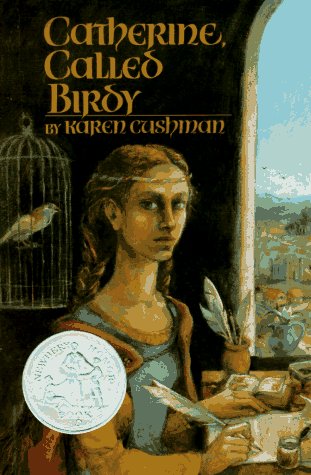
This is one of the best children's books I've read in a while. When I was working in a library, kids would come in for this one every year because it was assigned. I was curious about it but never found the time to get it myself, so I was glad to have the opportunity to read it now. The image shown to left is the most common cover and the somewhat abstract, looks like pieces cut out of a magazine and pasted together style really doesn't appeal to me at all, and I feel like it really fails to capture the mood of the story. The ones I liked best after searching Google Images showed the protagonist's face (there were three), but one gets automatically taken out of the running for giving her brown hair. And only one of the remaining two makes her look Indian (part of her heritage) but shows a landscape not really suited to the book either. Some one please make this book the perfect cover it deserves?
Salamanca (Sal) Tree Hiddle has had a lot of changes to deal with in her 13 years. Originally from Bybanks, Kentucky, she was living a charmed life. She lived with both parents on a farm, with grandparents nearby. She and her mother were very close, there was a new baby on the way, and Sal was happy and at peace. But Sal's mother goes into preterm labor and loses the baby, and things become tense between Sal's parents. Sal's mother feels like she doesn't know who she is anymore, and goes on a road trip to Idaho, sending postcards along the way. Then the postcards stop, and she never returns.
Saddened by constantly being reminded of Sal's mother in everything he sees, Mr. Hiddle moves them to Euclid, Ohio. Sal hates it there. No farm, no animals, no space. . . and her father has been spending a lot of time with a local woman, Mrs. Cadaver (yes, this is apparently a real surname; I checked 411.com), which Sal sharply resents. Once she has settled in and had an adventure of her own in her new town, Sal is invited on a road trip with her grandparents to retrace her mother's steps so that they can all reach Lewiston, Idaho by her mother's birthday. I think we all know where this is going. And Sal does, too, although she manages to put it conveniently out of her mind for much of the story. As they drive, Sal entertains her grandparents with the story of her school year, and friend Phoebe (coincidentally Mrs. Cadaver's next-door neighbor).
From her first visit to Phoebe's house for dinner, it was obvious to Sal that Phoebe's mother was unhappy. She was very taken for granted by the family, and seemed tired of living such a plain and routine life. Then one day, without warning, she vanishes. She left a note behind on the kitchen table and a month's worth of meals with instructions in the freezer. She indicates that she plans to return, but says nothing of why she left. Phoebe is understandably distraught, and when mysterious notes start appearing on the porch, she becomes convinced that her mother has been kidnapped by a lunatic and is in real danger. Sal is unconvinced, but accompanies Phoebe on her investigation. And their two stories have more in common than either girl would admit.
Sharon Creech, blast you for making me cry. This book is amazing.
Showing posts with label 1995. Show all posts
Wednesday, November 12, 2014
Monday, July 12, 2010
Catherine, Called Birdy, by Karen Cushman
Written in diary format, this is the chronicle of a year or so in the life of a 13-year-old girl living in England in the year 1290. She is the head-strong daughter of a minor knight, assigned by her monk brother the task of writing about her days. She writes of her frustrations at the life she is destined to live, married off to the highest bidder, sewing sheets, making soap, having children... She also writes of the life of the villagers she knows, including Perkin the goat boy, Meg the milkmaid, Gerd the baker's son, and so on. She sees their lives as delightful and free compared to her own - they are allowed some say in who they marry, and can come and go as they please (vs her own relative captivity in the manor). She laments that if she must be born a lady, why not a rich one who wouldn't have to hem shirts and sew sheets and embroider for the church? She is restless and clever, and easy to identify with if you're at all familiar with what it feels like to be 13 in any era.
The book is enjoyable enough that you hardly notice when the author slips in informative things like herbal remedies of the time, how a 30-year-old woman was considered fairly old, what it meant to go to a medieval fair, social structure, and the difficulties of travel at the time. It makes it easy to imagine medieval life, and to see how being 13 in 1290 might not have been as different from being 13 today as you might have thought. Would be a good companion to Good Masters! Sweet Ladies!.
Subscribe to:
Posts (Atom)