Showing posts with label 1945. Show all posts

Wednesday, October 30, 2013

The Silver Pencil, by Alice Dalgliesh

How fun that this book is largely autobiographical!  It explains how the author was able to describe so many locations, as well as the protagonist's impressions of them, so well.

Janet Laidlaw is our protagonist, the daughter of a Scottish father and an English mother.  Because her mother is often ill and susceptible to extreme weather, the small family has relocated frequently in an attempt to keep her comfortable.  As a result of her mother's necessary withdrawal due to illness, Janet is also much closer to her father, who has a keen sense of humor and an appreciation of his young, enthusiastic daughter.

When our book begins, nine-year-old Janet and her family have just moved to a new home on the island of Trinidad.  Over the next few years, in her small community and among her friends, Janet's talents for reading and creative writing are improved further by lots of opportunity to stretch them.  As further encouragement, her father gives her a special silver pencil for Christmas, to continue her writing.

Eventually, their contented, stable life comes to an abrupt end when Janet's beloved father dies unexpectedly from heart failure.  Unexpectedly, her mother decides that they should relocate back to England, where she has family support and is familiar with the lifestyle.  She leaves the care of her former husband's business affairs in the care of his business partner and Janet's adult brother, and she and Janet embark on a long ocean voyage before arriving in England.

The culture shock is very difficult for Janet.  Her clothes are wrong, her accent sounds strange to others, and (almost worst) she's placed behind her peers in school because her education was lacking.  But over time she is able to succeed with the help of a few very close friends.  She is eventually promoted to the appropriate year, and even advances to the head of the class.  Janet also continues to write, winning several prizes from the youth section of a prominent magazine.  Because of her academic success, at 16 years Janet is able to win a scholarship to advance to college and continue her education, an opportunity that she is thrilled to have.  However, she learns upon telling her mother that she still cannot afford to go- beyond the free tuition lies clothing and lodging and other expenses that are simply unaffordable.  Additionally, because of her mother's ill health in the English climate, she has decided that they should relocate back to Trinidad.

Janet is heartbroken but wants the best for her mother, so they head back and move into their old home with her brother.  She makes a new friend, a Canadian girl named Mary, but finds over time that both her energy and her motivation to write are waning with so little stimulation.  Mary suggests that she write for course catalogs from some American and Canadian schools to see about becoming certified teaching kindergarten, since she has had some experience working with the island children, writing and directing plays.  Janet's mother agrees that although she would be missed, such an undertaking would be best for Janet, and allows her to proceed with the understanding that she will be met and supervised by family friends upon her arrival in New York (her eventual choice of destinations).

The remainder of the book follows Janet as she studies, has successes and failures in interacting with children in a school setting, and polishes her writing skills.  She also makes close friends along the way and learns some important lessons about herself.  Although there are many obvious differences, this book reminds me SO SO MUCH of the Anne of Green Gables books (although very much condensed, given that this book covers Janet from 9 years into young adulthood).  Also, although she does fall in love, Janet doesn't cling to romantic notions of love or relationships.  But Janet's growing into adulthood, finding the best way to use her talents and where she fits in the world, and figuring out what home is has some very good parallels.

Wednesday, October 23, 2013

The Hundred Dresses, by Eleanor Estes

It's always a surprise for a Newbery medalist to be so slim, even when you've read it before!

This book is about Maddie, a young girl who is best friends with Peggy, the most popular girl in school.  Lately, Peggy has taken to teasing Wanda, the daughter of an immigrant single father.  Generally, Wanda flies under the radar- she sits unnoticed in the back of room 13 and participates as little as possible.  But one day she calls attention to herself by mentioning that she has one hundred dresses at home, all lined up in her closet.

Since Wanda appears at school every day in the same clean but tired dress, this claim is a ludicrous one.  She seems oblivious to how foolish this sounds coming from her, so Peggy makes a point to wait for her regularly on the way to or from school to ask her about them and praise their descriptions profusely in jest.  This makes Maddie uncomfortable, and she never joins in, but she also doesn't dare ask Peggy to stop, either.  After all, Wanda has never been brought to tears, so no real harm has been done, and Maddie certainly doesn't want to call attention to her own hand-me-down dresses.

Eventually, the girls notice that Wanda has been absent from school for several days (they have been made late to class by waiting to tease her, but she never passes by).  She doesn't even return in time to learn that she was her grade's winner for the girls' drawing contest- the winner was to design the most beautiful dress, and each of Wanda's 100 entries was better than any of the others.  Eventually, the teacher receives a letter from Wanda's father.  In his own awkward English, he narrates that Wanda and her older brother will no longer be attending school there.  Their family is moving to the city, where there are plenty of immigrants with unusual surnames, so they should no longer be mocked.  This makes Maddie feel much worse about never having stood up for Wanda, and Peggy is apparently also upset by her role.

The two girls decide to try to find Wanda and make amends, but her home is long since empty.  The best they can do is to write her a kindly letter (they can't quite find the words to express their apology) and hope that the post office is able to forward it to Wanda's new home.  Months later, at Christmastime, their teacher receives a letter from Wanda, telling that she likes her new home and school, and that she especially wishes for Peggy and Maddie to keep two of her drawings.  Upon hanging hers up at home and studying it in more detail, Maddie notices that she herself has been drawn as the wearer of the dress.  She rushes over to Peggy's house, and the same is true of Peggy's drawing.  They know then that Wanda was fond of them all along, and that their letter was received and all is forgiven.

This one was a great book for kids about the subtle impact of bullying, without getting too preachy or overdramatic.  Of course, it was written in a different time when a bully's access to a victim is not as pervasive as it is now.  But it allows a young reader to gain empathy under a simpler set of circumstances.  Definitely a keeper story.

That said, I know that this book won the Newbery Honor, and not the Caldecott.  And I know that Eleanor Estes and Louis Slobodkin appear to have a "thing" (he illustrated most, if not all, of her books in their original edition).  But if the main thrust of your book is the beauty of 100 hand-drawn dresses, wouldn't it have been in the publisher's best interest to select an illustrator who would effectively convey this?  The cover shown above reflects all of the book's illustrations.  They're hardly awe-inspiring.

Sunday, June 2, 2013

Lone Journey: The Life of Roger Williams, by Jeanette Eaton

Ah, Jeanette Eaton, you writer of juvenile biographies, you.  We meet again!  This time her subject is one of great interest to me, Roger Williams.  Since I moved to Rhode Island for graduate school, I missed out on the local history lessons that the long-time residents received in public school.  But *everything* down here is all about Roger Williams (there's a university, I'm just a quick drive from the park and the zoo it contains). . . you can't visit Rhode Island without tripping over the man.

Lone Journey does an excellent job of describing pertinent events in the childhood and youth of Roger Williams that led him to his eventual place of influence in the colonies.  As a young child, he was raised Anglican, as was proper.  It was believed at the time that it was absolutely necessary that religious and state authority be unified, and one used to enforce the other, to maintain power and influence.  But Roger soon saw how the civil government and the church corrupted each other, and waged war against decent people (often other Christians, especially Puritans) for their refusal to conform.  Despite the disapproval of his parents, Roger also became a member of the Puritan faith and went to study under a prominent lawyer.  Here, also, he discovered firsthand how the King and other politicians used his influence to force the church to sanction their own immoral acts.  Eventually becoming outspoken in his own right, Roger fled to the colonies to avoid prosecution in England for his beliefs.

He had hoped to find new freedoms in a new land, but found to his disappointment the powers that be (in this case, the heads of the Massachusetts Bay Company) were recreating exactly the same power structure that existed at home.  Men were imprisoned for refusing to attend church services, and those of minority Christian faiths were being persecuted and exiled (and, in later years, executed).  Roger Williams was of the firm conviction that civil law should only address civil matters, and that matters of religious faith and belief should be left to the individual to freely express.  He founded his own colony in Providence, as well as the islands in Narragansett Bay, and welcomed people of all faiths, including Quakers, which were being exiled from Massachusetts, and Jews, which were being cast out of Europe.

Part of the reason for his success in his colony is that he was a genuine and honest man, who dealt honestly with his peers, and with the native tribes that surrounded him.  He always brokered fair trades, paid for land with fair currency, and was often relied on to mediate disputes amongst tribes, or between tribes and other white men.

It is interesting to note that Roger Williams seemed to have a great fondness for Native American tribes (going so far as to publish a language reference which is still available today), but did not see it as his mission field to try to convert them to Christianity.  He felt that it would be hypocritical to encourage him to join the white man's faith, when the white men were behaving so abominably and in direct opposition to what they claimed to believe.  Instead, he lived his own faith through his actions.

Finally, the last tidbit that made this book especially fun for me was getting to meet the people who various places in Rhode Island are named for.  Makes me feel like I kind of know where I am!

Monday, May 24, 2010

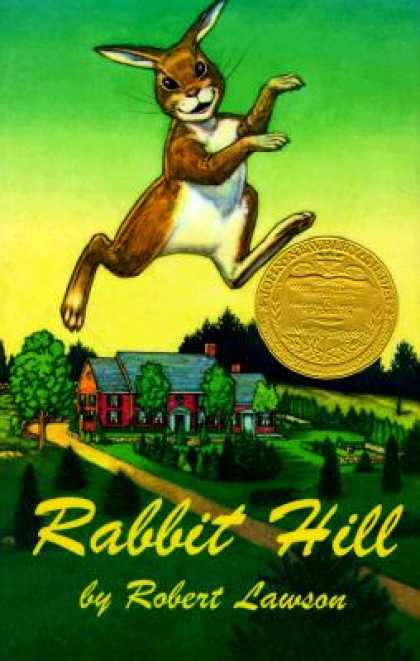
Rabbit Hill, by Robert Lawson

I had never read this book, though I do remember seeing it around on classroom shelves. Honestly, I think I was a little bothered by the cover rabbit's expression. But I should have opened it - I would have liked it.

The story is told from the perspective of the small animals - rabbits, mice, a mole, and a woodchuck, to name a few - living around a vacant homestead, who are anthropomorphized enough to have recognizable societal rules and language, but maintain their major animal habits. The animals have heard that there are "new folks" moving into the house, and there is much discussion over what sort of people they will be. Good farmers, who will stock the seed shed well and take care of their crops? Shiftless people who will let the crops die in the field and leave everyone hungry? Cruel ones, who will fumigate their burrows and set traps?

The new folks are a surprise to all the small creatures - when a young mouse falls into the rain barrel, he is rescued and given a warm bed of cotton until he recovers. When a rabbit is struck by a car, he is rescued, splinted, and nursed back to health, and signs are erected warning motorists to drive slowly. The animals are wary and don't necessarily trust the new people (they are human, after all), but they do find that they respect them.

The book ends on a spiritual note. A statue of St Francis is put up in the garden, and a nightly spread of food put out for the animals at its feet. The animals are, as I mentioned before, wary of humans, but refer to St Francis as "our saint" and agree that their benefactor's crops in the field should be sacred and left alone. The tone at the end was a somewhat startling shift in the mood of the book, but it was actually very touching.

The book itself has some charming elements. Georgie, the young rabbit who is as close to the protagonist as the book has, makes up a song as he travels to his uncle's house, and the tune is in the book (and catching - I had it in my head for a day afterward!). The illustrations are lovely, and there is a clear message about being kind to our fellow creatures. For those who have read Thornton W. Burgess' Mother West Wind series, this book will strike a familiar chord.