Seabird begins by introducing us to Ezra, a fourteen-year-old Ship's Boy on his first sailing trip from New Bedford. While scouting through dense fog, he sees a white bird in the mist. Its unique flight pattern alerts him to the presence of an iceberg in the waters ahead, and he's able to warn the crew in time to save the ship.
Not long afterward, the crew encounters an Arctic native who trades in skins and furs. Ezra trades with him for two walrus tusks, and sets about carving a replica of the bird that saved the ship. He adds a few gems as features, and the seabird becomes a good luck token of sorts. From that moment onward, it is Ezra's constant companion as he rises through the ranks and eventually becomes the captain of his own ship.
Seabird is next passed on to Ezra's son, and then in turn his grandson, each becoming the engineer and captain of a progressively more modern mode of transportation as his father's vessel becomes obsolete.
The book does a great job making you familiar with Ezra as he grows and learns, although less time is spent on his son and grandson. Each chapter is short, just one page, with a full-page color illustration facing it. What I especially liked was that in the margins of the text page, anything that would need a more detailed or technical sketch is illustrated in black-and-white. For example, how Seabird was assembled, the different features of a whaling boat, or the formation of a tropical island. I really enjoyed this slim volume from the author of Paddle-To-the-Sea.
Showing posts with label 1949. Show all posts
Friday, September 12, 2014
Monday, September 8, 2014
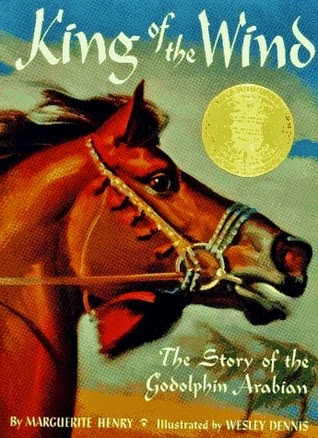
King of the Wind, by Marguerite Henry
ALRIGHT already. I'm on my third Marguerite Henry book for this blog and I'm eating a hearty portion of crow for having disliked her books and refusing to read them in grade school. The only reason I can think of is that when they were recommended to me, I didn't feel like they were really being recommended based on what the teacher knew of me and what I liked. Rather, it was more of a "You're a girl, girls like horses, here you go" sort of reasoning. Except I never really had a horse thing. But I would have still liked the books.
The story of the horse in question begins in Morocco. A mute boy named Agba, who works tending horses in the Sultan's stables, is present when his favorite mare gives birth to a new foal. The golden coat of the foal inspires Agba to name him Sham, the Arabic word for "sun". Sham's mother does not survive for long after his birth, and it is assumed that Sham will soon follow. No one is especially concerned about this since he's small and has a pattern of hair on his chest that signifies bad luck. But as Agba notices, he also has a marking that signifies swiftness. Agba hopes that the good marking will overpower the bad, and is able to nourish the horse to health with camel's milk.
Sham grew until he was the swiftest horse in the Sultan's stables. Agba is constantly caring for him, a substitute for the mother he lost. One day, Agba and five other stable boys are bathed and prepared to meet the Sultan. The Sultan wants the six best stallions from his stables, one of each color, to be selected. Each boy will be responsible for one horse, and the entire party will be sent by boat to Versailles as a gift to Louis XV, the boy king of France. Each horse bears a document describing its pedigree stretching back to the horses of Mohammed himself, as well as stones and amulets intended to ward off sickness and injury. The boys are to remain with the horses and care for them as long as the horse lives before returning to Morocco. The Sultan is hoping that such a lavish gift will make the kind look favorably upon him.
What the Sultan does not know is that the ship's captain kept the money intended for rich foods for his passengers and stocked hay for the voyage instead. When they finally arrive at Versailles, horses and boys alike are emaciated and in poor condition. The king and his officials laugh at such a gift, and sends them away from the stables to be sold for other purposes. Here begins Sham's journey through multiple owners and households, some kind, others abusive. Agba refuses to leave the horse, and is the only person Sham will gladly cooperate with. Sham eventually does find his way to a kind owner who discovers his true potential (and that of his offspring).
So, without giving all of the details away, another great horse book.
The story of the horse in question begins in Morocco. A mute boy named Agba, who works tending horses in the Sultan's stables, is present when his favorite mare gives birth to a new foal. The golden coat of the foal inspires Agba to name him Sham, the Arabic word for "sun". Sham's mother does not survive for long after his birth, and it is assumed that Sham will soon follow. No one is especially concerned about this since he's small and has a pattern of hair on his chest that signifies bad luck. But as Agba notices, he also has a marking that signifies swiftness. Agba hopes that the good marking will overpower the bad, and is able to nourish the horse to health with camel's milk.
Sham grew until he was the swiftest horse in the Sultan's stables. Agba is constantly caring for him, a substitute for the mother he lost. One day, Agba and five other stable boys are bathed and prepared to meet the Sultan. The Sultan wants the six best stallions from his stables, one of each color, to be selected. Each boy will be responsible for one horse, and the entire party will be sent by boat to Versailles as a gift to Louis XV, the boy king of France. Each horse bears a document describing its pedigree stretching back to the horses of Mohammed himself, as well as stones and amulets intended to ward off sickness and injury. The boys are to remain with the horses and care for them as long as the horse lives before returning to Morocco. The Sultan is hoping that such a lavish gift will make the kind look favorably upon him.
What the Sultan does not know is that the ship's captain kept the money intended for rich foods for his passengers and stocked hay for the voyage instead. When they finally arrive at Versailles, horses and boys alike are emaciated and in poor condition. The king and his officials laugh at such a gift, and sends them away from the stables to be sold for other purposes. Here begins Sham's journey through multiple owners and households, some kind, others abusive. Agba refuses to leave the horse, and is the only person Sham will gladly cooperate with. Sham eventually does find his way to a kind owner who discovers his true potential (and that of his offspring).
So, without giving all of the details away, another great horse book.
My Father's Dragon, by Ruth S. Gannett
This humorous and somewhat silly story is very reminiscent of old folk tales and trickster tales. The chapters are short and fun, and this would be a great book for young reluctant readers!
The author's father, Elmer Elevator, brings an alley cat in from the rain on a stormy day to dry by the furnace and have a saucer of milk. But Elmer's mother will have none of it, and sends the cat away. Elmer goes in search of the cat later, and out of appreciation the cat tells him about the Wild Island, off the coast of Tangerina. It's full of dangerous wild animals, and no one (save the cat) has ever survived to describe it to outsiders.
Of most interest to Elmer is the young dragon kept captive by the animals of the island to ferry them across a wide river. The cat tells him that the dragon would no doubt give him a ride in gratitude if Elmer could free him. So Elmer packs himself a bag of food suitable for young boys and stows away on a vessel heading to deliver goods to Tangerina.
Elmer slips away at nighttime to Wild Island through the secret path the cat told him would be revealed at low tide. Once there, he realizes that all of the animals can speak and that he won't be able to conceal his presence for long. When Elmer finally encounters animals (who, of course, would all like to kill or eat him) he manages to cleverly outwit each one with an item from his backpack. This part of the story is really fun.
I don't think I'm ruining the story to say here that he does manage to free the dragon and fly away on his back- this volume is first in a trilogy. I can only assume that the subsequent volumes are just as silly as the first.
The author's father, Elmer Elevator, brings an alley cat in from the rain on a stormy day to dry by the furnace and have a saucer of milk. But Elmer's mother will have none of it, and sends the cat away. Elmer goes in search of the cat later, and out of appreciation the cat tells him about the Wild Island, off the coast of Tangerina. It's full of dangerous wild animals, and no one (save the cat) has ever survived to describe it to outsiders.
Of most interest to Elmer is the young dragon kept captive by the animals of the island to ferry them across a wide river. The cat tells him that the dragon would no doubt give him a ride in gratitude if Elmer could free him. So Elmer packs himself a bag of food suitable for young boys and stows away on a vessel heading to deliver goods to Tangerina.
Elmer slips away at nighttime to Wild Island through the secret path the cat told him would be revealed at low tide. Once there, he realizes that all of the animals can speak and that he won't be able to conceal his presence for long. When Elmer finally encounters animals (who, of course, would all like to kill or eat him) he manages to cleverly outwit each one with an item from his backpack. This part of the story is really fun.
I don't think I'm ruining the story to say here that he does manage to free the dragon and fly away on his back- this volume is first in a trilogy. I can only assume that the subsequent volumes are just as silly as the first.
Wednesday, August 27, 2014
Daughter of the Mountains, by Louise Rankin
The book begins with a brief foreword which describes the history of India and its role as a trade center. The cover description doesn't mention the nationality of our protagonist, so imagine my surprise (and the required shifting of gears) to find myself in a book set in Tibet!
Momo lives in a small village with her father, who carries the mail across dangerous mountain passes, and her mother, who runs a tea house for the various traders and muleteers who pass through en route to bazaars and trade centers farther away. Momo has seen dogs before, but when her eyes fall upon the lama's dog, a golden Lhasa terrier, she is smitten. She can think of nothing but the dog, and wants nothing but to own one exactly like it. But such dogs are nearly nonexistent in her part of the country, and much more expensive than her family could ever afford.
However, Momo is not easily redirected. She directs all of her energy toward praying to receive a dog just like the lama's. When she begs her parents for one, her father tells her that her uncle will bring her one when he comes from Lhasa. As years pass, however, that refrain grows tiresome and Momo is understandably skeptical. She decides to put more energy into prayers, leaving her most precious possession at Buddha's temple and determining to wear out his ears until he gives in.
Not long afterward, a familiar mule train stops at Momo's home for tea. When updating the leader on what Momo has been up to in the last year, he pulls a red-gold Lhasa terrier puppy from his coat and presents it to her! He was en route to sell it in the big city, but its mother died and he is now unable to care for it properly on the road. Although this would usually be a very expensive dog, the muleteer strikes a bargain with Momo. If she will care for it like a child and feed and train it well, and permit him to breed it for puppies when it is grown, Momo can keep the dog.
Because this was such an exceptional answer to prayer, the astrologist is immediately summoned to help name the dog and draw up its horoscope. The dog is given the name Pempa, and Momo is told that the two of them will have a great adventure together, and that he will bring good fortune to the family.
In time, Pempa grows up fat and strong, and loves Momo, always answering her calls enthusiastically. However, a simple quiet life isn't meant for the two. One day, a team of muleteers steals the dog when Momo and her mother are distracted with duties in the tea house. Momo doesn't realize that Pempa has been stolen until she goes outside to search for him and a local boy tells her how he saw the men carry him away with his legs bound and wool in his mouth to quiet him.
Pemma is horrified and doesn't plan to let her dog go so easily. She runs in to tell her mother that Pempa has been stolen and she's going after him. Her mother, busy caring for a sick child, nods absentmindedly, not having really heard. Pemma's journey is set to be a long one- she learns that the leader of the mule train has been offered a large sum by a rich woman in India to deliver such a dog. But Momo plans to catch up to them long before they reach Calcutta.
I don't plan to share the rest of the plot here lest I spoil it. But suffice it to say that the author does a great job describing the people Momo meets and the villages she passes through on her way down the mountains. And yes, she does get her dog back, and Pempa's horoscope does indeed come true!
Momo lives in a small village with her father, who carries the mail across dangerous mountain passes, and her mother, who runs a tea house for the various traders and muleteers who pass through en route to bazaars and trade centers farther away. Momo has seen dogs before, but when her eyes fall upon the lama's dog, a golden Lhasa terrier, she is smitten. She can think of nothing but the dog, and wants nothing but to own one exactly like it. But such dogs are nearly nonexistent in her part of the country, and much more expensive than her family could ever afford.
However, Momo is not easily redirected. She directs all of her energy toward praying to receive a dog just like the lama's. When she begs her parents for one, her father tells her that her uncle will bring her one when he comes from Lhasa. As years pass, however, that refrain grows tiresome and Momo is understandably skeptical. She decides to put more energy into prayers, leaving her most precious possession at Buddha's temple and determining to wear out his ears until he gives in.
Not long afterward, a familiar mule train stops at Momo's home for tea. When updating the leader on what Momo has been up to in the last year, he pulls a red-gold Lhasa terrier puppy from his coat and presents it to her! He was en route to sell it in the big city, but its mother died and he is now unable to care for it properly on the road. Although this would usually be a very expensive dog, the muleteer strikes a bargain with Momo. If she will care for it like a child and feed and train it well, and permit him to breed it for puppies when it is grown, Momo can keep the dog.
Because this was such an exceptional answer to prayer, the astrologist is immediately summoned to help name the dog and draw up its horoscope. The dog is given the name Pempa, and Momo is told that the two of them will have a great adventure together, and that he will bring good fortune to the family.
In time, Pempa grows up fat and strong, and loves Momo, always answering her calls enthusiastically. However, a simple quiet life isn't meant for the two. One day, a team of muleteers steals the dog when Momo and her mother are distracted with duties in the tea house. Momo doesn't realize that Pempa has been stolen until she goes outside to search for him and a local boy tells her how he saw the men carry him away with his legs bound and wool in his mouth to quiet him.
Pemma is horrified and doesn't plan to let her dog go so easily. She runs in to tell her mother that Pempa has been stolen and she's going after him. Her mother, busy caring for a sick child, nods absentmindedly, not having really heard. Pemma's journey is set to be a long one- she learns that the leader of the mule train has been offered a large sum by a rich woman in India to deliver such a dog. But Momo plans to catch up to them long before they reach Calcutta.
I don't plan to share the rest of the plot here lest I spoil it. But suffice it to say that the author does a great job describing the people Momo meets and the villages she passes through on her way down the mountains. And yes, she does get her dog back, and Pempa's horoscope does indeed come true!
Saturday, May 21, 2011
Story of the Negro, by Arna Bontemps
I wasn't sure what I could expect from this book. The few libraries in my system which have it in their collections all shelve it with the adult non-fiction, perhaps because it's worth keeping but would receive more challenges in the juvenile or young adult collections.Bontemps begins his story with the arrival of the first African slaves in the North American colonies, at Jamestown in the 1600s. They were not brought at the request of the colonists, but 20 were nonetheless purchased at that time, and the remainder were sent away with the ship. Bontemps then goes back in time to Africa, when various cultures were flourishing independently. He discusses a number of the more noteworthy ones.
From there he follows history to when the export of slaves began to the American colonies and to a number of island colonies (such as Haiti) as well. After discussing the conditions of slavery in these location, a number of noteworthy freedom fighters are profiled (such as Crispus Attucks, Toussaint L'ouverture, and Nat Turner).
Chapter by chapter, the book brings us toward the present through the eyes of the enslaved. Although descriptions of slavery are always difficult to read, Bontemps writes in a very level and fair way. He points, out, for example, that not every white man in the south was a slave owner. From his chapter "Masters and Slaves,"
Only the rich and well-to-do could afford that
luxury. A good slave was worth around two thousand
dollars, sometimes more, and that was more money
in those days than it is now. For every master of slaves
in the southern states there were nearly a dozen poor whites.
In many cases the slaves were actually better off than
the poor whites. They lived in cabins on the big plantations
and ate food provided by the owner. They wore the
clothes that were given to them. If the master happened
to be humane, and sufficiently prosperous, the quarters
he build for his slave people were not too uncomfortable.
In some special cases, well-liked slaves enjoyed unusual
favors. At no time did they have to worry about their job
or where the next meal was coming from or how they
would pay their rent. Some poor whites got the impression
that the slaves had the best of everything, and they
resented it. They began to feel that the Negroes were the
cause of all their troubles.
You can see how easy to read the author's narrative style is, as well. So although the book is a reasonably lengthy one, it's easy to read quickly. The author doesn't overcomplicate the story he is looking to tell with unnecessary facts and dates, but despite lack of citations you can rest assured of his research credentials- he has several college degrees, worked teaching and high schools and colleges, and was the Head Librarian at a college in Tennessee (bonus points).
I have in my possession at the moment the fifth edition of the book, ends by covering the black power movement of the 1950's (which, obviously, was not in the first edition). It's definitely a fine piece of work, and it appears that it was regularly updated into the 1960's. It's a shame that our library system doesn't have the final edition published; the copy I'm reading seems woefully incomplete in the absence of Martin Luther King, Jr. and the events that followed.
Subscribe to:
Posts (Atom)