I wasn't familiar with this author before picking up this book. But when researching her a bit after finishing it, it appears she's written one that I've at least heard of (The Door In the Wall) and the topics of her children's books sound like things that I'd be very interested to read. I'll have to come back to her after I finish the two books I'm currently in the middle of!
Brus and Jan are thirteen-year-old Norwegian twins, the youngest of four in their family. The eldest sons left to seek their fortunes and never returned. Due to overcrowding limiting the family's opportunity to prosper, their father, Harald, decides that the family should resettle in a part of England where his wife's Danish relatives have found a welcoming spot. They pack the family, goods, and some livestock into three ships, with the men (and the twins) in the first and strongest to defend the others should need arise.
During the voyage, a storm separates the twins' ship from the other two, and eventually sinks it. Most of the men wash up on the shore of Scotland. Because the land is unfamiliar and the mood of the natives unknown, Brus is advised to stay apart from everyone else, in case his likeness to his brother can be used to advantage. The wisdom of this soon becomes clear; the men are found by local Thane Bègan Mòr and "invited" to a feast celebrating his daughter's engagement to Gavin Dhu, Laird of Lorne (the titular Black Fox) that evening at the castle. Jan is taken to ensure their attendance.
The men have no choice but to attend, and as drink flows freely, the evening's mood turns sour. Bègan Mòr has all of the men, Harald included, slaughtered, their bodies thrown from the castle walls. Jan is held in a cell until the time of Gavin Dhu's departure and will be enslaved to him. Brus manages to locate his father, barely alive, and drags him to a cave for safety. But when he leaves to go find fresh water, he returns to find his father dead, and his heirloom jeweled brooch missing from his cloak. Brus is certain that Harald has been murdered, but is absolutely helpless. He has no choice but to follow "Black" Gavin's men, and his brother, and hope that he will somehow find a way to avenge his father's murder.
During the long travel, Brus is able to signal his presence to his brother, and they swap places several times during the journey, initially to ensure that both are equally well-fed. They vow to continue to keep their twin-ness a secret and hope that it will help them to someday avenge their father. Over time, they become invaluable in Black Gavin's castle, although only one can make an appearance at a time. And they discover that Black Gavin is their father's murderer as he frequently wears the dead man's brooch. Brus wants to kill him at the first opportunity, but Jan (whose name morphs into the Scottish Ian) has had numerous encounters with Christians and prefers to bide his time, not only because he knows that Gavin has many enemies and would prefer not to act in haste, but because he has also been cautioned that vengeance belongs to God alone. Brus, on the other hand, thinks his brother is going somewhat soft and is indignant that he has lost his allegiance to Thor, Freya, and the other gods his family venerated.
Suffice it to say that all more or less turns out as it should by the end of the story, and the twins make their peace with their new homeland and this curious new religion professed by so many.
I really enjoyed this book more than I expected. I'm really not a fan of adventure-y sorts of stories, but this one really held me (apart from the author's occasional tendency to narrate rather than show the reader what she wants him/her to know). I was also impressed that she did all of her own (very good) illustrations. I'm going to have to look into her other titles.
Showing posts with label medieval. Show all posts
Saturday, October 20, 2018
Wednesday, August 30, 2017
The Inquisitor's Tale, or, the Three Magical Children and Their Holy Dog, by Adam Gidwitz
Ok, it is really time for me to get on the ball and read the 2017 winner, because I can not FATHOM why this is not it. I have not enjoyed a children's book this much in a very long time. If we had a *favorite* favorite tag, I'd be applying it right now.
The author spent six years researching and writing this book, part of which was spent in Europe with his Medieval-scholar-wife, researching history and poking around in ruins. Although the story is completely fictional, the characters are all based on actual historical figures (Joan of Arc, Guillaume d'Orange, Guinefort, and many religious and political figures).
I really hesitate to even try to summarize this book because it was published to so much acclaim that I could scarcely begin to do it justice. Set in 1200's France, it follows the journeys of three very special children (and one holy dog) who discover that they have special gifts which, unfortunately, make them targets of the Church. They meet quite randomly and form a close bond as they seek sanctuary and safety.
Beyond the fantastic story, the book addresses (and not in a heavy-handed way) gender roles and classes, as well as religious conflict and race relations (all anchored in this time period). This book is so crazily well-rounded and engaging that I finished it in about 24 hours. Go read it.
The author spent six years researching and writing this book, part of which was spent in Europe with his Medieval-scholar-wife, researching history and poking around in ruins. Although the story is completely fictional, the characters are all based on actual historical figures (Joan of Arc, Guillaume d'Orange, Guinefort, and many religious and political figures).
I really hesitate to even try to summarize this book because it was published to so much acclaim that I could scarcely begin to do it justice. Set in 1200's France, it follows the journeys of three very special children (and one holy dog) who discover that they have special gifts which, unfortunately, make them targets of the Church. They meet quite randomly and form a close bond as they seek sanctuary and safety.
Beyond the fantastic story, the book addresses (and not in a heavy-handed way) gender roles and classes, as well as religious conflict and race relations (all anchored in this time period). This book is so crazily well-rounded and engaging that I finished it in about 24 hours. Go read it.
Wednesday, March 23, 2016
The Apple and the Arrow, by Mary and Conrad Buff
I see that this book has been reissued in more of a shorter-height book format and I think that's a good call on the part of the publisher. This particular edition has the size and shape of a chapter book, with a few full-page color illustrations. But that leaves entire giant pages with nothing but text on them. That makes for a rough read!
This book is, obviously, about the legend of William Tell and the beginnings of Switzerland's independence. What makes it somewhat unique is that it's told from the perspective of William Tell's son, so you learn about the everyday life of the village and what independence (or lack thereof) would mean to a boy in the mountains.
Labels:
1952,
based on a true story,
medieval,
quick,
world
Sunday, April 20, 2014
The Hidden Treasure of Glaston, by Eleanore M. Jewett
The story begins on a dark and stormy night. In the midst of a storm, the residents of the monastery in Glaston are awakened in the middle of the night. A nobleman, clearly fleeing something, asks to leave his son in their care. In exchange, he offers several rare and valuable books which will be treasured by the residents. Rather than staying to rest, he then ventures back into the storm to continue his journey.
The young man, Hugh, is lame in one leg and knows that a future as a knight or nobleman is probably not feasible. So he resigns himself to an apprenticeship, although he soon grows fond of the men who he works with. During a walk outdoors on his own, he also encounters another young man his age: Dickon, an oblate, whose tasks keep him elsewhere in the monastery. The two become fast friends. Dickon would like for them to become sworn brothers, but Hugh refuses to disclose his origins.
When Hugh suddenly encounters a man from his past fleeing an angry crowd, he steals a horse and cart to speed the man to the sanctuary of the church. The man, Jacques, was a member of the staff in Hugh's household, and it is revealed at that time that Hugh is the son of Hugh de Morville, who was fleeing the country due to his role in the murder of the Archbishop Thomas Beckett. Hugh can then be reconciled to Dickon- he had only maintained secrecy because he had sworn an oath to his father to do so for his own protection. With no secrets between them, Dickon takes Hugh to his secret hideaway- a cavern underground which may have once allowed the monastery's residents to flee from Vikings. There appears to be no entrance besides an opening in the rocks too small for a grown man to enter. And some treasures still remain there- a sword, a jeweled altar, and a number of loose pages written in ancient Latin.
When Hugh, working with the monks to clean old, useless parchments for reuse, discovers similar writing hidden underneath the surface, he realizes that they (and the secret pages from the cavern) relate stories of the Holy Grail. He knows that Joseph of Aramithea had carried the Grail to this region and established the church here. With Dickon's help he resolves to translate the pages secretly so that they can solve the mystery of the location of the missing Grail themselves and present it to the church.
It's evening and I'm tired and I'm somehow feeling as if I've never written a more dry description of a novel. But I really, really, loved this one. It had mystery, folklore, and a bit of adventure to it. And it's written in such a way that it's timeless- it's a book that a child today could enjoy just as easily as one sixty years ago when it was first published.
The young man, Hugh, is lame in one leg and knows that a future as a knight or nobleman is probably not feasible. So he resigns himself to an apprenticeship, although he soon grows fond of the men who he works with. During a walk outdoors on his own, he also encounters another young man his age: Dickon, an oblate, whose tasks keep him elsewhere in the monastery. The two become fast friends. Dickon would like for them to become sworn brothers, but Hugh refuses to disclose his origins.
When Hugh suddenly encounters a man from his past fleeing an angry crowd, he steals a horse and cart to speed the man to the sanctuary of the church. The man, Jacques, was a member of the staff in Hugh's household, and it is revealed at that time that Hugh is the son of Hugh de Morville, who was fleeing the country due to his role in the murder of the Archbishop Thomas Beckett. Hugh can then be reconciled to Dickon- he had only maintained secrecy because he had sworn an oath to his father to do so for his own protection. With no secrets between them, Dickon takes Hugh to his secret hideaway- a cavern underground which may have once allowed the monastery's residents to flee from Vikings. There appears to be no entrance besides an opening in the rocks too small for a grown man to enter. And some treasures still remain there- a sword, a jeweled altar, and a number of loose pages written in ancient Latin.
When Hugh, working with the monks to clean old, useless parchments for reuse, discovers similar writing hidden underneath the surface, he realizes that they (and the secret pages from the cavern) relate stories of the Holy Grail. He knows that Joseph of Aramithea had carried the Grail to this region and established the church here. With Dickon's help he resolves to translate the pages secretly so that they can solve the mystery of the location of the missing Grail themselves and present it to the church.
It's evening and I'm tired and I'm somehow feeling as if I've never written a more dry description of a novel. But I really, really, loved this one. It had mystery, folklore, and a bit of adventure to it. And it's written in such a way that it's timeless- it's a book that a child today could enjoy just as easily as one sixty years ago when it was first published.
Labels:
1947,
based on a true story,
medieval,
mythology and folk tales,
world
Saturday, March 16, 2013
Adam of the Road, by Elizabeth Janet Gray
Adam of the Road marks Elizabeth Janet Gray's final appearance on the Newbery list, and she's had several!
1943 was definitely a good Newbery year, and the winner doesn't disappoint. Adam is our title character, the son of Roger the Minstrel. Adam has likewise learned the ways of the road, having traveled extensively with his father and learning his trade. As the story begins, Adam is at a boarding school awaiting the return of Roger, who has gone to France to improve his skills and learn new stories and songs to bring back with him. Adam's beloved spaniel, Nick, is also at boarding school with him (although in the care of a local widow, since he isn't permitted to stay in the dormitory).
When Roger returns, he, Adam and Nick leave their friends behind and join a wagon convoy headed to the estate of Sir Edmund de Lisle, who has become Roger's patron. Roger's prior performances had pleased de Lisle so much that he had given Roger a retired war horse named Bayard, whom Roger and Adam are able to ride on their long journey. Roger and Nick settle in nicely at the estate, and Adam makes friends with the children there. They, and several other minstrels, are also permitted to perform at a wedding, and Adam is proud to receive, along with the adults, a small purse of pennies in recognition of his performance.
The following morning, it is time to leave. De Lisle doesn't have need of his minstrels all the time, so once again, Roger, Adam and Nick will make their home along the road until they are needed in the future. Unfortunately, Bayard does not join them- Roger had spent the night playing dice with the other minstrels and lost his pennies, and then the horse trying to get them back. Jankin, a fellow minstrel, has won the horse. When they encounter him later, Jankin offers Roger the chance to gamble Nick to win him back, but Roger firmly declines. Nick does not belong to him, and he's had his fill of gambling.
Further on, at an inn, the encounter Jankin again. He has lamed Bayard through rough riding. The next morning, they awake to find that Jankin is gone, as is Nick! A stable hand is questioned and we learn that Jankin claimed that Roger traded Nick for Bayard, and snuck out in the early hours of the morning. This is where our story really begins- Roger and Adam pursue Jankin to a large fair, but Adam follows his own leads and is separated from his father. The remainder of the book follows Adam as he learns to be a minstrel in his own right, while following clues and desperately trying to find both his dog and his father.
Nick is an extremely likeable character! He's also mature for his age (at least by today's standards) but genuine and kind. This would be a great book for young readers who have an interest in medieval England- the perspective of the minstrel isn't one that's often considered!
1943 was definitely a good Newbery year, and the winner doesn't disappoint. Adam is our title character, the son of Roger the Minstrel. Adam has likewise learned the ways of the road, having traveled extensively with his father and learning his trade. As the story begins, Adam is at a boarding school awaiting the return of Roger, who has gone to France to improve his skills and learn new stories and songs to bring back with him. Adam's beloved spaniel, Nick, is also at boarding school with him (although in the care of a local widow, since he isn't permitted to stay in the dormitory).
When Roger returns, he, Adam and Nick leave their friends behind and join a wagon convoy headed to the estate of Sir Edmund de Lisle, who has become Roger's patron. Roger's prior performances had pleased de Lisle so much that he had given Roger a retired war horse named Bayard, whom Roger and Adam are able to ride on their long journey. Roger and Nick settle in nicely at the estate, and Adam makes friends with the children there. They, and several other minstrels, are also permitted to perform at a wedding, and Adam is proud to receive, along with the adults, a small purse of pennies in recognition of his performance.
The following morning, it is time to leave. De Lisle doesn't have need of his minstrels all the time, so once again, Roger, Adam and Nick will make their home along the road until they are needed in the future. Unfortunately, Bayard does not join them- Roger had spent the night playing dice with the other minstrels and lost his pennies, and then the horse trying to get them back. Jankin, a fellow minstrel, has won the horse. When they encounter him later, Jankin offers Roger the chance to gamble Nick to win him back, but Roger firmly declines. Nick does not belong to him, and he's had his fill of gambling.
Further on, at an inn, the encounter Jankin again. He has lamed Bayard through rough riding. The next morning, they awake to find that Jankin is gone, as is Nick! A stable hand is questioned and we learn that Jankin claimed that Roger traded Nick for Bayard, and snuck out in the early hours of the morning. This is where our story really begins- Roger and Adam pursue Jankin to a large fair, but Adam follows his own leads and is separated from his father. The remainder of the book follows Adam as he learns to be a minstrel in his own right, while following clues and desperately trying to find both his dog and his father.
Nick is an extremely likeable character! He's also mature for his age (at least by today's standards) but genuine and kind. This would be a great book for young readers who have an interest in medieval England- the perspective of the minstrel isn't one that's often considered!
Wednesday, November 2, 2011
Out of the Flame, by Eloise Lownsbery
Out of the Flame takes place in the mid-1500's in France, and centers around the "Children of France"- the three sons and two daughters of François I, as well as a ward of the king's, Pierre de Bayard. Pierre is truly the book's protagonist.The story begins after the return of Princes Henri and François II to France- after the nation suffered a devastating loss to the Spanish, they demanded that the two princes be retained in a dungeon in place of the King himself. They had been imprisoned for three years and Henri especially is withdrawn and on edge. It becomes apparent that he feels he has to compete with Pierre, who has lived at court and has had education and experiences that Henri himself was deprived of for three years. Pierre, with the assistance of his tutor, is struggling to maintain his demeanor and prior friendship with Henri; he is a page in the king's court and has hopes of advancing to knighthood, devoting his life to the service of king and country.
Over the course of the book, the children mature and are engaged, and Pierre continues to struggle with his desire for scholarship and his need to uphold his family's reputation and honor as a knight, two ambitions which seem inconsistent with each other. The course of history also continues, with the various children becoming betrothed and then married, being amazed by a visiting delegation of North American Native Americans, and Pierre being briefly kidnapped by pirates loyal to Spain.
Other bloggers have complained of the blandness of this book. Frankly, I disagree. I thoroughly enjoyed this one. Yes, there was more dialogue than action at many times, but it was an easy read where I certainly learned a lot.
Saturday, July 30, 2011
Spice and the Devil's Cave, by Agnes Danforth Hewes
This was a very busy year for illustrator Lynd Ward- he also illustrated The Cat Who Went to Heaven, the Newbery Award winner this same year. Although the cover leads one to believe that this book takes place primarily on the open sea, it is actually set in the port city of Lisbon, Portugal, in the late 1400's. Bartholomew Diaz has recently completed the first known European voyage around the southern tip of Africa, and he and a number of other prominent men (some real, some invented for the story) are making plans for further voyages to determine whether this could be the beginning of a new trade route toward India. This would allow Lisbon to become a major trading port and hopefully edge out Venice, its primary competitor.
Throughout the book, everyone is anxiously awaiting the return of Vasco da Gama, who has set sail with a number of ships to attempt to see if it is possible to reach India and the spice islands by continuing Diaz's voyage. However, after no word is received for some time, the sailing community is beginning to lose hope. At the center of the story is Abel Zakuto, a Jewish Banker, who also has a keen interest in mapmaking and sea navigation. One evening he and his wife Ruth find a young girl of undetermined race peering into the window, appearing to be fleeing something (or some one). They take the bedraggled creature in and care for her, but they are unable to coax her name, or any language at all, from her to determine her origins. Meanwhile, things become uncomfortable for them- the king of Portugal has formed an alliance with Spain through an engagement, one of the conditions of which is the expulsion of all Jews from Portugal.
The book takes place in interesting times and has a well-developed stage and cast of characters. I'll admit that when I first saw the cover my first though was "Not ANOTHER seafaring book. I'm going to hate this". It certainly proved me wrong. The author also has tremendous insights not only into the political and trade relationships between various nations and people groups at the time, but also into the cultures of the Arab world (she had the fortune to be raised in Syria as the daughter of missionaries). Although the initial chapter is confusing in the way it introduces so many characters without placing them, it quickly redeems itself!
Tuesday, July 26, 2011
Mountains are Free, by Julia Davis Adams
If you're paying close attention, you may remember our author as the woman who also wrote Vaino: A Boy of New Finland. This particular story is much more straightforward and does not incorporate folklore into the story, allowing it to speak for itself.Our protagonist is Bruno, a young man who is being raised by friends after the death of his parents. He loves his home in the mountains of Switzerland. Although they are technically under the dominion of the Austrian Empire (this being the 1300's or so), the Swiss have enjoyed a unique measure of independence and freedom due to the rights that have been passed down from their ancestors.
One day, Bruno encounters two Austrian horsemen passing through the mountains on their way home. Sir Rupprecht is amused by the young man's boldness and smart mouth, so he offers to take him along as a vassal. Although his guardians fear for him, he is certain that he can make a life for himself and learn enough to return and care for his own land and home someday.
Over the course of the journey and upon arriving at the castle of the Duke, however, Bruno soon learns that Rupprecht's initial fondness for him in no way relieves him of harsh expectations. He is a servant, after all. A young man of his own age, Kyo, takes Bruno under his wing and shows him how to get by in the castle. Bruno eventually sees that the life of a servant in a small courtyard pales in comparison to his former life as a free person amongst the mountains. When the castle is attacked, Bruno flees, along with Kyo and Zelina, the proud but sympathetic ward of the Duke.
Arriving in Switzerland, they see that it has changed. More Austrian officials have been set into place, and they are abusing the people and oppressing mercilessly. We eventually see how the Swiss gained independence, and where the famous legends of William Tell originated.
It was good for me to read about William Tell as just another character (who, granted, did some exceptional things)- I hadn't honestly even known that he was Swiss. I just knew that he shot an apple off some one's head and that he took his garbage to-the-dump, to-the-dump, to-the-dump-dump-dump. So it was just the encouragement I needed to do some quick online research.
This book was a treat and would be enjoyable for anyone with an interest in castles and medieval life.
Wednesday, October 20, 2010
Tod of the Fens, by Elinor Whitney

I've had so many books piling up on me these days that Tod took me much longer to finish than it should have! Suffice it to say that it's a load of fun. It takes place in the town of Boston (England) in the 1400s. Tod and his band of men, known only by aliases to each other, live among the surrounding forests. When they get together, their amusement is had in one-upping the others by telling stories of the mischief they have created. But Tod meets a new man, whom he dubs Dismas, who runs the best prank of all! Unfortunately, his true identity prevents him from appearing in person to tell the story.
Dismas' prank sets off a series of events that cause a great deal of distress to Boston's residents, including Sir Frederick (recently beginning a new venture to export wool) and his daughter, Johanna.
I'm not giving away the plot, not because I'm lazy, but because the pranks are too funny to spoil. Unfortunately, this book is pretty rare and you may have trouble getting your hands on it.
Monday, July 12, 2010
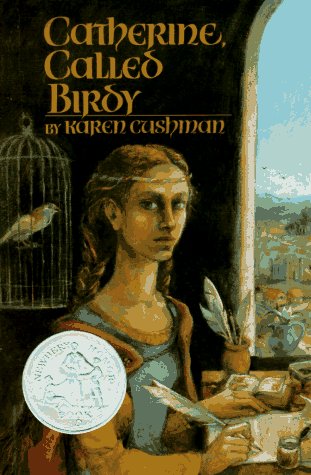
Catherine, Called Birdy, by Karen Cushman
Written in diary format, this is the chronicle of a year or so in the life of a 13-year-old girl living in England in the year 1290. She is the head-strong daughter of a minor knight, assigned by her monk brother the task of writing about her days. She writes of her frustrations at the life she is destined to live, married off to the highest bidder, sewing sheets, making soap, having children... She also writes of the life of the villagers she knows, including Perkin the goat boy, Meg the milkmaid, Gerd the baker's son, and so on. She sees their lives as delightful and free compared to her own - they are allowed some say in who they marry, and can come and go as they please (vs her own relative captivity in the manor). She laments that if she must be born a lady, why not a rich one who wouldn't have to hem shirts and sew sheets and embroider for the church? She is restless and clever, and easy to identify with if you're at all familiar with what it feels like to be 13 in any era.
The book is enjoyable enough that you hardly notice when the author slips in informative things like herbal remedies of the time, how a 30-year-old woman was considered fairly old, what it meant to go to a medieval fair, social structure, and the difficulties of travel at the time. It makes it easy to imagine medieval life, and to see how being 13 in 1290 might not have been as different from being 13 today as you might have thought. Would be a good companion to Good Masters! Sweet Ladies!.
Monday, March 29, 2010
Crispin: The Cross of Lead, by Avi

This is the story of a 13-year-old peasant boy who never knew his name. When his mother dies, though, his priest hints that there is more to the story of the boy's life than he ever knew, and that he does have a name: Crispin. Crispin, now an orphan, must leave the only village he's ever known, as he has been accused of a crime he didn't commit, and declared a "wolf's head", meaning he is no longer considered human and can be killed on sight for a sizable reward. Lonely, confused, and destitute, he leaves town... and encounters a traveling juggler called Bear, who takes Crispin on and helps him discover that besides having a name, he also has a soul. Set in medieval England, the story has undertones of discontent with feudal life, the idea of freedom - both from harsh rulers and from one's past, and generally being one's own person.
It's a good read - quickly engaging the reader, and hard to put down! The reader is left wanting to examine their inner self, and decide if they're living the life they want to live, or merely accepting the "lot in life" they've been dealt. That said, I was a little disappointed by this book when compared to what I remember of another of Avi's books, Newbery Honor The True Confessions of Charlotte Doyle. To be fair, I read Charlotte Doyle when I was more in line with target audience, and as Crispin hardly knows himself, it's unsurprising that the reader doesn't get to know him very well. But even so, I felt that there was plenty of room for more depth of character in both Crispin and Bear. There are in fact two sequels: Crispin: At the Edge of the World (2006), and Crispin: The End of Time (available June 2010), and it's probable that we will get to know both of them better with these books. I'd happily read the sequel(s), but don't find myself wanting to go out of my way to acquire them.
I give Crispin: The Cross of Lead an 8 on its own.
Wednesday, March 24, 2010
Cedric the Forester, by Bernard Marshall
Our narrator first encounters Cedric in the woods when he is attacked in the woods by a member of a rival family. Cedric quickly eliminates the problem by putting an arrow squarely through the opponent's forehead. Although the book doesn't linger on gore, it certainly doesn't gloss over the action, either! Dickon brings Cedric back to his home and introduces him to his father, who recognizes Cedric as not only formidable with a crossbow, but also a fellow of good character despite his lack of education. The Mountjoy family welcomes him into their home as Dickon's squire and promises to help him hone his skills.
For a while I had trouble figuring out the story arc of the book- after Dickon and Cedric meet, the plot seems to be a series of more or less disconnected incidents spread out over time. However, at the end of the book it becomes clear that these skirmishes and personal conflicts further build Cedric's resolve and character. He and Dickon have both been knighted for their skill and loyalty by the end of the book, and Cedric is instrumental for forcing through some of the pivotal language in the Magna Carta which guarantees basic civil liberties for free citizens of England.
It's hard for me to give this one a score. It's definitely a boy book. But those boys who are interested in battle and Robin Hood-ish stories will love this one. So for those kinds of kids, it's a great fit!
Incidentally, this book is among the hardest of the Newberries to acquire- it's rare, was never reprinted, and very few libraries have it in their circulating collections. Being a librarian has its advantages- I scanned all of the pages of the copy I was able to borrow and am in the process of digitizing it for access at Project Gutenberg's site (a collection of public domain documents and books). Look for it reasonably soon!
Sunday, March 14, 2010
The Trumpeter of Krakow, by Eric P. Kelly

The story takes place in 1461-1462, in Krakow, Poland. The main character is Joseph, a boy of about 15, whose family leaves their home in the Ukraine after a Tartar raid on their house. The raid turns out to have been because of a treasure that Joseph's family has guarded for generations; in the event that its hiding place was discovered, the family had sworn an oath to surrender it only to the king of Poland. So to Krakow they go; on the way they are confronted by a Tartar-Cossack named Peter of the Button Face who has guessed about their treasure. They make it safely, though, and there they meet a well-respected priest, a kindly alchemist, and his neice, Elzbeitka, who is just about Joseph's age, thus rounding out the cast of main characters. Joseph's father finds work as a tower watchman, and the story takes place around his hourly playing of a certain hymn, called the Heynal (or in Polish, Hejnał) from the guard tower.
I really enjoyed this book. It felt a little like King Arthur - a story involving magic, kings, treasure, good and evil. You don't get very close to any of the characters, but it felt like you weren't supposed to, the way it was told, and I didn't mind. There's a lot of alchemy talk, and hypnotism was clearly an interesting topic to the author (more than to this reader!), but it doesn't matter if you skim those parts, and if you've read Harry Potter the alchemy bits won't bother much.
The Heynal is real, and is a story of its own, which you can read about here (click here to hear it). Also worth noting is that the author clearly loved the city; Krakow has largely been off my radar, but I finished the book wanting to know what of the ancient city is still there, and considering it for the first time as a destination someday.
Today's kids might find the writing style somewhat dated, but the story is still solid - I give it an 8 for readability and overall enjoyment!
Labels:
1929,
medieval,
mythology and folk tales,
winner,
world
Tuesday, March 2, 2010
Good Masters! Sweet Ladies! Voices from a Medieval Village by Laura Amy Schlitz

I remember hearing about this book on public radio soon after it received the Newbery Award, and thought it sounded like a unique and fun idea for a book. I never got around to finding a copy, though, but when I visited my library's Newbery Award section for this project I found several copies proudly displayed on the top shelf. And with good reason; it's a beautiful book!
The book is designed to be a class project of sorts; there are twenty-three short essays or poems meant to be read/recited/performed, each from the point of view of a child in a medieval village. The collective performance, then, will give the audience a little view of the life of the falconer's son, the miller's son, the "half-wit" boy, the lord's daughter, and so on. Religion and class differences are explored, and you leave with the realization that while the details of life have changed a lot, there are also a lot of ways in which nothing has changed at all.
As a kid, I would have liked that you saw village life from the children's point of view. I would also have enjoyed the sidebars explaining parts of medieval culture that wouldn't be familiar to a modern child. They were frequent enough to help with context, but the text was not so full of asterisks that it became distracting. I would have loved it if my class had taken on the performance of this book as a project! I also think that two kids with time and inclination could have a good time with it, reading back and forth (or occasionally together - there are a couple of duet pieces). You could also read it with one or both of your parents. The entries are written in varying styles of poetry and occasionally prose, which was fun for me to read as an adult, and would make a good teaching point in a classroom setting. My only real issue with this book, in the end, is that it's not very friendly to the silent reader, a bit like reading a play on your own. It would be easy to be drawn to it, with its gorgeous format and interesting subject matter, and then find that it's not really meant for you to read to yourself.
I can definitely see the appeal of the book as a class activity, and why teachers would want to use it. My biggest regret, reading this now, is that it wasn't available for my own 5th grade class in 1990! I give it a 10 for a class or team project idea, and a 7 for reading alone.
Subscribe to:
Posts (Atom)