Showing posts with label animals. Show all posts

Thursday, August 5, 2021

Chúcaro: Wild Pony of the Pampa, by Francis Kalnay


 This book is at an excellent reading level for a beginning chapter book reader. It's short, with short chapters, and illustrated.


That said, I found this book difficult to get through. It sat around my house for so long that the owning library has threatened to bill me for it. It simply wasn't telling the story that was begging to be told, in my opinion, and nearly every other chapter was incidental to the plot.  

I can summarize the entire plot for you (something I prefer not to do thoroughly, but I think I'm doing you a favor here).


Young Pedro lives on the plains of Argentina, an area populated by various sharecropping families. One day he catches sight of the most beautiful wild pony he has ever seen, and Juan (an adopted father to the boy) catches it for him tames it, and teaches Pedro to ride it.

One day the patrón sends word that he wants a good pony for his shiftless son upon their return, and the mayordomo has his eyes on Chúcaro (who was, after all, caught on the patrón's property). The sharecroppers figure out a solution: They will let the horse decide. If the patrón's son cannot lasso Chúcaro, he will remain with Pedro.

Of course, he can't, and is made a fool of. In a fit of anger he throws a set of bolas (think three bocce balls attached by a leather strap) at the pony's face, knocking it to the ground. When the boy approaches later, the pony gives him a good hard kick to the stomach. The boy accuses Juan of having ordered the pony to kick him, and when Juan defends himself, the patrón fires him for calling his son a liar and evicts him from the property.

Juan and Pedro ride off into the sunset forever to explore what other opportunities await elsewhere.

This is the story that took 127 pages to tell. You're welcome.

Monday, July 26, 2021

The Horsecatcher, by Mari Sandoz


I always do a little research on the authors before writing up these blog entries, and Mari Sandoz sounds like someone I'd love to read an engaging biography of! The daughter of a pioneer, she was raised in Nebraska, and from her brief Wikipedia entry, would have had amazing stories to tell. Although not of Native American descent, she apparently admired the cultures of the plains Indians, and they feature in many of her books, including this one.

Young Elk is a young Cheyenne who is drawn to the capture and care of horses, despite the fact that it is often to his detriment. Although his village's elderly horse catcher has earned respect for his role, there is much less place for a young man who hasn't earned prestige through battle. But despite the pressure put on him by society and family, he often slips off to track and gentle horses- both wild and belonging to enemy tribes.


I enjoyed the story quite a bit, but what I enjoyed more was the author's gentle way of teaching us aspects of Cheyenne (and cross-tribal) culture without being heavy-handed. She clearly studied familiar and cultural interactions very carefully, and it helps put the reader into the story.

Wednesday, June 23, 2021

Along Came a Dog, by Meindert DeJong


I should have enjoyed this book more, probably, but it described farm life in such a blunt way that I found it incredibly off-putting and it was difficult for me.

"The man" works for a farmer but has a flock of chickens that he cares for. As winter is ending, he discovers that his little red hen HAS FROZEN ALL OF HER TOES and they literally drop off as she tries to walk. The book contains other upsetting descriptions of the chicken trying to hobble along on her little ankle nubbins and care for herself among a flock that immediately demotes her to the bottom of the pecking order.

But the real protagonist of this story is a stray dog, who wanders into the barnyard hoping to find a home there, since he can sense that The man is good and kind to animals. He sets himself up as the secret guardian of the little red hen and spends the book defending her (and by extension, all the flock) and hoping he will eventually be welcomed into the farm family, although the man does catch him twice and abandon him far away.

It's just an animal story for a different time that didn't speak to me in the way it was meant to.

Friday, October 6, 2017

Hurry Home, Candy, by Meindert DeJong

Yes, you read the cover right.  Illustrated by Maurice Sendak!  However, most of the pictures in the book are similar in style and quality to what you see here (that is, mostly lacking the charm and detail I recall from his picture books).

This book covers the journey of a dog who was adopted by two siblings as a puppy, but was then lost in a storm on a road trip.  He then spends the next few years skirting the fringes of where his home had been, scrounging for food, almost finding home but not quite.

I didn't find this exceptional as a stray-dog sort of book, but those who love dogs will enjoy it.

Wednesday, August 30, 2017

The Inquisitor's Tale, or, the Three Magical Children and Their Holy Dog, by Adam Gidwitz

Ok, it is really time for me to get on the ball and read the 2017 winner, because I can not FATHOM why this is not it.  I have not enjoyed a children's book this much in a very long time.  If we had a *favorite* favorite tag, I'd be applying it right now.

The author spent six years researching and writing this book, part of which was spent in Europe with his Medieval-scholar-wife, researching history and poking around in ruins.  Although the story is completely fictional, the characters are all based on actual historical figures (Joan of Arc, Guillaume d'Orange, Guinefort, and many religious and political figures).

I really hesitate to even try to summarize this book because it was published to so much acclaim that I could scarcely begin to do it justice.  Set in 1200's France, it follows the journeys of three very special children (and one holy dog) who discover that they have special gifts which, unfortunately, make them targets of the Church.  They meet quite randomly and form a close bond as they seek sanctuary and safety.

Beyond the fantastic story, the book addresses (and not in a heavy-handed way) gender roles and classes, as well as religious conflict and race relations (all anchored in this time period).  This book is so crazily well-rounded and engaging that I finished it in about 24 hours.  Go read it.

Tuesday, April 25, 2017

The Bears on Hemlock Mountain, by Alice Dalgliesh

I've had to break my own rule here.  Generally I try to include the cover images that matches the copy of the book I read, whether or not it's a first edition.  This time around, the library's copy of the book has a one-of-a-kind cover hand-drawn years ago by an 11-year-old back in the 1990's.  Her name was on the back.  I wrote her; she's in her 30's with a child now.  She was amazed that this is still in a library somewhere :-)

We've encountered our good friend Alice Dalgliesh twice before.  However, unlike the other youth novels we've covered in the blog, this is intended for much younger readers.  Although it's divided into chapters, this is definitely a one-sitting read.

Jonathan lives by the foot of a mid-sized hill, named (not especially accurately) Hemlock Mountain.  His family is planning to host a christening, but because they have such a large extended family they will need to borrow aunt Emma's giant soup tureen.  Because the adults are busy with preparations, Jonathan is sent over the hill to bring it back.  Although no bear has been seen there in recent memory, Jonathan is still concerned about heading out alone (he's never been before).  Not especially reassured by his parents' insistence that there are no bears on Hemlock Mountain, he heads out and reaches his destination safely.

Stomach full from aunt Emma's cookies, Jonathan naps in her chair and forgets that he was charged with returning with the soup tureen before dark.  He wakes up just in time to lug it back up the hill.  But as dusk falls, Jonathan sees two sets of eyes attached to two dark, hulking bodies, moving through the trees. . . what to do?

This book would make a fantastic read-aloud for younger children.  I may read it to mine before it goes back to the library!

Tuesday, April 11, 2017

Shiloh, by Phyllis Reynolds Naylor

Let's talk about Shiloh. I remember seeing it around in many classrooms, but never actually read it until recently. It was never required, and I knew it was about a dog, and I didn't think I liked dogs (little did I know...). I should have picked it up - although, I suspect I would have missed a TON of the point of this book if I'd read it at 12. 

This was a quick read for an adult, I easily finished it in an afternoon. The story isn't complicated - kid wants a dog, his parents say no, kid finds a dog, and tries to keep it himself without his parents knowing. Things go south. 

But in the end, there's a lot of discussion about feelings that I think most kids - and let's be honest, adults too - are familiar with. Guilt. Having a bad secret. Unreliability of people around you. How you feel when your bad choice has horrible consequences. And, that things can work out after all once you own up to your mistakes and start picking up the pieces. 

Confession: I read this almost two years ago, intending to blog about it right away...and here I am. I still think about it often, though, which I think says an awful lot.

Saturday, December 3, 2016

The Defender, by Nicholas Kalashnikoff

This book is the story of Turgen, a man who lived alone high in the hills of Siberia.  He was of a different tribe than his nearest neighbors, who for superstitious reasons believed him to be in league with Satan, and therefore largely avoided him.

One winter, this solitary man noticed that the noble rams in the mountains were suffering from hunger and looking weak and thin.  Turgen decided to carry some hay up the mountain on a sled and leave it for them.  Over time the rams grew to accept his presence (although they did not completely trust him), and Turgen was delighted to see the herd slowly grow healthy and produce strong offspring.

In the wake of Turgen's gifts to the rams, he has a dream in which his deceased wife and son visit him, and lead him into the presence of the Great Spirit.  The Great Spirit tells Turgen that He is pleased with his care of the rams, which gives him confidence and joy in continuing this task.

During these months, Turgen is also slowly building a relationship with Marfa, a poor widow who lives down the hill, and her two children, Timofey and Aksa.  Marfa creates a comforting and cozy place for Turgen to rest and visit, and Turgen enjoys the companionship of the mother and the children alike, and helps provide the family with much-needed food in exchange for milk from their cow.

This is such an easy-to-read, gentle story that I enjoyed quite a bit.  The author was actually exiled to Siberia for several years before emigrating to the United States and becoming a citizen, so he speaks of the people there with kindness and affection.

Thursday, November 17, 2016

Minn of the Mississippi, by Holling Clancy Holling

Holling Clancy Holling continues his penchant for natural history epics for children.  In this volume, we learn about the landscape and history of the Mississippi River through the eyes of Minn, a three-legged snapping turtle.

We first observe her as the last hatchling to leave her nest, losing a leg to a stray bullet from a teenage hunter (later fined and relieved of his firearm for making use of it on Federal land).  Over time she not only travels downriver, but encounters other wildlife, hibernates on the river bottom over the winter, matures into a large adult, and lays eggs of her own.

The volume is the size of a large picture book (only thicker).  The story is punctuated by full-page color illustrations of Minn and the landscape, and the margins around the text are full of pencil drawings demonstrating cell growth and comparative biology, maps and diagrams, and specifics of other species and technology encountered in the story.

This book is an amazing work of art and knowledge.  That said, I had trouble summoning the patience to read it in its entirety.  I honestly wasn't that attached to Minn that much (the story is so matter-of-fact that it's difficult to summon up emotions for her experiences), and at 86 pages, the story feels very long.  I would have found it easier to cover the same material as a non-fiction work with more chapters.  I'm sure there are plenty of children who would appreciate this volume; I just wouldn't have been one.

Monday, February 2, 2015

Kildee House, by Rutherford Montgomery

Jerome Kildee, an introverted stonemason, decides to retire to the redwood forest of northern California.  He has enough to live alone simply, and builds himself a cabin with a large redwood tree as its back wall.  But he quickly learns that even in the forest, a hike from his nearest neighbor, he'll never be left completely alone.  Raccoons quickly make their presence known in the house, skunks under it, and mice in the walls.  Over time he befriends the raccoons and the skunks, feeding them at mealtimes and arranging his living space to keep them from getting into everything he owns.

One day his downhill neighbor, Emma Lou Eppys, drops in to become acquainted.  She originally has somewhat ulterior motives (Donald Cabot, another neighbor, has been running his dog after animals on the hill and she's seeking allies to keep him further afield).  But she is instantly charmed by the shy, quiet Jerome and his brood of curious, friendly animals.  And Jerome is likewise charmed by this tall, red-headed, forthright girl.

Over the course of the year, Jerome weathers all four seasons in his little cabin with his animals and Emma Lou as an occasional visitor.  Donald eventually finds his way to the cabin as well, intrigued by the stories he's heard of the animals (especially the skunks, whom Emma Lou has taught tricks).  Jerome would like for them both to get along, especially since he'll need everyone's brain to help him come up with a solution to his growing problem.  All of his animal babies have struck out. . . and returned with babies of their own.  He'll soon be overrun, and stressed skunks mixed with volatile raccoons in your house are a risky proposition.  If Jerome can get his two human friends in his house at the same time, hopefully he can get peace in all areas of his life!

A really fun and pleasant story!  Often times I lose interest in descriptions of the personalities of wildlife, but this book didn't have that effect on me at all.  I also really enjoyed the charming illustrations by Barbara Cooney.

Saturday, January 24, 2015

The Blue Cat of Castle Town, by Catherine Cate Coblentz

An interesting modern folk tale based on actual historical events and people in a small Vermont town in the mid-1800's.  Zeruah Guernsey, resident of Castleton, embroidered a carpet so noteworthy that it was added to the collection of the Metropolitan Museum of Art in New York City.  The book's author has created a story to explain the origin of the blue cat that it features at the bottom.

A blue cat born during a blue moon has a destiny, as all such cats do, to learn the river's song and teach it to the people who need to hear it.  In this case, the blue cat must go to Castleton so the beauty, peace and content[ment] that the song can bring will drive back an evil enchantment that is spreading through the town through greed and haste.

Wikipedia has a pretty thorough summary of the book so I won't invent the wheel by doing it again here.  The book in its entirety is also available in the public domain for those who are curious.  At 123 pages, it isn't exceptionally long.  The author certainly did her research into primary sources to add important townspeople to the narrative.  Although from some quick research I've done, I am sorry that the book was so unfair to Mr. Arunah Hyde- he's feared and reviled in the book as a man who values profit over everything and produces shoddy products in his haste.  Accounts I've found of him seem to indicate that he was very invested in the town's prosperity and gave generously of both his time and his money and resources to promote its progress.  Sorry, Arunah!  I hope that somewhere there is another contemporary account that recalls you favorably.


Thursday, January 1, 2015

The Cricket in Times Square, by George Selden


I was always a huge fan of this story.  It was assigned to my class when I was roughly in the 2nd grade and for being more than 20 years old, I still stood up then and probably does today just as well.  I asked a well-read friend for suggestions on what to read next from the list (going forward from start to finish was starting to feel a bit punishing) and this was her suggestion.  Hooray!  At some point I know I read a few of the sequels as well, but they're not remotely memorable to me.  This was the good one.

Chester the cricket has lived a happy life in the meadows of Connecticut.  He loves his home in an old tree stump.  He knows the local animals and the landscape- even the signs that mark the changing seasons.  But he's about to get a taste of another life.

One lovely warm day, his field is descended upon by picnickers.  Unable to resist the aroma of the leftovers, Chester jumps into a basket and helps himself.  But during his post-meal nap, he's buried under leftover sandwiches and carried away on a subway train back to New York City.

Lost and alone, Chester makes a few tentative chirps and is discovered by Mario, a young boy working the late shift in his family's newspaper kiosk.  His mother has reservations, but his father gives him permission to keep Chester, provided he stays in the newspaper stand and doesn't come home.  At night, two of the station's residents come calling to introduce themselves: Tucker the mouse and Harry the cat.  Long-time friends, they quickly adopt Chester into their group and teach him about life in the station.

During their late-night visits to the station, Tucker and Harry quickly learn that Chester has an amazing ear for music.  They teach him a number of popular songs from the radio, as well as classical pieces.  As Chester begins to play these for Mario and his family in the daytime, an astonished crowd begins to gather.  Over time, Chester becomes quite the attraction and the Bellini family's small newspaper stand finally begins to turn a nice profit!  But Chester is shy.  He doesn't like being poked at and stared at.  And as the air cools he misses his meadow and the changes Autumn brings.  It's time for Chester to decide to unhappily remain where life has landed him, or to choose his own path home.

For those of you familiar with the titles of the sequels, the end result is no mystery!

Sunday, November 2, 2014

Mrs. Frisby and the Rats of NIMH

I think there are very few people in my generation who haven't read this book or seen the film.  I thought the film was great as a kid, but now as an adult I wish it had seemed less magic-y and more science-fictiony, if that makes sense!

Our title character, Mrs. Frisby, is a widowed mouse who lives in a farmer's fields with her children during the winter.  Her youngest son, Timothy, had fallen gravely ill, so she seeks out the help of Mr. Ages.  Mr. Ages is an old white mouse who is very smart and has a vast store of medicines he develops from local plants.  As promised, with the help of Mr. Ages's medicine, Timothy recovers.  But he is still very weak.  And the spring thaw has begun early- Mrs. Frisby may not be able to keep him warm enough in their Summer home to prevent a severe relapse.  But if they remain in their winter home, they will all die when the plow comes.

Jeremy, a crow who Mrs. Frisby has befriended, offers to fly her to the home of the owl.  As the oldest owl in the forest, he has been known to help animals with difficult problems.  Although he doesn't seem to have much advice for Mrs. Frisby, upon hearing her name he suddenly becomes more helpful.  He tells her to seek out the rats who live in the rosebush by the farmhouse, and gives her the names of two of the rats to look for.  Mrs. Frisby is told that they should move her house to the lee of the rock, where the plow will miss it.

Mrs. Frisby is uncertain why the rats would be willing to help her, or how they would be able to do so, but she learns that her deceased husband had had some sort of dealings with them.  When she is finally admitted to their lair, the *real* story begins.

The rats, especially their leader, Nicodemus, share with her the story of how they came to exist as a community.  Formerly scavengers in a city, they were captured and sold to NIMH (National Institute of Mental Health) as test subjects.  Those in Nicodemus's group received a number of injections which heightened their intelligence, and greatly increased their physical strength and lifespan.  Over time they grow in knowledge (which their keepers vastly underestimate) which they then use to escape and form their present advanced community.  However, they still live very much like wild rats, stealing things to build and maintain their home.  So the rats have planned a move of their own, to relocated to an isolated place, grow their own food, and live completely independently of humans and other creatures.  As far as I'm concerned, this story is by far the most interesting part of the book.

Suffice it to say that everyone gets their wish and lives happily ever after.  The book is set up perfectly for a sequel, which the author unfortunately did not have time to write.


Friday, September 12, 2014

Seabird, by Holling Clancy Holling

Seabird begins by introducing us to Ezra, a fourteen-year-old Ship's Boy on his first sailing trip from New Bedford.  While scouting through dense fog, he sees a white bird in the mist.  Its unique flight pattern alerts him to the presence of an iceberg in the waters ahead, and he's able to warn the crew in time to save the ship.

Not long afterward, the crew encounters an Arctic native who trades in skins and furs.  Ezra trades with him for two walrus tusks, and sets about carving a replica of the bird that saved the ship.  He adds a few gems as features, and the seabird becomes a good luck token of sorts.  From that moment onward, it is Ezra's constant companion as he rises through the ranks and eventually becomes the captain of his own ship.

Seabird is next passed on to Ezra's son, and then in turn his grandson, each becoming the engineer and captain of a progressively more modern mode of transportation as his father's vessel becomes obsolete.

The book does a great job making you familiar with Ezra as he grows and learns, although less time is spent on his son and grandson.  Each chapter is short, just one page, with a full-page color illustration facing it.  What I especially liked was that in the margins of the text page, anything that would need a more detailed or technical sketch is illustrated in black-and-white.  For example, how Seabird was assembled, the different features of a whaling boat, or the formation of a tropical island.  I really enjoyed this slim volume from the author of Paddle-To-the-Sea.

Monday, September 8, 2014

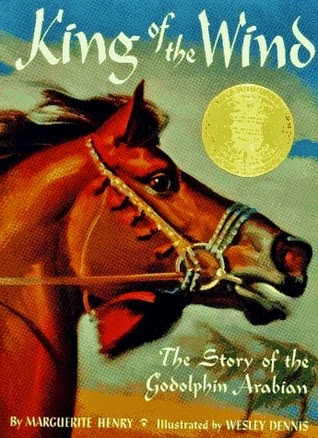
King of the Wind, by Marguerite Henry

ALRIGHT already.  I'm on my third Marguerite Henry book for this blog and I'm eating a hearty portion of crow for having disliked her books and refusing to read them in grade school.  The only reason I can think of is that when they were recommended to me, I didn't feel like they were really being recommended based on what the teacher knew of me and what I liked.  Rather, it was more of a "You're a girl, girls like horses, here you go" sort of reasoning.  Except I never really had a horse thing.  But I would have still liked the books.

The story of the horse in question begins in Morocco.  A mute boy named Agba, who works tending horses in the Sultan's stables, is present when his favorite mare gives birth to a new foal.   The golden coat of the foal inspires Agba to name him Sham, the Arabic word for "sun".  Sham's mother does not survive for long after his birth, and it is assumed that Sham will soon follow.  No one is especially concerned about this since he's small and has a pattern of hair on his chest that signifies bad luck.  But as Agba notices, he also has a marking that signifies swiftness.  Agba hopes that the good marking will overpower the bad, and is able to nourish the horse to health with camel's milk.

Sham grew until he was the swiftest horse in the Sultan's stables.  Agba is constantly caring for him, a substitute for the mother he lost.  One day, Agba and five other stable boys are bathed and prepared to meet the Sultan.  The Sultan wants the six best stallions from his stables, one of each color, to be selected.  Each boy will be responsible for one horse, and the entire party will be sent by boat to Versailles as a gift to Louis XV, the boy king of France.  Each horse bears a document describing its pedigree stretching back to the horses of Mohammed himself, as well as stones and amulets intended to ward off sickness and injury.  The boys are to remain with the horses and care for them as long as the horse lives before returning to Morocco.  The Sultan is hoping that such a lavish gift will make the kind look favorably upon him.

What the Sultan does not know is that the ship's captain kept the money intended for rich foods for his passengers and stocked hay for the voyage instead.  When they finally arrive at Versailles, horses and boys alike are emaciated and in poor condition.  The king and his officials laugh at such a gift, and sends them away from the stables to be sold for other purposes.  Here begins Sham's journey through multiple owners and households, some kind, others abusive.  Agba refuses to leave the horse, and is the only person Sham will gladly cooperate with.  Sham eventually does find his way to a kind owner who discovers his true potential (and that of his offspring).

So, without giving all of the details away, another great horse book.

Wednesday, August 27, 2014

Daughter of the Mountains, by Louise Rankin

The book begins with a brief foreword which describes the history of India and its role as a trade center.  The cover description doesn't mention the nationality of our protagonist, so imagine my surprise (and the required shifting of gears) to find myself in a book set in Tibet!

Momo lives in a small village with her father, who carries the mail across dangerous mountain passes, and her mother, who runs a tea house for the various traders and muleteers who pass through en route to bazaars and trade centers farther away.  Momo has seen dogs before, but when her eyes fall upon the lama's dog, a golden Lhasa terrier, she is smitten.  She can think of nothing but the dog, and wants nothing but to own one exactly like it.  But such dogs are nearly nonexistent in her part of the country, and much more expensive than her family could ever afford.

However, Momo is not easily redirected.  She directs all of her energy toward praying to receive a dog just like the lama's.  When she begs her parents for one, her father tells her that her uncle will bring her one when he comes from Lhasa.  As years pass, however, that refrain grows tiresome and Momo is understandably skeptical.  She decides to put more energy into prayers, leaving her most precious possession at Buddha's temple and determining to wear out his ears until he gives in.

Not long afterward, a familiar mule train stops at Momo's home for tea.  When updating the leader on what Momo has been up to in the last year, he pulls a red-gold Lhasa terrier puppy from his coat and presents it to her!  He was en route to sell it in the big city, but its mother died and he is now unable to care for it properly on the road.  Although this would usually be a very expensive dog, the muleteer strikes a bargain with Momo.  If she will care for it like a child and feed and train it well, and permit him to breed it for puppies when it is grown, Momo can keep the dog.

Because this was such an exceptional answer to prayer, the astrologist is immediately summoned to help name the dog and draw up its horoscope.  The dog is given the name Pempa, and Momo is told that the two of them will have a great adventure together, and that he will bring good fortune to the family.

In time, Pempa grows up fat and strong, and loves Momo, always answering her calls enthusiastically.  However, a simple quiet life isn't meant for the two.  One day, a team of muleteers steals the dog when Momo and her mother are distracted with duties in the tea house.  Momo doesn't realize that Pempa has been stolen until she goes outside to search for him and a local boy tells her how he saw the men carry him away with his legs bound and wool in his mouth to quiet him.

Pemma is horrified and doesn't plan to let her dog go so easily.  She runs in to tell her mother that Pempa has been stolen and she's going after him.  Her mother, busy caring for a sick child, nods absentmindedly, not having really heard.  Pemma's journey is set to be a long one- she learns that the leader of the mule train has been offered a large sum by a rich woman in India to deliver such a dog.  But Momo plans to catch up to them long before they reach Calcutta.

I don't plan to share the rest of the plot here lest I spoil it.  But suffice it to say that the author does a great job describing the people Momo meets and the villages she passes through on her way down the mountains.  And yes, she does get her dog back, and Pempa's horoscope does indeed come true!

Friday, July 4, 2014

Misty of Chincoteague, by Marguerite Henry

Oh, Marguerite Henry, I have been twice proven wrong.  What on earth did I have against you and your horse books when I was little?  These are really solid, fun, appealing books.  I stand corrected.

Based on a true story, this book follows Paul and Maureen, two siblings who live on Assateague Island off the coast of Virginia.  Wild horses live on neighboring (and unsettled) Chincoteague Island, and every year the people on Assateague Island have an event where the men round up as many horses as they can and swim them across, so they can be penned and sold (the proceeds benefiting the fire department).  The most desired horse is the Phantom, a mare who is so fast and unruly that she has never been caught.  Because this is such a tradition, the townspeople also have events and raffles and a big community dinner.  This year will be Paul's first assisting with the roundup, and he is sure that he will be able to catch Phantom.  Not only that, but he and Maureen would like to own her.  They spend the summer digging clams and performing odd jobs for the neighbors, until they've collected a full $100.

On the day of the roundup, Paul finds himself left behind on Chincoteague Island while the more experienced riders race ahead without him.  Alone in the trees, he comes across Phantom who, to his astonishment, is with a colt and allows him to round them up.  During the swim, the colt begins to sink because he is too young to swim the distance alone, but Paul jumps from the boat and swims with him, holding his head out of the water.  Paul and Maureen realize that they will have to buy both Phantom and the colt, who Paul names Misty.  They plan to get to the pony sale the first day to ask the fire chief to reserve the two horses for them, leaving their $100 as a deposit and planning to earn the remainder through the rest of the Summer.

Due to circumstances outside their control, Paul and Maureen are unable to reach the sale in time and they find that Misty has already been sold.  Fortunately, a turn of events works out in their favor and she eventually does become theirs.  The remainder of the book concerns their raising her and teaching her to love her new home.

Misty eventually became the author's own horse, and lived with her in Illinois.  Although many of the events in the novel are stretched or outright fictionalized, it paints a picture of the region and the origin of the horses that bear the island's name.

Friday, February 14, 2014

Justin Morgan Had a Horse, by Marguerite Henry

You'd think by now I'd have learned not to judge a book by its cover.  I went through a stage in 2nd-3rd grade where I really tried (I really tried, people!) to like the Marguerite Henry horse books because everyone liked them and they'd won awards and HORSES!  Who doesn't like horses?  I liked horses!  But I didn't like the books, for whatever reason.  So when this book came up next on my list I'll admit I was transported back into childhood with a sense of dread.  Completely misplaced dread.  This book was pretty awesome!  I'm so sorry for having doubted you.

Although Justin Morgan was the owner of the "first" Morgan horse, he isn't our book's protagonist.  The book actually follows Joel Goss, a student of Morgan's, who is present when Li'l Bub, the horse in question, is given to Morgan as partial payment on a debt owed.  Although Li'l Bub is small and shows none of the signs that he'll ever be remotely useful, Joel takes to him immediately.  Justin Morgan sees that Joel is smitten, and as he has neither time nor inclination to deal with the horse himself around his teaching schedule, he asks Joel to gentle the horse for him.  Joel is apprenticed to the miller around this time and must attend school in the evenings, but after school lets out he has a few scarce hours of Vermont daylight remaining to work with Li'l Bub.

After Li'l Bub has been successfully gentled, much to Joel's dismay, he is rented out to a man to help him clear land.  Li'l Bub soon proves himself as an able puller, and eventually gains a widespread reputation for both pulling and racing, even beating out two purebreds who had traveled from New York just to beat him.  With this reputation firmly in hand (hoof?), Justin Morgan eventually sells Li'l Bub so that he is able to pay his outstanding debts and buy needed supplies (including a harpsichord) for his schoolhouse.  The remainder of the story follows Joel through his apprenticeship into adulthood, trying to locate his beloved horse so that he can eventually purchase him for his own.  Over the years the horse changes hands many times (and upon Morgan's death, his name as well) until he and Joel are eventually reunited.

A very well-told story!

Wednesday, June 5, 2013

Mountain Born, by Elizabeth Yates

The image shown to left is the one that was on my version of the book, but, since mine lacked a jacket, it was a somewhat disturbing mustard yellow-on-sky blue.  This one is much nicer!

As a young boy living in the mountains of an undisclosed country, Peter is given a small lamb from his parents' flock as a pet.  "Biddy," as his black ewe is later known, was stillborn but nursed back to life by Peter's mother.  The remainder of the book follows Peter (and, by extension, Biddy) through the remainder of Biddy's lifespan: the cycles of grazing and shearing, wandering the mountains and protecting the flock from harm.

It was a charming enough book, but not especially exceptional.  I also found it confusing at times- all adults are referred to by their first names, and there are several men around whose functions are not explicitly stated, so I often forgot which one was Peter's father.  Where did these men live?  Perhaps this information was implied but I was feeling too thick to understand it.  Also, I completely winced at the description of tail docking, using fire-heated tongs.  I know, I know, in some cases there are good reasons for it, but how awful.

Thursday, May 9, 2013

Rascal: A Memoir of a Better Era, by Sterling North

In Rascal, Sterling North tells the story of one year in his childhood.  In 1918, Sterling lives alone with his father, a widower.  His two older sisters are living their own lives elsewhere, and his older brother is overseas fighting in the war.  But apart from this, the war seems to have very little impact on his childhood.

Sterling and his father, both avid outdoorsmen, live an ideal bachelor's life.  Sterling is in the process of assembling a canoe their home's living room.  The two men cook to suit themselves.  And when his father, an attorney, is not working, the two often take extended wilderness trips.  Sterling also has a number of animals as pets, including a Saint Bernard and a tamed crow.  But what makes this year special is the addition of a raccoon kitten, named Rascal, to his herd.

Captured as a very young kit, Rascal relies on Sterling for his care in every regard.  And in return, Sterling is rewarded by seeing how Rascal develops and learns. The two are inseparable, and Rascal even shares Sterling's bed and food.  But over the course of the Summer, Rascal develops into more and more of a raccoon as well, stealing shiny objects (sometimes valuable ones) and raiding corn from the gardens of irate neighbors.  Eventually, in order to keep Rascal, Sterling is required to leash him when out, and cage him the rest of the time.

Rascal isn't the only one who is developing.  Sterling is becoming more a part of his community, learning, and growing himself.  An avid reader, he also has a talent for writing.  In the Spring, about a year after Rascal became his companion, Sterling has grown enough to understand that Rascal needs to live his own life as an independent creature, and returns him to the wild to seek his own fortune.  And encouraged by dear family, he knows that one day he'll record all of his memories of that year so others will experience them, too.

Great coming-of-age book.  Growing up "in the woods" myself, I'm surprised that his book wasn't in the curriculum.