Showing posts with label island. Show all posts

Tuesday, April 25, 2017

Red Sails to Capri, by Ann Weil

So I noticed that this one had a logo on the back cover indicating that it was published by Sonlight Curriculum, which, I discovered upon further research, is a Christian homeschooling publishing company.  I'm curious as to how this was selected and why (it doesn't have religious overtones of any kind), but I can't object to the content, either.  They have this one indicated for second grade.

Fourteen-year-old Michele lives on the island of Capri with his parents.  They tend a small inn together but can barely make ends meet.  At the beginning of the book, a boat with beautiful red sails, unlike any seen before, approaches the island and three foreigners depart.  Because it is the off season, Michele's family would be beyond thrilled to host them.  Michele's fisherman friend, Angelo, agrees to intercept the visitors and make sure they don't go to the competitor, while Michele races home to warn his parents so they can prepare the vacant hotel.

When the guests arrive, the Pagano family learns that they are foreigners from three different countries, each pursuing a different passion.  Lord Derby, from England, has come to seek beauty and to paint.  Herre Erik Nordstrom, from Denmark, is a student of Philosophy and seeks truth.  Monsieur Jacques Tiersonnier, a Frenchman, is a writer in search of adventure.

The three guests, and the Paganos, find their source of adventure soon enough.  Monsieur Jacques brings Michele and his best friend, Pietro, for a sail in his fabulous red-sailed boat.  They pass a cove that the visitors would like to explore, but it is forbidden among the islanders to even discuss the cove, let alone the reasons it is off-limits to visit the cave there.  But the visitors, new to the strange social stigma of discussing this topic in this far-flung locale, are having none of it.  Once they hear the legend, they make plans to return to discover the truth of the cove and the cave.

This was a light and fun read.  It's also fortunate that the book was reasonably short since none of the reveal about the cave actually happens until very close to the end.  But it is reasonably firmly based on a true story, which I would have liked a brief summary of at the end.

Thursday, April 6, 2017

Bright Island, by Mabel Robinson

This was one of the older books I didn't expect to come across anytime soon since it was available through my local library system.  But the library came to the rescue anyhow- I found it somewhat randomly in the digital collection.  So this is the first book (for this blog or otherwise) that I've ever read on my phone.  It was an interesting experience.

The book is a short novel, punctuated with some beautiful, although somewhat understated, Lynd Ward illustrations.

Thankful Curtis is the youngest of five siblings.  Her four older brothers have long since married and moved to the mainland, and she remains on Bright Island with her practical Scottish mother and her gruff sailor father.  She loves the rhythms of her days- early morning swims, sailing in her boat, and doing any of the manual labor that needs doing.

Unfortunately, her family doesn't see the life she loves as completely suitable for a girl.  Her recently-deceased grandfather willed money for her education, and her family (and especially her meddling older sisters-in-law) have decided that this is the the year that Thankful will head to the mainland to attend school.  Her mother has taught her all she can, and her father believes it's time for her to learn "what a girl's for."  New clothes are chosen for her to replace her practical denim and overalls.  But thankful does take a few things into her own hands- she immediately sails her girdle out to sea and drops it overboard, and refuses to live under the thumb of a sister-in-law while on the mainland.  She decides to spend some of her inheritance to board.

The remainder of the book deals with Thankful's one year of school (she's sufficiently advanced from home study that she will be able to graduate after just two terms).  She has to adjust to the school schedule, being surrounded by crowds, speaking in class, having a roommate, and not having constant access to the sea, while maintaining her own identity and choosing her own path.

It's a nice, gentle coming-of-age story and has a few similarities to the Anne of Avonlea miniseries that I was automatically a fan.  It also occurs during the nice lull where the first World War is too far away for the protagonist to be affected by, and the second is not yet on the horizon.

Monday, March 28, 2016

The Light at Tern Rock, by Julia L Sauer

If the author's name looks familiar, it's because we've encountered her before!

This is a very short book, just 63 pages (including chapters and full-page illustrations) so I won't be able to say too much without giving the plot away entirely.

Ronnie lives with his aunt (circumstances undisclosed), who used to be married to a lighthouse keeper and had lived with him at an isolated lighthouse, the titular Tern Rock, for decades.  The current keeper approaches her one day and asks if she would be able to take Robbie and man (woman?) the light for him for two weeks so he can visit family in Nova Scotia in early December.  He insists that he will return to relieve them well in advance of Christmas.  Aunt Martha loved her time at the lighthouse and, with Ronnie's agreement, makes plans to relieve Mr. Flagg.

Ronnie quickly learns the routines of the lighthouse, and finds his days full between caring for it with his aunt, keeping the house tended, and keeping up with his school lessons.  But when December 15th arrives, the promised homecoming date, Mr. Flagg is nowhere to be seen.  Ronnie becomes more and more bitter as he realizes that he may be stuck at the lighthouse for Christmas.  How can he and his aunt possibly celebrate properly so far from home?

This slim, quick read would be great for beginning readers.

Thursday, August 27, 2015

Turtle in Paradise, by Jennifer Holm

Eleven-year-old Turtle has had a rough go of things.  Raised by her single mother and her various short-term boyfriends, she's never been in one place for very long.  She's taken enough abuse at the hands of the kids of her mother's various employers to know to expect the worst of most anyone.  But her mother's new boyfriend, Archie, seems different.  He makes their little unit feel like more of a family, buying Turtle a new pair of much-needed shoes over flash gifts that other boyfriends gave to impress her mother.  And they have plans.  They've picked out a prefab house from the Sears Roebuck catalog and once enough money has been saved, they'll be able to be a family forever.

There's a catch.

Turtle's mother has taken a new job as a housekeeper, and the homeowner won't welcome a child with her new employee.  So Turtle is sent to the Florida Keys to live with her mother's sister, Minnie, and her family.  Turtle has never seen this kind of poverty before.  No one wears shoes at all, clothes are ragged, homes are shacks.  No one has money.  Her cousins work for candy, babysitting the neighborhood infants and treating diaper rash with a secret formula.

Turtle is slowly accepted by the neighborhood, children and adults alike.  She also learns that her mother's mother is still living, despite what her mother had told her.  The victim of a stroke, Nana Philly is a mean and grumpy old lady.  Nonetheless, Turtle eventually becomes the one responsible for bringing her grandmother's lunch every day.  During one of these visits, she accidentally collapses the termite-eaten piano and finds a treasure map inside.  She decides to enlist the Diaper Gang as comrades to set out for it on their own.

This was a fun read which introduced me to a people, lifestyle, and a time that I wasn't especially familiar with.  I enjoyed getting to know the community along with Turtle, and seeing the results of her adventure.  I just wish that the ending hadn't come on so suddenly!

Monday, September 8, 2014

My Father's Dragon, by Ruth S. Gannett

This humorous and somewhat silly story is very reminiscent of old folk tales and trickster tales.  The chapters are short and fun, and this would be a great book for young reluctant readers!

The author's father, Elmer Elevator, brings an alley cat in from the rain on a stormy day to dry by the furnace and have a saucer of milk.  But Elmer's mother will have none of it, and sends the cat away.  Elmer goes in search of the cat later, and out of appreciation the cat tells him about the Wild Island, off the coast of Tangerina.  It's full of dangerous wild animals, and no one (save the cat) has ever survived to describe it to outsiders.

Of most interest to Elmer is the young dragon kept captive by the animals of the island to ferry them across a wide river.  The cat tells him that the dragon would no doubt give him a ride in gratitude if Elmer could free him.  So Elmer packs himself a bag of food suitable for young boys and stows away on a vessel heading to deliver goods to Tangerina.

Elmer slips away at nighttime to Wild Island through the secret path the cat told him would be revealed at low tide.  Once there, he realizes that all of the animals can speak and that he won't be able to conceal his presence for long.  When Elmer finally encounters animals (who, of course, would all like to kill or eat him) he manages to cleverly outwit each one with an item from his backpack.  This part of the story is really fun.

I don't think I'm ruining the story to say here that he does manage to free the dragon and fly away on his back- this volume is first in a trilogy.  I can only assume that the subsequent volumes are just as silly as the first.

Saturday, July 5, 2014

Li Lun: Lad of Courage, by Carolyn Treffinger

Imagine if Mafatu in Call It Courage had decided not to face his fear of the ocean, but instead refused to enter a boat.  This is the situation Li Lun finds himself in.  Li Lun lives with his family on Blue Shark Island.  All of the men are fishermen, but Li Lun is terrified of the open water and ocean waves.  The day he is old enough to join his father for his first sea voyage, he refuses, begging for another shore-based task.  So his father, in a fit of anger, gives his son an assignment intended to make him beg for the sea- to grow 49 grains of rice from seven on the top of the island's dry, mostly-naked mountain.

On his mother's advice, Li Lun goes to see Sun Ling, a very old man who knows how to grow rice.  He learns all he can from the old man before returning to his mother to gather his supplies and start his walk to the mountain.

After a difficult climb, Li Lun is able to find a small cave for shelter.  He then has to search for a suitable place to grow the rice- not easy because of the wind, exposure, and constant threat from sea gulls and rats.  Then he must find sources of water so he can hydrate his plants from a gourd he brought with him.  And because rice takes four months to completely ripen, Li Lun has many days ahead of him in which to face hardship and find his own source of courage.

I really enjoyed this book as a change from the boy-faces-greatest-fear book- it shows that an aptitude for another skill can be just as useful and require just as much work!

Friday, July 4, 2014

Misty of Chincoteague, by Marguerite Henry

Oh, Marguerite Henry, I have been twice proven wrong.  What on earth did I have against you and your horse books when I was little?  These are really solid, fun, appealing books.  I stand corrected.

Based on a true story, this book follows Paul and Maureen, two siblings who live on Assateague Island off the coast of Virginia.  Wild horses live on neighboring (and unsettled) Chincoteague Island, and every year the people on Assateague Island have an event where the men round up as many horses as they can and swim them across, so they can be penned and sold (the proceeds benefiting the fire department).  The most desired horse is the Phantom, a mare who is so fast and unruly that she has never been caught.  Because this is such a tradition, the townspeople also have events and raffles and a big community dinner.  This year will be Paul's first assisting with the roundup, and he is sure that he will be able to catch Phantom.  Not only that, but he and Maureen would like to own her.  They spend the summer digging clams and performing odd jobs for the neighbors, until they've collected a full $100.

On the day of the roundup, Paul finds himself left behind on Chincoteague Island while the more experienced riders race ahead without him.  Alone in the trees, he comes across Phantom who, to his astonishment, is with a colt and allows him to round them up.  During the swim, the colt begins to sink because he is too young to swim the distance alone, but Paul jumps from the boat and swims with him, holding his head out of the water.  Paul and Maureen realize that they will have to buy both Phantom and the colt, who Paul names Misty.  They plan to get to the pony sale the first day to ask the fire chief to reserve the two horses for them, leaving their $100 as a deposit and planning to earn the remainder through the rest of the Summer.

Due to circumstances outside their control, Paul and Maureen are unable to reach the sale in time and they find that Misty has already been sold.  Fortunately, a turn of events works out in their favor and she eventually does become theirs.  The remainder of the book concerns their raising her and teaching her to love her new home.

Misty eventually became the author's own horse, and lived with her in Illinois.  Although many of the events in the novel are stretched or outright fictionalized, it paints a picture of the region and the origin of the horses that bear the island's name.

Wednesday, March 21, 2012

The Twenty-One Balloons, by William Pène du Bois

This book got off to a slow start - at least for me - with a lot of philosophical talk about the benefits of slow vs fast travel, and the way the "atomic age" would soon be changing things entirely. But after a few pages of that, it really picked up, and I was as curious as the mobs in the book about how Professor Sherman could possibly have ended up in the Atlantic Ocean with twenty deflated balloons, when he had only a month before set off over the Pacific with just one!

The answer involves an immense diamond mine, a secret Utopian society on the island of Krakatoa immediately prior to its infamous explosion, many fantastic inventions, and a complicated restaurant-based economy. The inventions made me laugh, and you can tell du Bois enjoyed thinking them up - there is electrical furniture which raises up from the floor (and more importantly, sinks back to be flush with the floor, allowing easy cleaning), there is a bed with a continuous belt of sheet that rotates every morning so that a new section is on the bed and another section is washed in the basement, and there is a "balloon carousel" with twenty balloons connected in a circle, among many others.

In the end, a lot of fun! It would make a great read-aloud book (I'm saying that a lot lately, but it keeps being true!), and the author's illustrations fit the character of the story really well. They even *look* French (which the author was - I had to do a little bit of digging to figure out how this was eligible for a Newbery award, but it turns out he moved back to the US as a teenager).

An interesting tangent is the author's note at the front of the book, which I will quote here and allow you to enjoy in its entirety:
Just before publication of The Twenty-One Balloons, my publishers noted a strong resemblance between my book and a story by F. Scott Fitzgerald entitled "The Diamond as Big as the Ritz," published by Charles Scribner's Sons. I read this story immediately and discovered to my horror that it was not only quite similar as to general plot, but was altogether a collection of very similar ideas. This was the first I had heard of the F. Scott Fitzgerald story and I can only explain this embarrassing and, to me, maddening coincidence by a firm belief that the problem of making good use of the discovery of a fabulous amount of diamonds suggests but one obvious solution, which is secrecy. The fact that F. Scott Fitzgerald and I apparently would spend our billions in like ways right down to being dumped from bed into a bathtub is altogether, quite frankly, beyond my explanation. William Pene du Bois, 1947 
I haven't read Fitzgerald's story yet (though I do intend to!) but other reviews point out that although there are strong similarities on the face, the two stories' tones differ significantly. It does make one wonder, though, if there are certain things, both fantastic and fantastically mundane, that naturally come to mind when one thinks of diamonds and diamonds and diamonds...

Sunday, January 1, 2012

The Winged Girl of Knossos, by Erick Berry (pseud. Allena Best)

Every blog entry I've managed to find reviewing this book mentions how rare and difficult to find it is, what an awesome book it is, and how it really needs to be reprinted because it's a shame that it can't be widely read. I wholeheartedly agree on all counts!

Winged Girl takes place in ancient Crete during the Minoan period. Although the names of many of the places and people will be recognizable from mythology, the author has taken great pains to tell a story that is realistic fiction, so she's created a world where the origins of these tales are placed in a likely context.

The protagonist of this story is Inas, the daughter of Diadalos (Daedalus, as we're familiar with him today). Counter to the mythology surrounding him, he does not have any other children or family in this story. Inas is a butt-kicking female protagonist- she enjoys the company of sponge-fishermen and often dives herself just for sport. A true athlete, she is among the few chosen for the public spectacle of bull-vaulting. And she loves that her father is experimenting with flight, despite the fears of the ignorant villagers that it is akin to black magic. Although Minos, the king, would prefer that Daedalus not experiment in this way, he values Daedalus' clever scientific mind and often calls upon him in the palace. Because of this proximity to royalty, Inas has become a close friend of the princess Ariadne.

Inas' other close friend Kadmos has recently returned to Crete after a voyage abroad. Kadmos is glad to be home and is concerned that Minos has grown too secure in his own power- much of Knossos is unfortified and he worries that when all of the strong men are away exploring or collecting tributes, the island is vulnerable. This time, the returning ships have brought a number of valuable gifts, as well as a number of Greek tribute slaves (it is interesting to note here that in this story, the Cretans consider themselves the superior culture and the Greeks barbaric). Among these tributes is a tall, proud man named Theseus. Ariadne sees him and is immediately smitten.

This lays the groundwork for the remainder of the story, which I will not spoil. The book has wonderful period-inspired illustrations drawn by the author herself, and other recognizable mythological elements to the story include the Minotaur and the Labyrinth, Ariadne's thread and Daedalus' escape to Sicily, although their appearance in the story is very different from how you may remember these tales in mythology. This was a very creative tale, from some one who clearly did her homework, given the list of references in the back of the book.

Monday, December 26, 2011

Boy of the South Seas, by Eunice Tietjens

Ten-year-old Teiki, the son of the chief, enjoys a reasonably stable life on one of the Marquesas Islands (in French Polynesia). One day, his island is visited by a schooner. Such visits are rare, and exciting for the island. The inhabitants of the ship, both white and Pacific islanders, usually come with rare fish, fruit, and metal objects to trade. In the excitement, Teiki wanders about the ship, seeing what there is to see. But the heat of the day and his exploration tires him, and he falls asleep in a lifeboat, undiscovered. When he wakes, the ship has already departed and is too far from the Marquesas to return him. Although the captain is less than impressed to have a stowaway, the crew sympathizes with Teiki. They give him tasks to perform and see that he is fed. He prefers, however, to sleep in the open in the lifeboat, rather than in the cramped, smelly bunk he is assigned.

When the ship nears an island, Teiki sees his chance. He dreads landing at Tahiti, which sounds too bustling and crowded for him. Teiki jumps from the ship and swims to the shore of the island of Moorea (also in French Polynesia, more or less adjacent to Tahiti), and commits to knowing the island on foot and seeing what kind of people live there before making his presence known. Over time he is adopted into a family, attends school, and becomes part of the community. But he finds life on this island is a bit too easy and lacks challenges. Teiki is unsure how to remedy this lack, but in the meantime, excels at everything he sets his hand to through hard work, so that his father would not be ashamed of him.

Eventually Teiki is able to see a definite future for himself and pursue it, though a series of events in the book. However, for a book with so many cultures and sea voyages in it, it's not very exciting. I much preferred Call It Courage, for something along similar lines but more engaging.

Monday, November 7, 2011

Jane's Island, by Marjorie Allee

Alas, the jacket for this particular title seems to be lost in time, so we'll have to make due with the cover itself. I've given this title an "island" tag although the book doesn't take place on one- there's still enough coastal boating around islands, and poking about on islands, to make it qualify, I think!

Twelve-year-old Jane Thomas lives with her parents and brother in Woods Hole, Massachusetts, every summer. Her father is a scientist who is studying marine organisms in a laboratory there and needs warm-weather access to the water, as well as fresh specimens, so each year their family makes the trek to the coastline and rents a home there. The Thomases have their concerns about Jane, however, who is impulsive and not very ladylike. Instead of shaking the sand from her shoes upon entering the house, and folding her clothes neatly, and being quiet and calm, she'd rather run amok about the town, picking wild berries, turning over rocks in the water to help her father find new lab specimens (or herself to find new pets to sneak into the house in buckets), or boating around the coastline. Summer wouldn't be nearly as enjoyable if devoid of these prized activities, and when faced with the her parents' (well, mostly mother's) frustration, she imagines that some day when she is grown, she will live alone on a small island where she can have everything exactly as she likes it, the wishes of parents and society aside.

To help rein her in and ensure Jane's safety, the Thomases have engaged Ellen, a freshman college student from Chicago, to live with them and be her companion this summer. Ellen learns quite a bit from Jane, but has her concerns about her ability to manage the girl to her parents' satisfaction. As she tells Dr. Thomas, "I would be a fraud if I let you think I could always manage her. Of course I could pull her out of the water if she needed that, and I hope I could see that she didn't get hurt, but I think that Jane will mostly manage me!" Fortunately, Mr. Thomas is sympathetic and much less concerned about Jane's energy and failure to keep her clothes neat than Mrs. Thomas!

The book follows the two girls and their community over the course of the summer. Dr. Thomas is hoping to secure grant funding to continue his research on planaria. However, an old friend from Germany is also working in the laboratory, pursuing evidence to support a completely contradictory theory, and is competing for the same funding. Jane immediately dislikes Dr. von Bergen, who speaks sharply and is grouchy (perhaps on account of a crippled leg), but Dr. Thomas is pleased to see his old friend and welcomes him warmly, although Dr. von Bergen hardly seems in the mood to visit or reminisce. Through the months Ellen and Jane get to know him better, as well as the other scientists and members of the community.

It's an easy-to-read story and I did enjoy Jane quite a bit. But I wouldn't call this book especially exceptional but for its depiction of the area from a time that's mostly disappeared from recent memory- it probably is enjoyed by the region's inhabitants (the Woods Hole Historical Collection took it upon themselves to reprint the book in 1988 to make it available to a new generation).

Sunday, July 31, 2011

Floating Island, by Anne Parrish

This tale was written by the same Anne Parrish who wrote the Newbery Honor books The Dream Coach and The Story of Appleby Capple (which I haven't yet gotten to). It's a rather simple story for being so long. A family of dolls live a comfortable life in a toy shop, along with their cook, various furniture pieces and decorations, and "meals". The pick up bits and pieces of information from other toys and books in the shop. Eventually their house and its contents are packaged and put on a ship for a girl who lives abroad on a cocoa plantation with her family. However, the ship encounters a storm en route and the Doll family and house eventually wash ashore on a tropical island.

Mr. Doll, misunderstanding how islands work, dubs their new home Floating Island. Apart from Mr. and Mrs. Doll, the remainder of the house's occupants are separated, and the bulk of the story tells of their adventures in finding their way back to each other (and how Mr. and Mrs. Doll set up a new house in a coral cave, their own house being full of water).

It's a very simple story that would probably entertain children of a certain age, but generally speaking it's not very exciting or exceptional- none of the characters have very unique personalities which made most of them seem pretty unnecessary.

Sunday, June 5, 2011

Call it Courage, by Armstrong Sperry

Mafatu's name means "Stout Heart", but unfortunately, the name is more of a source of embarrassment than of pride. He lives on the island of Hikueru (now part of French Polynesia) with his people, but has always been terrified of the sea. Because Hikueru is largely barren, his people rely heavily on the ocean for survival, but Mafatu is too afraid to go out in the boats with the others, and instead tends to women's work like mending the nets and helping in other ways.

As an infant, during a severe storm, Mafatu and his mother were swept out to sea in a canoe. They eventually washed ashore on an uninhabited island, where his mother died almost immediately. Mafatu was found some time later. Although he sincerely wishes to take part in the activities of his peers, he is simply too afraid to. He reaches his breaking point when he hears a boy whom he has been reasonably friendly with calling him a coward to the other boys. He knows that he must conquer his fears, or he will never find a place among his people. So early the next morning, before anyone is awake, he takes his dog Uri, a spear, and some drinking nuts, and steals a canoe from the shoreline. He sets out to sea, watched by Kivi, an albatross who has also become his friend.

The remainder of the book follows Mafatu as he learns how to be comfortable in the world around him. He and Uri weather a storm which washes them ashore on a lush, but deserted, island. There he teaches himself, from necessity, how to survive from the land and the sea, fighting animals and creating shelter for himself. Because of an alter he finds, he suspects that the island may be a sacred place for a feared tribe of cannibals, and eventually they return, and are angry to see Mafatu there. He manages to outpace them in his boat, and works his way home, finally the boy that his father can be proud of.

One thing that I really respect about this author is that he *paid his dues*. He learned to write and draw (this book was also illustrated by the author), but he had always dreamed of visiting the small mysterious islands in the Pacific. So after college, away he went, to Bora Bora!

Saturday, September 25, 2010

Downright Dencey, by Caroline Dale Snedeker


When I first saw the title of this book, the picture I had in my mind was that of an incorrigible tomboy who gets herself into neighborhood scrapes. I was so completely wrong! In the context of the publication date, the word "downright" is actually used in its obsolete form, meaning "forthright".

Of the books I have read for this blog thus far, this one is my favorite! It's charming and easily-readable.

The book takes place in 1800's Nantucket, when whaling was still the island's primary industry and a great number of the island's inhabitants were Quakers. Young Dionis Coffyn ("Dencey") lives with her parents and a large number of cousins. Her aunt died in childbirth while her uncle was away at sea, so her mother, Lydia, took in all of the children so they would still be a family when their father returns. Also in her life, if not in her home, are her Congregationalist grandfather (who gives whippings in her father's absence, and scares her with hellfire and brimstone sermons) and her aunt Lovesta (who is attentive and loving, unlike Dencey's own mother, who is severe and distant).

While walking home from school with a group one day, she sees a group of boys taunting the island outcast, Sam Jetsam. Sam has no proper last name- his father found him shipwrecked during a voyage and brought him home to his Indian wife. He abandoned the family shortly after that, but life with Indian Jill is also no picnic- she is cruel and violent. Sam is also unruly and uneducated- and perfectly scornable by those of more elite parentage. Although she was only a witness, Jetsam assumes Dencey to be one of his tormentors and calls her a "nigger-face, portugee girl". To be honest, I would have chosen to omit the "n-word" from my summary of this book, but I found it interesting that in this time and place, it indicated Portuguese origin (this is corroborated elsewhere in the book), which was utterly shameful.

Dencey, with her dark complexion and brown hair, has always felt a bit touchy about her appearance when compared to the other Coffyns and Coffins, and immediately gives chase. She eventually succeeds at striking Jetsam with a thrown rock, but when she sees the cut in his shirt and the blood on his back she is immediately remorseful. She knows that she has injured some one much less fortunate than herself, but when she tries to apologize, Jetsam pushes her away and assaults her with a barrage of epithets and foul language.

Dencey knows that she must receive Jetsam's forgiveness, and her mother agrees to go to Injun Jill's home with her to ask for it. However, Lydia becomes preoccupied in helping caring for a woman whose husband's ship has just sailed into port (unfortunately, with the husband's dead body aboard). Dencey picks out her favorite keepsake, a gift from her father, as a peace offering, and slips off herself to speak to Jetsam.

Jetsam is still angry and breaks her gift, but when he sees Dencey's persistence, he tells her he wants her book. The Pilgrim's Progress is the only book that she owns all to herself, and she often uses it at school to instruct the younger pupils. But she is willing to make the sacrifice and agrees to give it to Jetsam, to her great sadness. After a while, Jetsam admits that the book is of no use to him, as he cannot read. He offers Dencey a bargain: he will forgive her, but not until she has taught him to read, using the book.

Dencey agrees, but finds herself having to sneak off and lie perpetually to her mother, as she knows she would never be permitted to associate with Jetsam in public, let alone in private. These sins are extremely troubling to her, but after time she is found out by her mother and forced to confess everything.

I won't spoil the remainder of the book for you, but there's a whoooooole other half beyond what I've described. It's such a fun and easy read, and the characters, even the peripheral ones, are well-developed and three-dimensional. I fully recommend this one!

Friday, August 6, 2010

Calico Bush, by Rachel Field

Calico Bush is the story of Marguerite, a 12-year-old French girl, who has found herself orphaned and "bound out" to an English family settling in what is now Maine in 1743.

I remember having this book recommended to me by my 5th grade teacher, but being unable to get into it. In short, I abandoned it. Reading it today, I have no idea what my problem was! It was a quick-paced, engaging read, and Marguerite is a well-developed, likable character.

Marguerite is bound out to a family with several children younger than herself, and one son a year her senior. The family makes its way to Maine, and to the plot of land they acquired from a friend - only to find that the house has been burned down by Tarratine Indians. Despite neighbors' warnings that the site is somehow important to the Indians, and the resultant risk of raids, the family's patriarch decides to rebuild. We watch as Marguerite learns about roof-raising festivities, corn-shucking bees, and other daily trials and tribulations of settlers of the "New World".

We also hear referenced the war with the Canadian French, protestant/Catholic tensions, and about conflicts with the Indians in the area. Marguerite herself actually finds a cave with the remnants of a white victim of a relatively recent raid; however, she also makes friends with an Indian she happens to cross paths with on Christmas Eve. That chance meeting sets the stage - and probably outcome - of a later meeting with a large group of Indians, who show up at the door of the family's cabin. Marguerite takes the situation in hand, and first gives the Indians all the food in the house, and then, in desperation, rips apart a fine linen sheet from her mistress' hope chest to make ribbons for a maypole. She does her best to show the children, and the Indians in turn, how to weave the ribbons around. It doesn't exactly work, but the Indians are enchanted, and when the maypole breaks, they take pieces of the "ribbons" and go on their way, leaving the family unharmed. As a result, the point of land where all this took place is named "The Maypole".

I wasn't able to find out via google, though I plan to do some local research when I get a chance, how true this story is. However, there is a point called The Maypole on one of the Cranberry Isles off the coast of Maine, and there is also a grave in one of the old cemeteries of a woman named Marguerite LaCroix, "the French wife of one of the early settlers". So I think Ms. Field may have been working from a local legend when she wrote this book.

Modern readers might be surprised by the treatment of Indians (more often referred to as "Injuns") in this book; at the same time, the attitudes of the English people in the book toward the Indians are probably fairly accurate. It would be worth discussing with a child reader, but for a book of this period, the treatment is not too bad. We do see their human side, thanks to Marguerite's encounters.

The book also contains some really insightful passages about Marguerite's transition from her former life in France with her grandmother and uncle, to living with this English family who don't like to hear her talk about anything Catholic or French, and who forbid her use of French with the children. She talks, for example, about noticing the first time that the thoughts in her head are in English, not French, and worrying about forgetting all of her French songs and stories, while at the same time being desperate for approval and inclusion in this new world she's found herself in.

I'd definitely recommend this book, especially to classes who are learning about early settlers of New England, for a perspective other than the Plymouth Pilgrims. It also gives a good background for discussions about French/English/Indian conflict in the 18th Century. Maine children could probably be especially interested, but I think it's a good story for a child anywhere. I'm sorry I missed out on it as a kid!

Friday, April 16, 2010

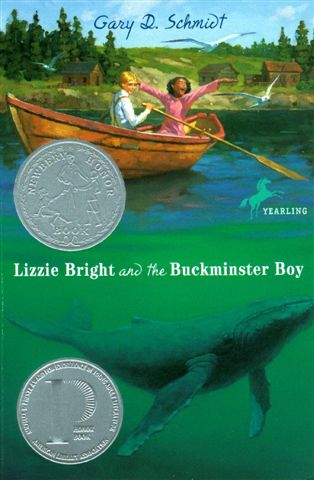
Lizzie Bright and the Buckminster Boy, by Gary D. Schmidt

"The Buckminster Boy" in the title is actually the book's protagonist; Turner Ernest Buckminster is a 13-year-old minister's son, who moves with his parents to Phippsburg, Maine, where his father is taking a position the Congregational Church. It is 1912. At first the problems he experiences are fairly standard for a "new kid" plot line - the boys in the town tease him, he was good at baseball in Boston, but here they pitch differently and he can't hit anymore... he's lonely and gets into trouble a lot, without meaning to.

Phippsburg is on the coast, and he ends up spending a lot of time by the water, where he meets a girl from Malaga Island, a small island just 100 yards from the Phippsburg shore. The girl is Lizzie Bright, and she becomes a good friend. Unfortunately, his parents and the "proper" people of Phippsburg don't approve of this friendship at all, because Lizzie is black.

And from here we start to see larger things - things larger than Turner can do anything about - start to happen in Phippsburg. The town elders have decided that they need to build hotels and attract tourists from New York and Philadelphia, and that the houses (or shanties, as they call them) on Malaga Island are a blight, and need to go away. The people who live in them should go away too, as Phippsburg has no need for paupers. It doesn't matter where they go, but they need to be gone by Fall.

With all this in the background, we watch as Turner's friendship with Lizzie grows, and they both get to know - and like! - an old lady in town who at first disapproved of both of them. We also watch as the tremendous mistake that the town elders are making becomes more and more obvious to Turner and also his parents (who at first were willing to believe that the town elders knew best). And Turner comes of age, when he realizes that he needs to make a stand.

The book doesn't end happily. It ends even less happily when you realize that the story of Malaga Island is true; Phippsburg researched until they found the "true" owner of Malaga Island (the people living on it had technically been squatting there for decades), from whom the state purchased the land and officially told the residents to move on. They were largely of mixed race, which had not been a real problem on the coast of Maine until the idea of eugenics became generally popular; but in 1912, it was a big deal, and not all of them could find a town that would let them stay. A few, including one young girl (who the author says doesn't have a recorded name), were removed from the island and sent to the Pownal Home for the Feeble-minded, where all but one of them died. The houses on the island were burned, and the graves in the graveyard dug up, the bones consolidated into five caskets, and reburied at the cemetery for the Pownal Home for the Feeble-minded. Gary Schmidt has fictionalized it a bit, but only in small details. The larger story is true, and terrible, and sad. And worth remembering.

The book is really well done. Seriously.

Tuesday, April 6, 2010

Jacob Have I Loved, by Katherine Paterson


Set on a small island in the Chesapeake in the early to mid 1940s, it is told as the memoir of a girl's teenage years living in the shadow of her beloved-by-everyone twin sister, island life, family, and first love. The protagonist is Sara Louise Bradshaw, older twin sister of Caroline Bradshaw. Caroline is beautiful, musically talented, and fragile - Sara Louise (Wheeze, as many people call her) is jealous, but fiercely strong and determined, and smart.

I read it for school in fourth grade, and I remember the first line of my book report to this day, because I was a little embarassed when it was handed back (I probably wrote it in a hurry): "Caroline, Caroline, Caroline. She's the only one anyone ever thinks about." I remember enough about reading the book to know that the jealousy between the sisters is primarily what I focused on at the time. But oh, there is more. I loved reading this again - I'm almost surprised it's marketed only as children's lit, it works so well.

The book is partly about her relationship with Caroline, of course. But it's also about her relationship with her parents (strictly adherent to the Methodist rule of Island culture), her grandmother who lives with them and is growing more and more senile and hostile. It's about her mother, who we learn moved to the Island as a young schoolteacher - Louise is both fascinated and horrified that as she sees it, her mother had all the world at her fingertips and freely chose this suffocating life. It's about her father, who has lived on the island all his life, and is strong but quiet at home - but sings to oysters out in his boat. It's about her relationship with "the Captain", a former islander who returns after decades on the mainland, who in some ways understands Louise better than she understands herself. And it's about how life on the Island prepared her for the life she makes for herself after the War.

If you haven't read this, or if you only read it for school, find it and give it a go. It's worth it.