Showing posts with label favorite. Show all posts

Saturday, October 13, 2018

The Golden Name Day, by Jennie D Lindquist

I have to start by saying that the copy of this book that I read was a red-orange Permabound library edition, so I didn't realize until starting this blog that the picture chosen for the cover is, unfortunately, the least attractive one from the entire book and actually makes it seem less appealing to read (and it's especially unfortunate because it's meant to depict one of the most beautiful scenes in the book, and is a letdown compared to my own imagination). My first impressions were quite different. Because of the blank cover I had no expectations until opening the book, and then I immediately felt comfortable within it because it looks *so much* like a Little House book- the typeface and layout are exactly the same, the illustrations are by Garth Williams, and it takes place in an indistinct time before technology, when trains and horses were the most common means of transportation. So it made me feel like this family could have been teenage Laura's neighbors.


See? Just like Little House!
I also felt like this book was a great counterbalance to some of Ma's impressions. Like the author, the majority of the people in this book are of Swedish descent and truly relish their traditions. Far from being bizarre and foreign, as they seemed to be portrayed in Little House, they are beloved and anticipated joyfully, and explained well. If Laura could have read this book, I bet she would have envied them a little.

On to the summary! Nine-year-old Nancy's mother has fallen seriously ill, so she needs to be sent away for a few months while her mother receives treatment. She is staying with "Grandma" and "Grandpa," who aren't her biological grandparents, but are the parents of her mother's childhood best friends. These old best friends also have children around Nancy's age (Helga, Sigrid, and Elsa) who are looking forward to having another friend to enjoy the Spring and Summer seasons with.

When Nancy arrives, Grandma is baking and preparing for her name day. Nancy is unfamiliar with the idea, and Grandma explains that every Swedish name has its own day in an Almanac, and on that day the honoree makes a cake and invites her friends to celebrate, and decorates with flowers and gets to wear a flowered garland on her head. Nancy looks through the almanac and is devastated to learn that, because her name isn't Swedish, she doesn't have a name day at all, although the other girls all do.

"Aunt" Anna and "Aunt" Martha and the three "cousins" determine that they will somehow find a name day for Nancy. This thread is carried through all of the events in the book as they consider different ideas. But Nancy will accept no compromises; she doesn't want a fake name day.

The seasons pass with flowers and picnics and traditional events, and homesickness for Nancy as well. But at the end of the book, she does get her name day- two, actually! But I'm not going to spoil here. So go read it!

Wednesday, August 30, 2017

The Inquisitor's Tale, or, the Three Magical Children and Their Holy Dog, by Adam Gidwitz

Ok, it is really time for me to get on the ball and read the 2017 winner, because I can not FATHOM why this is not it.  I have not enjoyed a children's book this much in a very long time.  If we had a *favorite* favorite tag, I'd be applying it right now.

The author spent six years researching and writing this book, part of which was spent in Europe with his Medieval-scholar-wife, researching history and poking around in ruins.  Although the story is completely fictional, the characters are all based on actual historical figures (Joan of Arc, Guillaume d'Orange, Guinefort, and many religious and political figures).

I really hesitate to even try to summarize this book because it was published to so much acclaim that I could scarcely begin to do it justice.  Set in 1200's France, it follows the journeys of three very special children (and one holy dog) who discover that they have special gifts which, unfortunately, make them targets of the Church.  They meet quite randomly and form a close bond as they seek sanctuary and safety.

Beyond the fantastic story, the book addresses (and not in a heavy-handed way) gender roles and classes, as well as religious conflict and race relations (all anchored in this time period).  This book is so crazily well-rounded and engaging that I finished it in about 24 hours.  Go read it.

Saturday, May 6, 2017

New Land, by Sarah Schmidt

I'll admit that it's nice to be able to fill in a gap in my list.  This one had been unavailable through the local library system and on a whim I decided to search online.  I found fulltext with illustrations, hooray!  A decision was made that the "pioneers" tag should also apply to homesteading for brevity, so this book will have no covered wagons in it for you!

New Land actually takes place in roughly the 1920's.  The Morgan family (seventeen-year-old twins Charles and Sayre, younger sister Hitty, and their father) are migrating from Chicago to greener pastures in Wisconsin.  Their father is the restless type who has never been able to stay in one place for long without becoming discontented, so the family has been unsettled for a long time, and especially since the death of his wife three years prior from pneumonia.  A coworker had tried homesteading and had failed at it, and offered the land and buildings to the Morgan family to try to settle themselves on.  Sayre is truly hoping that this will finally be their long-term home.  The book is told from her perspective.

Upon arriving in Upton, Wyoming, the family settles into the little house and gets to know the town.  Since the area is already settled and somewhat established, there is a town center with store (run by Mr. Hoskins, the town's most prominent citizen), a high school, and a small community.  But when Mr. Morgan goes to the land office to register his claim, he learns that he is simply not qualified to file.  He has no farming experience and no equipment, and because so many farmers had failed in this particular area, the government had become more selective.  Sympathetically, the land agent tells them that they can certainly remain where they are, but they will have no legal claim on the land they farm.

It's at this time that Sayre develops a plan.  She's fallen in love with this new land and won't leave willingly.  She goes to the local teacher and meets the agriculture instructor there.  Although he's surprised that a girl wants to register for his classes, he agrees to seek permission from the board on her behalf.  As Mr. Kitchell is also the football coach, she hopes that he will be able to use that influence on her football-loving brother to encourage him into the class as well.  Sayre hopes that they can, between them, learn enough about farming to keep their family in its place.

Although Sayre is decisive and optimistic, not everyone is rooting for their success.  The Morgans quickly discover that Upton has a lot of small-town politics, and that those who are ahead wish to remain there, on the backs of their neighbors.  Additionally, the man who originally leased his claim to them returns to "visit," and Sayre quickly intuits that he has misled them, intending to lay claim to their hard work on the land to "prove up" the claim for himself.

There are a lot of factors working against the Morgans, and they are all well-developed (as are the characters).  I especially enjoyed reading this one; the Little House series primed me to enjoy a good homesteading success story, and this one is exceptionally well-written.  I won't spoil the resolution here, you can rest assured in the fact that the final chapter is entitled "The Happy Ending."

Friday, March 13, 2015

Gandhi: Fighter Without a Sword, by Jeanette Eaton

OK, it's time for a bit of a confession.  My understanding of world history, and particularly that of Asia, is severely lacking.  It wasn't part of the school curriculum and, lacking exposure, it wasn't something that I explored myself, either.  So if you'd asked me a week ago who Gandhi was, I couldn't have told you much beyond the fact that he was some Indian guy who was really peaceful.  I couldn't have even told you roughly when he lived, beyond the general sense that he's not alive now.  Pretty embarrassing, I know.

Just the same, I wasn't sure whether I'd find this book interesting when I picked it up.  Jeannette Eaton and I have had our difficulties in the past.  The cover is not remotely exciting, although completely accurate.  So it was such a pleasant surprise to thoroughly enjoy this book from start to finish.  I know it sounds kind of hyperbolic to use a phrase like "a masterpiece of juvenile biography" but it's really the best one that comes to mind, having completed it.

The book is the perfect introduction to the life of a man who accomplished so much.  It touches on all aspects of his life- culture, family, religion, education, employment, social relationships, daily habits. . . all without overwhelming the reader or brain-dumping facts.  It's all handled very methodically at a reasonable pace.  At the same time, the book engages the reader and helps him develop a genuine interest in the things that concerned Gandhi himself.

The entire volume has just over 250 pages, but covers Gandhi's life beginning as a teenager, all the way through his eventual assassination.  It's a book that I'd sincerely recommend for young readers today, although it wants a newer edition to update some obsolete language.

Thursday, January 1, 2015

The Cricket in Times Square, by George Selden


I was always a huge fan of this story.  It was assigned to my class when I was roughly in the 2nd grade and for being more than 20 years old, I still stood up then and probably does today just as well.  I asked a well-read friend for suggestions on what to read next from the list (going forward from start to finish was starting to feel a bit punishing) and this was her suggestion.  Hooray!  At some point I know I read a few of the sequels as well, but they're not remotely memorable to me.  This was the good one.

Chester the cricket has lived a happy life in the meadows of Connecticut.  He loves his home in an old tree stump.  He knows the local animals and the landscape- even the signs that mark the changing seasons.  But he's about to get a taste of another life.

One lovely warm day, his field is descended upon by picnickers.  Unable to resist the aroma of the leftovers, Chester jumps into a basket and helps himself.  But during his post-meal nap, he's buried under leftover sandwiches and carried away on a subway train back to New York City.

Lost and alone, Chester makes a few tentative chirps and is discovered by Mario, a young boy working the late shift in his family's newspaper kiosk.  His mother has reservations, but his father gives him permission to keep Chester, provided he stays in the newspaper stand and doesn't come home.  At night, two of the station's residents come calling to introduce themselves: Tucker the mouse and Harry the cat.  Long-time friends, they quickly adopt Chester into their group and teach him about life in the station.

During their late-night visits to the station, Tucker and Harry quickly learn that Chester has an amazing ear for music.  They teach him a number of popular songs from the radio, as well as classical pieces.  As Chester begins to play these for Mario and his family in the daytime, an astonished crowd begins to gather.  Over time, Chester becomes quite the attraction and the Bellini family's small newspaper stand finally begins to turn a nice profit!  But Chester is shy.  He doesn't like being poked at and stared at.  And as the air cools he misses his meadow and the changes Autumn brings.  It's time for Chester to decide to unhappily remain where life has landed him, or to choose his own path home.

For those of you familiar with the titles of the sequels, the end result is no mystery!

Friday, November 7, 2014

Dear Mr. Henshaw, by Beverly Cleary

Another classic here.  Beverly Cleary, how I love you.  It's amazing how much of this book I remembered without having picked it up since grade school.  I love how her characters are the sort of average kids who are generally utterly overlooked by mainstream fiction- they live in apartments (often in need of repair or upgrade) instead of homes with well-used furnishings, they don't have a lot of the accessories or fad items that their peers do, they eat leftovers and sale meats. . . It's a shame that the lovely Mrs. Cleary lives so far away because I'd gladly go all fangirl on her and beg her to sign my copy of "My Own Two Feet."  Anyway.

Leigh ("Lee") Botts lives with his mother, who works for a catering business.  They share a small apartment which they've just moved to after his parents' divorce (his father, a trucker, craved the open road too much to settle into a regular home life with a family).  Leigh is adapting to a new school where he doesn't know anybody, but he's a generally quiet fellow so he has a hard time making friends.

As part of a school assignment, he writes a letter to his favorite author (the titular Mr. Henshaw) with a list of questions for a report.  Mr. Henshaw replies with his own list of questions, to which Leigh grudgingly responds in parts while his television is broken.  So the book is composed as a series of letters to this author (and later, to Leigh's journal).  Mr. Henshaw occasionally writes back.  We don't see his end of the correspondence so we only hear of it secondhand from Leigh's perspective.  It's unclear to me whether Mr. Henshaw is somewhat hostile, or is a gigantic tease.  Maybe both.

The book follow's Leigh from his first letter in the second grade, through sixth grade.  We get to see him mature in his behavior and understanding as he figures out how to make friends in a new place, figure out who is stealing the best parts of his lunch, make peace with his parents' divorce, and come to terms with his fathers' inconsistency.  It's got a lot of happy and sad parts, but in a way that is realistic and not heavy-handed, which makes it a wonderful children's book.

Wednesday, August 27, 2014

Daughter of the Mountains, by Louise Rankin

The book begins with a brief foreword which describes the history of India and its role as a trade center.  The cover description doesn't mention the nationality of our protagonist, so imagine my surprise (and the required shifting of gears) to find myself in a book set in Tibet!

Momo lives in a small village with her father, who carries the mail across dangerous mountain passes, and her mother, who runs a tea house for the various traders and muleteers who pass through en route to bazaars and trade centers farther away.  Momo has seen dogs before, but when her eyes fall upon the lama's dog, a golden Lhasa terrier, she is smitten.  She can think of nothing but the dog, and wants nothing but to own one exactly like it.  But such dogs are nearly nonexistent in her part of the country, and much more expensive than her family could ever afford.

However, Momo is not easily redirected.  She directs all of her energy toward praying to receive a dog just like the lama's.  When she begs her parents for one, her father tells her that her uncle will bring her one when he comes from Lhasa.  As years pass, however, that refrain grows tiresome and Momo is understandably skeptical.  She decides to put more energy into prayers, leaving her most precious possession at Buddha's temple and determining to wear out his ears until he gives in.

Not long afterward, a familiar mule train stops at Momo's home for tea.  When updating the leader on what Momo has been up to in the last year, he pulls a red-gold Lhasa terrier puppy from his coat and presents it to her!  He was en route to sell it in the big city, but its mother died and he is now unable to care for it properly on the road.  Although this would usually be a very expensive dog, the muleteer strikes a bargain with Momo.  If she will care for it like a child and feed and train it well, and permit him to breed it for puppies when it is grown, Momo can keep the dog.

Because this was such an exceptional answer to prayer, the astrologist is immediately summoned to help name the dog and draw up its horoscope.  The dog is given the name Pempa, and Momo is told that the two of them will have a great adventure together, and that he will bring good fortune to the family.

In time, Pempa grows up fat and strong, and loves Momo, always answering her calls enthusiastically.  However, a simple quiet life isn't meant for the two.  One day, a team of muleteers steals the dog when Momo and her mother are distracted with duties in the tea house.  Momo doesn't realize that Pempa has been stolen until she goes outside to search for him and a local boy tells her how he saw the men carry him away with his legs bound and wool in his mouth to quiet him.

Pemma is horrified and doesn't plan to let her dog go so easily.  She runs in to tell her mother that Pempa has been stolen and she's going after him.  Her mother, busy caring for a sick child, nods absentmindedly, not having really heard.  Pemma's journey is set to be a long one- she learns that the leader of the mule train has been offered a large sum by a rich woman in India to deliver such a dog.  But Momo plans to catch up to them long before they reach Calcutta.

I don't plan to share the rest of the plot here lest I spoil it.  But suffice it to say that the author does a great job describing the people Momo meets and the villages she passes through on her way down the mountains.  And yes, she does get her dog back, and Pempa's horoscope does indeed come true!

Tuesday, April 16, 2013

The One and Only Ivan

Ivan is the title character and narrator of this book.  He's a silverback gorilla, but not a fierce or angry one.  Ivan lives, with a number of other exotic animals, at the Exit 8 Big Top Mall and Video Arcade.  Taken as an infant from the jungle, he lived with the mall's owner, Mack, and his family until he became too large and strong and unpredictable. Now he's an attraction that is no longer attracting shoppers.

Ivan, understandably, isn't especially concerned with the shoppers.  His "domain" is small and his life is routine, eating and sleeping and watching television, and chatting with his neighbors.  One is Bob, a stray dog, who comes and goes as he pleases but enjoys sleeping on Ivan's belly.  The other is Stella, an aging retired circus elephant who uses her words as sparingly as Ivan does but always with purpose.

Ivan does have one other friend- Julia, the daughter of the mall's night custodian.  While her father works, she visits with the animals, does her homework, and draws.  Ivan likes to draw, too (although humans usually don't recognize his subjects), and Julia often smuggles extra supplies to him through a broken corner of his enclosure.

In an effort to draw new shoppers and keep his property from going out of business, Mack purchases Ruby, a baby elephant.  She is placed in Stella's enclosure and is confused and full of questions, and a bit skittish at first.  Ruby slowly becomes accustomed to her life at the mall, but her enthusiasm for life begins to wane when it becomes clear that Mack intends to train her for public performance, and he isn't opposed to physically harming her to force her to comply.

At the same time, Stella is succumbing to an injury incurred in her youth, as she was being trained in much the same way that Ruby is now.  Although she says very little about her time with the circus, it clearly pains her to think on it.  She is sadly resigned to her current state, but fears for Ruby's future since she is beginning on the same path.  Stella knows that she cannot help Ruby, and as she senses her life drawing to a close, she begs Ivan to promise that he will rescue Ruby.

Ivan is a bit baffled by the request, but he'd do anything for Stella.  But now he's in a quandary- how can he help Stella?  Does she even need helping?  After all, is life at the mall really that bad?  But before her death, Stella had been prompting Ivan to exercise his memory, and to think back about what he loved about his life before he was taken from his family and the jungle.  As things start to come back to him, he realizes that his domain really is a cage, and he has to get some one's attention to help all of them.

Katherine Applegate was inspired to write this novel after learning about the story of the real Ivan, a shopping mall attraction in Washington state who spent nearly 3 decades enclosed indoors before public outrage and the mall's financial troubles facilitated his placement in a more lifelike habitat at Zoo Atlanta.  The real life Ivan passed away recently and was one of the zoo's most popular family members.  You can read more about him here.

Saturday, March 16, 2013

Adam of the Road, by Elizabeth Janet Gray

Adam of the Road marks Elizabeth Janet Gray's final appearance on the Newbery list, and she's had several!

1943 was definitely a good Newbery year, and the winner doesn't disappoint.  Adam is our title character, the son of Roger the Minstrel.  Adam has likewise learned the ways of the road, having traveled extensively with his father and learning his trade.  As the story begins, Adam is at a boarding school awaiting the return of Roger, who has gone to France to improve his skills and learn new stories and songs to bring back with him.  Adam's beloved spaniel, Nick, is also at boarding school with him (although in the care of a local widow, since he isn't permitted to stay in the dormitory).

When Roger returns, he, Adam and Nick leave their friends behind and join a wagon convoy headed to the estate of  Sir Edmund de Lisle, who has become Roger's patron.  Roger's prior performances had pleased de Lisle so much that he had given Roger a retired war horse named Bayard, whom Roger and Adam are able to ride on their long journey.  Roger and Nick settle in nicely at the estate, and Adam makes friends with the children there.  They, and several other minstrels, are also permitted to perform at a wedding, and Adam is proud to receive, along with the adults, a small purse of pennies in recognition of his performance.

The following morning, it is time to leave.  De Lisle doesn't have need of his minstrels all the time, so once again, Roger, Adam and Nick will make their home along the road until they are needed in the future.  Unfortunately, Bayard does not join them- Roger had spent the night playing dice with the other minstrels and lost his pennies, and then the horse trying to get them back.  Jankin, a fellow minstrel, has won the horse.  When they encounter him later, Jankin offers Roger the chance to gamble Nick to win him back, but Roger firmly declines.  Nick does not belong to him, and he's had his fill of gambling.

Further on, at an inn, the encounter Jankin again.  He has lamed Bayard through rough riding.  The next morning, they awake to find that Jankin is gone, as is Nick!  A stable hand is questioned and we learn that Jankin claimed that Roger traded Nick for Bayard, and snuck out in the early hours of the morning.  This is where our story really begins- Roger and Adam pursue Jankin to a large fair, but Adam follows his own leads and is separated from his father.  The remainder of the book follows Adam as he learns to be a minstrel in his own right, while following clues and desperately trying to find both his dog and his father.

Nick is an extremely likeable character!  He's also mature for his age (at least by today's standards) but genuine and kind.  This would be a great book for young readers who have an interest in medieval England- the perspective of the minstrel isn't one that's often considered!

Tuesday, October 30, 2012

The Giver, by Lois Lowry

Classic! I'm so excited that I get to review this one.  I'm a huge fan of dystopian YA fiction, but at the time this one came out, it was a pretty unexplored topic for this age group (but hat tip to A Wrinkle in Time for some of the concepts, I'm sure).  One of the things I really loved about reading this when I was younger was that it was so fresh.  Now that I've read so much dystopian sci-fi, I know exactly where I'm supposed to feel foreboding and get suspicious of the established culture.  But you weren't really handed books like that when I was a teenager, and they certainly weren't recommended reading in schools.  And Lowry does a fabulous job of telling her own creepy story, and then making you look for creepiness where it doesn't exist, and sympathize with those who feel like the creepiness serves a necessary social good, and then get mad at yourself.  But I digress.  Here's your plot summary.

Jonas lives a happy life in a very regulated community.  There are many regulations that everyone is expected to abide by, and willingness to admit mistakes (and receive forgiveness) are pretty much the norm.  Each person's life is very laid out, and everyone's career and spouse and even children (bred elsewhere) are carefully selected for them.  Each year from 1-12, everyone born in a certain calendar year advances (at one age, every child receives jackets which button in the back, to teach interdependence; at another, haircuts to show maturity, at 9, everyone receives their bicycle).  But Jonas is 12, and 12 is the last year for ceremonies.  After having been carefully observed, each 12 will be given their assignment.  After the ceremony, they will leave friends behind and dedicate themselves to studying for and learning to be successful in their assigned careers, and will cease to mark age after that time.

Jonas can see that some of his classmates will be easy to assign, based on where they've most enjoyed spending their (mandatory) volunteer hours.  But Jonas doesn't feel any sort of inclination.  He's always been successful in school, but doesn't see himself as having any exceptional talents or skills.  At the ceremony, Jonas watches in panic as his classmates are called forward to receive their folder of instructions and their assignment, but he is skipped until the very end.  The Elders announce that he has not been assigned to a career, but rather, he has been selected to be the community's next Receiver.  None of his peers, nor Jonas, have any idea what the position is or what it entails, but Jonas is nonetheless relieved to find out that he hasn't disappointed his parents with an infraction so large that he would instead be Released from society and sent Elsewhere (the worst consequence for those who don't conform, or voluntary in the case of the ill or elderly).

Upon returning home that evening, Jonas eagerly opens his folder to find that he has only a single sheet of instructions, the most interesting of which are: "From this moment you are exempted from rules governing rudeness.  You may ask any question of any citizen and you will receive answers."  "Do not discuss your training with any other member of the community, including parents and Elders." "You may lie."  Jonas is stunned.  He's certain he won't need to take advantage of these exemptions from common courtesy.

As he begins his lessons with the former Receiver (now the Giver), whom he will eventually replace, he begins to learn more about how his society is constructed and why.  The Receiver's role is to hold the collective memory of humanity, so that he can advise the Elders when a change in the accepted order is proposed.  When the Giver passes memories on to Jonas, initially they're pleasant (such as a ride on a sailboat, the feel of sunshine, or the experience of sledding in snow).  Jonas is excited by these new experiences.  The community lives in a state of Sameness- level roads, climate control, absence of color and music, in order for everything to function as smoothly as possible, and these experiences are like highs for him.  But the Giver eventually shares unpleasant ones as well- wars, starvation, and neglect.  Jonas begins to realize that the Receiver's task is also an immensely burdensome one, and the more he learns, the more he finds he can't relate to the people he lives among.  He's frustrated that these memories really belong to everyone, but they've lived such a shallow existence that they wouldn't be able to bear them.  He needs to do something to improve society, but with all his knowledge, he just doesn't know how.

And I'm not spoiling the ending, so go get a copy!

I hadn't planned on reading this one for the blog; I had seen that Lowry had just published a fourth book intended to wrap up the The Giver/Gathering Blue/Messenger series and I thought I was high time I get myself caught up.  How nice to see a Newbery Medal on the cover!  If these last two entries seem somewhat quick to you, it's because we lost power for a while so I had lots of time to read (hey, I can't be expected to clean the bathroom if there's not enough light, right?)


Tuesday, May 29, 2012

On the Banks of Plum Creek, by Laura Ingalls Wilder

This book was my favorite in the series for a very long time.  Probably in part because it was the only book in the Little House series that I actually owned for quite a while, but also because I loved when snotty Nellie Oleson got her comeuppance, covered with leeches!

On the Banks of Plum Creek follows the Ingalls family as they settle along the aforementioned creek, first in a dugout purchased from a Norwegian homesteader, and later in a beautiful home built of boards (which Pa had purchased on credit against the following year's crop of wheat).  The surroundings are beautiful, the family is able to have access to town, church, and school, and the land is rich.  Things are looking good for the Ingallses!

Unfortunately, reading this book through an adult's eyes makes me so much sadder.  Before long, the promising wheat crop is destroyed by what could be described as no less than a plague of grasshoppers, which descend on the countryside and devour it until no living plants are left.  Laura has to give up her beloved rag doll, Charlotte, to a neighbor's bratty child (but is fortunately able to retrieve it later).  I feel sad for the family and wish Pa could catch a bit of luck so they could stay stable for a bit, and he wouldn't feel compelled to buy their necessities on credit, which usually doesn't work out well for him because something always happens to his crops (which certainly explains why Laura, later in the series, is determined not to marry a farmer).  Other things that happen during this time period but are not portrayed in the story are moves to Wisconsin (to the Big Woods!) from Kansas before settling on Plum Creek, as well as the birth and death of Laura's younger brother, Charles.  And between this book and the sequel, On the Shores of Silver Lake, the family is struck with scarlet fever, causing Mary to permanently lose her sight.  Pioneer life was hard!  It's amazing that with so much sorrow, there is also so much happiness in these books, and you can't help but falling in love with the family.  The hope they have is absolutely incredible.

Thursday, March 22, 2012

The Good Master, by Kate Seredy

Having read The White Stag, I was bracing myself for another slog when another Kate Seredy book came my way. But, I was very pleasantly surprised!

In addition to the gorgeous illustrations by the author, The Good Master is a sweet, easy to read, engaging story. It's in the same kind of category as Heidi and The Secret Garden - a thin, vaguely unhealthy city girl comes to the country and experiences honest work, good simple food, and becomes a new person. Instead of the Yorkshire moors or the Swiss mountains, this story takes place on the fruited plains of pre-WWI Hungary.

There is a boy, Jancsi, who lives with his mother and father on a large ranch. At the beginning of the book, he is excited that his cousin Kate, who he has never met, will be coming from the city to stay with his family. He does not have siblings, and is looking forward to company, "even a girl". When Kate arrives, though, she is not only delicate, but a little hellion, and almost as much fun as a brother! She gets into all kinds of trouble, and keeps Jancsi and his parents on their toes, but she comes around when she, along with the reader, is introduced to the rhythms of life in the country, from Easter to Christmas. As examples, we see eggs dyed (an Easter tradition I was not surprised to see) and all the boys in the village sprinkling all the girls in the village with water (an Easter tradition I had never heard of!).

There are lovely descriptions of various folk traditions surrounding major holidays, there are traditional folk tales told by sheepherders and millers (including the one told in The White Stag, but shorter and much more enjoyable!), there are gypsies, a circus, near-death experiences... and there is plenty of good-will throughout. Comparing it to Heidi and The Secret Garden is, I think, high praise well deserved. Unlike those two classics, however, there is also a main character who is a boy, and I think this could be enjoyed by both boys and girls. More people should read it. I'm also looking forward to its sequel, The Singing Tree (one of the1940 Newbery Honors)!

Note: Kate  Seredy was the illustrator of two 1936 Newbery books - she also illustrated the first edition of Caddie Woodlawn!

Thursday, March 1, 2012

Roller Skates, by Ruth Sawyer

This was my third reading of this book. I read it first in 3rd grade, and have somewhat vague memories of liking it, then again in college (not sure why anymore) where I loved it, and now. Still in love. Which you'll be able to tell by the length of this post!

The book is a semi-autobiographical story of the author's tenth year. Lucinda is ten, and calls herself a "temporary orphan" while her parents are away for a year in Italy. She stays with two ladies (one of them is a teacher at her school) and with a very few ground rules, is basically allowed to do as she pleases for the year. It's the 1890s, she's in New York, and the world is her oyster!

What does she do with her time, you ask? She makes friends. She makes friends with Mr. Gilligan the cab driver, who is from Ireland and invites her to tea so that they can have griddle cakes "cut pie-wise" and tell stories and sing Irish songs (Mrs. Gilligan is Irish too). She makes friends with Tony, an Italian boy whose father has a fruit cart. She makes friends with Trinket, a little girl who lives upstairs. She makes friends with the police officer whose beat is on the way to school. And Alena, a girl who lives with her grandparents who are in the theater. And Mr. Nightowl, who writes for a newspaper and twists his hair up into owl horns when he introduces himself. And Princess Zayda (Lucinda's name for her), an "Oriental" woman who hires Lucinda to give her English lessons. I could go on.

The whole book feels like a lark - there are no rules, and everyone is interesting, and Lucinda's intentions are pure gold. But she's *alive*, too, and can't always control her tongue, which gets her into trouble with her Aunt Emily*. And the world is not always kind, even to spirited ten-year-olds. There is pain in the book, too, which I think is part of why I love it so much. Lucinda is a happy girl, but has real feelings. She revels in feeling "wanted" (she was the fifth child in her family, and never made much of), and feels about ready to explode when winter drags on and she can "feel the lid closing on her" after days of snow and not being able to skate or run outside. There are two deaths in the book, each of which requires its own sort of dealing-with. And at the end, there is a feeling of things changing, and not being able to keep things forever, nor people, nor time. It's not exactly a happy ending, but that just adds to the genuine feel of the book.

Now, on to its accessibility for modern young readers. One review I saw mentioned that readers who liked Little Women might be able to put up with its long descriptions. I didn't mind the descriptions at all, and found it FAR less tedious than Little Women (this coming from someone who read Little Women as a kid and actually kind of liked it). There are some words that would need looking up, but none of them get in the way of understanding the story. I'll spare you the trouble of a couple: pongee is a sort of light cloth, guilp is a kind of ribbon, and pettyjohn is in the oatmeal/cream-of-wheat/other-porridge family. And there are the kinds of un-PC references that you're likely to find in a book of this era. Tony's family is forever having new babies, the cook is referred to as "Black Susan", and so on. All are portrayed in a very sympathetic light, but it can be condescending.

Spoiler Alert
And there's a random murder. If I were assigned the task of editing this book for a modern audience, I might leave in a lot of the un-PC parts and explain them away with a discussion of "it was a different time", but I might seriously consider editing Princess Zayda out. Lucinda never even mentions her to her caregivers, as she knows they would forbid her to continue seeing her. We know that she is "Oriental", has a fabulous exotic room (with curtains, cushions, tapestries, and a jeweled dagger on the wall) in a hotel, and a husband who we never really meet, but who seems harsh, jealous, and possibly abusive. And then Lucinda finds Princess Zayda in her room one day, stabbed in the back with the dagger from the wall. Lucinda is told by the hotel manager to forget that she ever saw it, and to pretend that Princess Zayda had gone away, back to her country, and is happy and well somewhere. Lucinda consoles herself that she is probably happy, having finally escaped her husband. Not essential to the plot, and pretty weighty for a children's book, especially without resolution. That said, I don't remember it bothering me when I read it as a kid - I remember it feeling exciting, and part of a real adventure. Take that as you will. I suppose it's not worse than what's in a lot of movies kids see.

Overall this book paints a great, active, multi-colored, multi-layered picture of a year in New York in the 1890s. I don't think it's for every kid, but give them a some credit - there are a lot who would like it! And if you're looking for something a little different for yourself, it ages well and is a good, satisfying read for an adult too. 


*It feels worth noting that I was simultaneously reading two books with an overbearing Aunt Emily (the other was Walker Percy's "The Moviegoer". If your name is Emily, please pay attention to what sort of Aunt you are.

Sunday, January 1, 2012

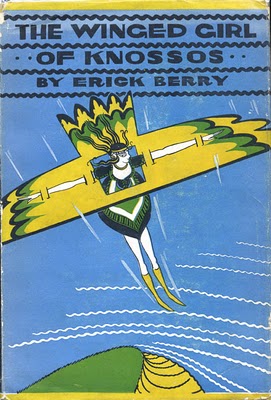
The Winged Girl of Knossos, by Erick Berry (pseud. Allena Best)

Every blog entry I've managed to find reviewing this book mentions how rare and difficult to find it is, what an awesome book it is, and how it really needs to be reprinted because it's a shame that it can't be widely read. I wholeheartedly agree on all counts!

Winged Girl takes place in ancient Crete during the Minoan period. Although the names of many of the places and people will be recognizable from mythology, the author has taken great pains to tell a story that is realistic fiction, so she's created a world where the origins of these tales are placed in a likely context.

The protagonist of this story is Inas, the daughter of Diadalos (Daedalus, as we're familiar with him today). Counter to the mythology surrounding him, he does not have any other children or family in this story. Inas is a butt-kicking female protagonist- she enjoys the company of sponge-fishermen and often dives herself just for sport. A true athlete, she is among the few chosen for the public spectacle of bull-vaulting. And she loves that her father is experimenting with flight, despite the fears of the ignorant villagers that it is akin to black magic. Although Minos, the king, would prefer that Daedalus not experiment in this way, he values Daedalus' clever scientific mind and often calls upon him in the palace. Because of this proximity to royalty, Inas has become a close friend of the princess Ariadne.

Inas' other close friend Kadmos has recently returned to Crete after a voyage abroad. Kadmos is glad to be home and is concerned that Minos has grown too secure in his own power- much of Knossos is unfortified and he worries that when all of the strong men are away exploring or collecting tributes, the island is vulnerable. This time, the returning ships have brought a number of valuable gifts, as well as a number of Greek tribute slaves (it is interesting to note here that in this story, the Cretans consider themselves the superior culture and the Greeks barbaric). Among these tributes is a tall, proud man named Theseus. Ariadne sees him and is immediately smitten.

This lays the groundwork for the remainder of the story, which I will not spoil. The book has wonderful period-inspired illustrations drawn by the author herself, and other recognizable mythological elements to the story include the Minotaur and the Labyrinth, Ariadne's thread and Daedalus' escape to Sicily, although their appearance in the story is very different from how you may remember these tales in mythology. This was a very creative tale, from some one who clearly did her homework, given the list of references in the back of the book.

Saturday, December 17, 2011

Children of the Soil: A Story of Scandinavia, by Nora Burglon

This might seem an odd choice to get my "favorite" label, since there's very little conflict in the book and no excessive excitement, either. But this book is marvelous in its simplicity, and I have a fondness for books about poor children who nonetheless live happy and rich lives because they have wonderful family and a life free from unnecessary complications (if that makes any sense). They're just kids being kids- the kind of kids who stay out of trouble and might get ignored by most but are actually pretty awesome.

Nicolina and her younger brother Guldklumpen live with their mother, Olina, in northern Sweden. Their father was a sailor who never returned from sea, and it's unknown whether he'll ever return (and remains unknown at the end of the book). They are a family of crofters (essentially tenant farmers) but since they are without a man in the household, they are exempted from providing a crop for the Colonel. Instead, Olina is responsible for doing the weaving for the big house, and paying an annual rent for her property. She and the children all work their property to bring in enough crop to last them and their goats through the winter, and Olina sells goat cheeses at the market. It's a reasonably simple life and although they more or less accept their place in the world, the children are occasionally chafed by the fact that blessings often seem to come to the rich, who have no need of them, leaving little or nothing for those who have the most need.

At the start of our story, it is Easter, and although eating eggs on Easter is a tradition, our family has none. The two children notice that it does seem unfair that the tradition is kept at the big house, where eggs are nothing out of the ordinary anyway, and Nicolina remarks that it's probably because there is a tomte (much like a gnome, from what I'm able to gather) living on the property and bringing good fortune. Guldklumpen notes that his purported home on the Colonel's property isn't remotely an attractive one, and decides to build a more attractive tomte house on their own property to lure him. He finds an old sea chest washed up from the ocean, and fills it with hay, and decorates around it with spruce boughs. And with that, their fortune begins to slowly change over the course of the following year.

We follow Nicolina and Guldklumpen through their annual traditions, marketing, and school, and by next Easter we find them generally unchanged, but with more comforts. It really is a happy little book, and although the children suffer small injustices and disappointments, no real misfortune comes to them.

It sounds as if the author herself was also an awesomely incredible woman. I am linking to a website that provides a brief biography; I'd love to read more of her works now. Here is the link.

Wednesday, May 25, 2011

When You Reach Me, by Rebecca Stead

Melanie has been telling me I should read this book for months now. And she was entirely right!

The story takes place in 1979. Miranda lives with her mother in an apartment in New York, directly above her best friend Sal (a boy Sal, not a girl Sal) who lives with his mother. She and Sal are friends, they go to school, they hang out... and then things change. And strange notes start showing up for Miranda. This book is a letter, written by Miranda to the mysterious note-writer, that explains how and why.

I don't want to tell too much about the reason that I think Melanie knew I'd love it, because it's such a great surprise at the end when all the pieces come together. I will say that the author mentions on the cover that she was inspired by Madeleine L'Engle's "A Wrinkle in Time", and it shows! Like "A Wrinkle in Time", it's a little bit science fiction, but you hardly notice. There are plenty of other good elements to discuss here, though.

One of the bigger elements running through this book is the exploration of friendships and how they can/should/don't work sometimes. Miranda and Sal had been best friends from the time they were babies. Sal needed a break from Miranda, it turns out, but didn't know how to convey that other than starting to ignore her. This of course hurt her deeply, but it did mean that she started making new friends, and a lot of good came of that. And she and Sal eventually make it up. Sometimes a best friend keeps you from having other good friends - Miranda and Sal are not the only ones in the book who discover this.
Another element is that of regret. It's not as obvious a topic for a kid's book, but I really loved how it was handled here. Great opportunity for discussion - are there things that happened a long time ago that you still feel bad about? Would you do anything differently if you could go back? Did you ever do something, that turned out to have effects you didn't predict? Could you have predicted them?

As I said after reading "The Black Pearl", the essay questions practically write themselves for this book - but this time, I think the questions/discussions would actually be fun. Totally read this - it's pretty quick (not quick enough for the tag, but a day or two will easily do it!) and a great time!

Friday, May 20, 2011

Meggy MacIntosh, by Elizabeth Janet Gray

I'm amazed that I was able to find a good cover image for this book online, even though this book seems much more rare than Garram the Hunter, the cover of which I scanned myself for lack of anything at all in Google Images.

I enjoyed this book *so so* much. It's probably kind of premature, but it's definitely my favorite book of the 1930's so far.

Meggy MacIntosh is the descendant of a proud Highland family. However, her life has become meaningless and dull. After the death of her father at Culloden under the command of Jaime Frasier, she is forced to leave their small stone castle in the hills and move to Edinburgh with her aunt, uncle, and cousin. Her cousin Veronica is kind to her, but is a typical socialite. As the older of the two, Veronica is very busy having her hair styled and being fitted for clothes and attending parties and generally making herself known. Meggy knows that she will never be an equal to her cousin, and it wearies her to see the disappointment on the faces of young men when she goes out in Veronica's hand-me-downs. And although she used to have time to at least share her day with Meggy, Veronica is becoming too worn with her busy social life to have much to say. The only highlight of Meggy's day is her tutoring with Mr. MacPherson, and even this small pleasure is ending because the old man wishes to return to the hills to retire.

Meggy's life seems to be coming to a standstill until she is presented with a surprising opportunity. One of Veronica's many suitors, Ewan, will be sailing for America in just a few days time. He has asked Veronica to slip away from a party that evening, be escorted by his traveling companions, join him on the boat, and marry him en route. Veronica, a fickle sort, has decided by morning that the idea doesn't suit her. But Meggy knows by then that she will go in her place. She takes from their hiding place all that remains of her family's jewels (two ruby earrings and an imperfect emerald), packs her bag, and boards the ship. She stays in bed, feigning exhaustion, until the ship is well out of port and she feels safe that it will not return.

Ewan, understandably, is furious when the exchange is discovered. Meggy attempts to reassure him that she plans to pay her own passage and not burden him, and be self-sufficient once she reaches the colonies, but it does little to cool his anger. All of her life she has heard stories of the beautiful Flory MacDonald, who helped smuggle Bonny Prince Charlie out of harm's way. Meggy is certain that if she can just get to Flory, she can be of some use. In any case, she is already better off than many of the passengers, who will be sold into indentured servitude for ten years to work off the cost of their passage.

During the length of the trip, Meggy (as one of the few who does not become seasick) makes herself useful as companion and nurse to those who need her, and upon arriving in Wilmington, is offered a place to stay with relatives of a fellow passenger who had grown fond of her. This relative, Mr. Clayton, has two daughters, about Meggy's age, and for the first time she is able to delight in the company of peers who are not only kind, but interested in her, and see her as an equal.

And we're only on page 90 of 274!

Meggy isn't able to go to Flory in North Carolina right away. But as she slowly acclimates to Wilmington, and gets her land legs back, she starts to see the political tension that is building (and will eventually lead to the American Revolution). She is torn about her own feelings on the matter, though- she has friends on both sides. She understands why people would want to be loyal to the land and to their neighbors here in America. However, she wants to better understand the position of her former countrymen- how could Flory MacDonald and others who lost so much fighting the King at Culloden be willing to put the same force and passion into fighting for the king in America? Unlike many books written for children about the Revolution, this one paints both sides as genuine and good people. Usually, what you see is that all of the characters you like are Patriots, and the ones you don't like so much (like the stodgy old grandfather in the Felicity series) are the stuffy, unsympathetic loyalists.

Also, the close contact with indentured servitude (and lifelong servitude, in the case of plantation slaves) sheds light on this aspect of American history that children's fiction usually doesn't talk much about. There are some very cringe-worthy terms used for black slaves in this book, but they are historically accurate and not deliberately unkind.

Tuesday, May 3, 2011

From the Mixed Up Files of Mrs. Basil E. Frankweiler, by E.L. Konigsburg

A quick dash off blog post - I've moved house in the two weeks since I finished this book, and I don't want to put it off any longer!

Claudia and her brother run away from home in style - to the Metropolitan Museum of Art! They sleep in the bed where a murder is supposed to have taken place, hide their things in a sarcophagus, and hide in the bathrooms (door just ajar, standing on the toilet) when the guards are making their rounds in the evenings. They bathe in the fountain and collect coins from the bottom to pay for food and laundry. It's delightful!

While they're there, the museum puts out a new acquisition - a small angel statue that may have been sculpted by Michaelangelo. Claudia and Jamie decide to solve the mystery. For Jamie, it's a detective story. But for Claudia, it's part of something bigger. Part of the reason she'd run away in the first place. She wants to be different somehow. I've enjoyed this book since the first time I read it, maybe in 4th grade, because it captures so elegantly the frustrated desire of a kid wanting more out of life - not that her existence isn't comfortable (it is), and not that she wants to be rich exactly (she doesn't, though I don't think she'd object). She wants more than just to be a kid, but not just to grow up. It's just a *wanting*.

There was a TV movie that came out in 1995, which I watched at the time and largely approved of, and there's also apparently a 1973 movie (with Ingrid Bergman!), which I haven't seen but will try netflixing! I think it probably works best in book form, though (don't they all?). The book is written in the form of a deposition, by Mrs. Basil E. Frankweiler (who sold the statue to the museum) to her lawyer, a Mr. Saxonberg (also, apparently, the children's grandfather), and I think her voice and commentary add a lot. She gives an adult perspective on a very kid experience, which makes it age well.

Plan a museum trip after you pick this one up - you'll totally want to. The MMA is only two hours away from me, I'm going to have to take advantage soon!

Wednesday, November 3, 2010

The Long Winter, by Laura Ingalls Wilder


This is perhaps the least fictional of Laura Ingalls Wilder's Little House books, her family's story of the winter of 1880-1881, which really did consist of blizzard after blizzard and which really did strand the town of DeSmet, South Dakota to fend for itself for seven months when the trains couldn't make it through the cuts that filled with snow. Two men from town braved the elements to find a claim on the prairie about 12 miles from town (in the book it's 20) where a farmer is rumored to have some seed wheat on hand, and bring it back for the town to eat for the rest of the winter - a trip that truly risked their lives, but was ultimately successful. The Ingalls family ground the wheat for their daily bread with a coffee grinder, what became a constant and tedious chore. There being no more fuel in town, they twisted hay into sticks to burn. And all the while, one blizzard after another howled outside, isolating the family even within the isolated town on the prairie.

One of my favorite scenes in this book is near the beginning, before the winter sets in. Laura is out helping Pa with haying, and they walk together to look at a muskrat house. They discuss the thickness of the walls, and how it foretells a cold winter, and Laura asks how they know. Pa tells her that he's not sure, but God must tell them. When she asks why God doesn't tell people, the ensuing discussion of what free will means is one of the clearest I've ever seen.

I have read this book, if I had to guess, literally dozens of times over the years. My sister and I would read it out loud to each other, taking turns chapter by chapter, in two situations. One, when it was very hot out (we were in Maine in the late 1980s and early 90s, when air conditioning was not at all common), and two, when it was very cold out (we not only lived in Maine, but in an old farmhouse primarily heated by wood). The descriptions in the book, of how very cold everyone was, and how resilient, were real enough to cool us down on a hot summer day, or make us feel like we were lucky to have as warm a house as we had when the wind and snow blew outside. For reference, the other book we used for the same purposes was "A Little Princess" by Frances Hodgson Burnett; Sara's trials in her attic were sufficient for a summer or winter day also, and both books make you feel like your chores are probably not too bad! But I digress.

As an adult, I can do a lot more reading between the lines of The Long Winter. This was written by someone who remembered very distinctly what it was like to be hungry and cold for six whole months, and the desperate hope for the train, and what it felt like when that hope was dashed, over and over, by new blizzards.

As far as political correctness goes, there's not a lot to object to in this particular book, except for a couple of Indian references near the beginning. We hear about how "Ma hated Indians" and there is a description of Pa being at the store when an old Indian comes to warn the townspeople about the upcoming winter. The dialog in the store scene is right out of a cheap Western movie - "Heap big snow come. I tellum you." Laura was a product of her time, and I like to think she'd have dealt more reasonably with Indians if she were writing today (especially since the Indian's visit in this book is one of the few fictional elements she introduced!). But the scene is probably worth discussing. Aside from that, there's also the false wisdom of rubbing snow on cold noses and ears to prevent frostbite; historically accurate, but not recommended!

Saturday, September 25, 2010

Downright Dencey, by Caroline Dale Snedeker


When I first saw the title of this book, the picture I had in my mind was that of an incorrigible tomboy who gets herself into neighborhood scrapes. I was so completely wrong! In the context of the publication date, the word "downright" is actually used in its obsolete form, meaning "forthright".

Of the books I have read for this blog thus far, this one is my favorite! It's charming and easily-readable.

The book takes place in 1800's Nantucket, when whaling was still the island's primary industry and a great number of the island's inhabitants were Quakers. Young Dionis Coffyn ("Dencey") lives with her parents and a large number of cousins. Her aunt died in childbirth while her uncle was away at sea, so her mother, Lydia, took in all of the children so they would still be a family when their father returns. Also in her life, if not in her home, are her Congregationalist grandfather (who gives whippings in her father's absence, and scares her with hellfire and brimstone sermons) and her aunt Lovesta (who is attentive and loving, unlike Dencey's own mother, who is severe and distant).

While walking home from school with a group one day, she sees a group of boys taunting the island outcast, Sam Jetsam. Sam has no proper last name- his father found him shipwrecked during a voyage and brought him home to his Indian wife. He abandoned the family shortly after that, but life with Indian Jill is also no picnic- she is cruel and violent. Sam is also unruly and uneducated- and perfectly scornable by those of more elite parentage. Although she was only a witness, Jetsam assumes Dencey to be one of his tormentors and calls her a "nigger-face, portugee girl". To be honest, I would have chosen to omit the "n-word" from my summary of this book, but I found it interesting that in this time and place, it indicated Portuguese origin (this is corroborated elsewhere in the book), which was utterly shameful.

Dencey, with her dark complexion and brown hair, has always felt a bit touchy about her appearance when compared to the other Coffyns and Coffins, and immediately gives chase. She eventually succeeds at striking Jetsam with a thrown rock, but when she sees the cut in his shirt and the blood on his back she is immediately remorseful. She knows that she has injured some one much less fortunate than herself, but when she tries to apologize, Jetsam pushes her away and assaults her with a barrage of epithets and foul language.

Dencey knows that she must receive Jetsam's forgiveness, and her mother agrees to go to Injun Jill's home with her to ask for it. However, Lydia becomes preoccupied in helping caring for a woman whose husband's ship has just sailed into port (unfortunately, with the husband's dead body aboard). Dencey picks out her favorite keepsake, a gift from her father, as a peace offering, and slips off herself to speak to Jetsam.

Jetsam is still angry and breaks her gift, but when he sees Dencey's persistence, he tells her he wants her book. The Pilgrim's Progress is the only book that she owns all to herself, and she often uses it at school to instruct the younger pupils. But she is willing to make the sacrifice and agrees to give it to Jetsam, to her great sadness. After a while, Jetsam admits that the book is of no use to him, as he cannot read. He offers Dencey a bargain: he will forgive her, but not until she has taught him to read, using the book.

Dencey agrees, but finds herself having to sneak off and lie perpetually to her mother, as she knows she would never be permitted to associate with Jetsam in public, let alone in private. These sins are extremely troubling to her, but after time she is found out by her mother and forced to confess everything.

I won't spoil the remainder of the book for you, but there's a whoooooole other half beyond what I've described. It's such a fun and easy read, and the characters, even the peripheral ones, are well-developed and three-dimensional. I fully recommend this one!