Showing posts with label 1934. Show all posts

Saturday, May 6, 2017

New Land, by Sarah Schmidt

I'll admit that it's nice to be able to fill in a gap in my list.  This one had been unavailable through the local library system and on a whim I decided to search online.  I found fulltext with illustrations, hooray!  A decision was made that the "pioneers" tag should also apply to homesteading for brevity, so this book will have no covered wagons in it for you!

New Land actually takes place in roughly the 1920's.  The Morgan family (seventeen-year-old twins Charles and Sayre, younger sister Hitty, and their father) are migrating from Chicago to greener pastures in Wisconsin.  Their father is the restless type who has never been able to stay in one place for long without becoming discontented, so the family has been unsettled for a long time, and especially since the death of his wife three years prior from pneumonia.  A coworker had tried homesteading and had failed at it, and offered the land and buildings to the Morgan family to try to settle themselves on.  Sayre is truly hoping that this will finally be their long-term home.  The book is told from her perspective.

Upon arriving in Upton, Wyoming, the family settles into the little house and gets to know the town.  Since the area is already settled and somewhat established, there is a town center with store (run by Mr. Hoskins, the town's most prominent citizen), a high school, and a small community.  But when Mr. Morgan goes to the land office to register his claim, he learns that he is simply not qualified to file.  He has no farming experience and no equipment, and because so many farmers had failed in this particular area, the government had become more selective.  Sympathetically, the land agent tells them that they can certainly remain where they are, but they will have no legal claim on the land they farm.

It's at this time that Sayre develops a plan.  She's fallen in love with this new land and won't leave willingly.  She goes to the local teacher and meets the agriculture instructor there.  Although he's surprised that a girl wants to register for his classes, he agrees to seek permission from the board on her behalf.  As Mr. Kitchell is also the football coach, she hopes that he will be able to use that influence on her football-loving brother to encourage him into the class as well.  Sayre hopes that they can, between them, learn enough about farming to keep their family in its place.

Although Sayre is decisive and optimistic, not everyone is rooting for their success.  The Morgans quickly discover that Upton has a lot of small-town politics, and that those who are ahead wish to remain there, on the backs of their neighbors.  Additionally, the man who originally leased his claim to them returns to "visit," and Sayre quickly intuits that he has misled them, intending to lay claim to their hard work on the land to "prove up" the claim for himself.

There are a lot of factors working against the Morgans, and they are all well-developed (as are the characters).  I especially enjoyed reading this one; the Little House series primed me to enjoy a good homesteading success story, and this one is exceptionally well-written.  I won't spoil the resolution here, you can rest assured in the fact that the final chapter is entitled "The Happy Ending."

Friday, February 3, 2012

Big Tree of Bunlahy: Stories of My Own Countryside, by Padraic Colum

Another fabulously fun book of tales by Padraic Colum! This time, the tales in the book are from the author's own small village in Ireland, and are a mixture of Irish folklore, and the stories of the men who lived in the village. The book gets its name from the large tree in the center of town that served as a sort of town square- visitors would go there to learn about the area, and the townspeople would go there to talk and to work outdoors.

Some of the stories are simple tales of the community and the people who live (or lived) in it, and others are more elaborate tales with magic, witches, and mythological creatures similar in some ways to Grimm tales. There are also hints of religious tension in the book (no doubt unavoidable then, as now) but Colum doesn't presume to tell you which side he favors (although you can probably guess). Wikipedia confirms my suspicion!

The author must have had an exciting life; he came to the US to participate in the gold rush, returned back to Ireland and lived an activist's life, eventually returned stateside, and died in Enfield, Connecticut, so he's almost local! In any case, a very enjoyable book.

Sunday, January 1, 2012

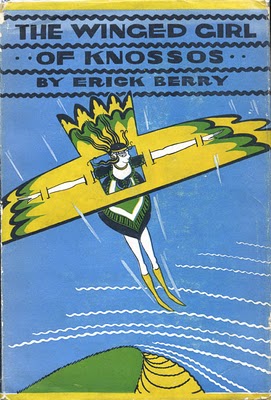
The Winged Girl of Knossos, by Erick Berry (pseud. Allena Best)

Every blog entry I've managed to find reviewing this book mentions how rare and difficult to find it is, what an awesome book it is, and how it really needs to be reprinted because it's a shame that it can't be widely read. I wholeheartedly agree on all counts!

Winged Girl takes place in ancient Crete during the Minoan period. Although the names of many of the places and people will be recognizable from mythology, the author has taken great pains to tell a story that is realistic fiction, so she's created a world where the origins of these tales are placed in a likely context.

The protagonist of this story is Inas, the daughter of Diadalos (Daedalus, as we're familiar with him today). Counter to the mythology surrounding him, he does not have any other children or family in this story. Inas is a butt-kicking female protagonist- she enjoys the company of sponge-fishermen and often dives herself just for sport. A true athlete, she is among the few chosen for the public spectacle of bull-vaulting. And she loves that her father is experimenting with flight, despite the fears of the ignorant villagers that it is akin to black magic. Although Minos, the king, would prefer that Daedalus not experiment in this way, he values Daedalus' clever scientific mind and often calls upon him in the palace. Because of this proximity to royalty, Inas has become a close friend of the princess Ariadne.

Inas' other close friend Kadmos has recently returned to Crete after a voyage abroad. Kadmos is glad to be home and is concerned that Minos has grown too secure in his own power- much of Knossos is unfortified and he worries that when all of the strong men are away exploring or collecting tributes, the island is vulnerable. This time, the returning ships have brought a number of valuable gifts, as well as a number of Greek tribute slaves (it is interesting to note here that in this story, the Cretans consider themselves the superior culture and the Greeks barbaric). Among these tributes is a tall, proud man named Theseus. Ariadne sees him and is immediately smitten.

This lays the groundwork for the remainder of the story, which I will not spoil. The book has wonderful period-inspired illustrations drawn by the author herself, and other recognizable mythological elements to the story include the Minotaur and the Labyrinth, Ariadne's thread and Daedalus' escape to Sicily, although their appearance in the story is very different from how you may remember these tales in mythology. This was a very creative tale, from some one who clearly did her homework, given the list of references in the back of the book.

Monday, October 10, 2011

Invincible Louisa, by Cornelia Meigs

The edition of this book I obtained through my local library system is the 1968 "Alcott Centennial Edition". It does speak well for the contents that the book was still in print 30 years after its initial publication, but the cover of the book scarcely inspires one to open it. The portrait on the cover makes Louisa look pretty dull, and the mustard-colored cover also does the book no favors (although, to be fair, in those days everyone looked bad in a portrait, and everyone's hair was pretty unfortunate).

That said, the book was a very easy and enjoyable read for some one familiar with Little Women. Meigs took a great deal of care to incorporate significant events in Louisa's life, especially ones that found their way into her novel in one way or another. I was pleasantly surprised, since Cornelia Meigs has been no great friend of mine during my Newbery journey.

Although most events are portrayed neutrally, and blame is never placed, I couldn't help but find myself frustrated with Louisa's father, Bronson. He seemed unmotivated by four daughters at home to apply himself to something useful with a regular and significant income. Instead he seemed to flit around hoping to apply himself to an experimental school or lifestyle or project that matched his inner inspiration. The family was always cheerful and close and made do, but Louisa always felt the burden of their poverty and made it her goal from a young age to put herself in a position to provide comfortably for them (which really should not have been her job, especially given the era in which she lived). She did eventually manage to do so, but at the expense of many missed opportunities, no doubt. She died unmarried and prematurely, the result of an incomplete recovery from typhoid, which she had obtained working far from home as a nurse for wounded Civil War soldiers. She was amazingly self-sacrificing but I couldn't help wishing that she could have been just a little bit selfish for her own sake. And I also wish that some one could have given Bronson Alcott, as charming and noble as he probably was, a swift kick in the shins and a reminder that his family's welfare was his responsibility.

Saturday, October 1, 2011

Glory of the Seas, by Agnes Danforth Hewes

Sea voyages really must have been all the rage in the 1920's and 1930's, since we've had to create a tag for all of these similar books. This novel takes place in pre-Civil War Boston. We're introduced to a shipbuilding company who is concerned because the invention of larger and swifter cutter ships is interfering with their ability to trade quickly with both the South and with California, and funds for investing in the new technology are tight. Also, the Fugitive Slave Act has recently been passed, a great offense to the north. The book proceeds more or less as you'd expect and doesn't contain any great surprises, which is why it took me six weeks to finish; it just wasn't exciting. Additionally, like many books written in this period, it begins in the meeting room of a large company (in this case, Mr. Pinkney's ship building firm) where an exciting event is being discussed and all of the principal characters chime in with their opinions. This may work for a movie, but there's something about the way that books of this era are written that makes it impossible for me to distinguish so many male principal characters when they're introduced in this way. And not to be gripey and all, since the author was female, but only two women exist in the entire world of this book- an aloof and often absent love interest, and a cook. How these many men went on to (presumably) reproduce I'll never know.

I'm probably not being fair to this one, but I'm just worn down from all of the like books, darnit! 20's and 30's, it's time for more creativity out of you.

Thursday, September 15, 2011

The Forgotten Daughter, by Caroline Dale Snedeker

When I realized that this one was written by the author of my most favorite Newbery book ever, I was really excited to read it! Her young female protagonist has much of the same charm as Dencey, but manages to keep out of trouble a bit better.
Chloé is a young girl who is a slave on a large Roman estate, along with Melissa, her caretaker. The two have quite an interesting history. Melissa, with her best friend (also named Chloé, confusingly) lived happily on the Greek island of Lesbos, but were taken captive when Roman soldiers invaded. Chloé's stoicism and strength charm her captor, and over their journey together they fall in love and marry in a Greek ceremony. Lævinus installs her as the lady of his estate and they live there happily, with Melissa as a servant, for some time. However, their happiness is interrupted when Chloé miscarries a son. In his grief, Lævinus leaves the estate and never returns. Chloé, after delivering her daughter, hears that he has married another woman in the city according to Roman tradition. She dies in her grief, and Melissa, fearing that Davus (the slave foreman) has orders to kill the baby, flees with little Chloé to a cave on another part of the estate and keeps her hidden.
Chloé has lived as a slave ever since, often abused by Davus, her life confined to the estate grounds and most of her time occupied in weaving. Her life improves somewhat when a new foreman is enstated, but her life is generally kept small, with the exception of the fantastic songs and stories of her homeland that Melissa teaches her. The only break in her routine is watching Aulus, the handsome son at a neighboring estate, show off on his horses.
Time passes, and the perspective changes to Aulus' own. After an auspicious start in the Roman army, he returns to the city to support his friend Tiberius. Tiberius has grand plans for reforming laws for the good of the common people, and rises quickly on their support. However, the Senate resents that he is chiseling away at their privilege. They eventually stage an assassination of Tiberius, and Aulus is injured trying to defend him. He escapes back to his country estate but in the ensuing chaos, hundreds of Tiberius' political supporters are killed in Rome. Aulus' own mother also dies from distress.
Barely escaping with his life, Aulus becomes morose and depressed, but eventually he finds strength in studying the ancient philosophers. One day as he is out walking in the woods, he falls into a snare and his arm is broken. He is discovered and set free by none other than Chloé! She brings him to Melissa, who is skilled at mending broken bones, and the three of them form a fast friendship that brings happiness to all of them. The inevitable happens, of course, but more secrets are eventually revealed which I will *not* share here since I've given everything else away already. Although Chloé is no Dencey, still a very enjoyable book!

Thursday, April 14, 2011

The ABC Bunny, by Wanda Gág


A very fun alphabet book which follows the story of a bunny as he runs about during his day, and encounters other animals as well. Charming black-and-white illustrations recall Garth Williams. I knew this one would be a treat after my obsession with the author's other book, Millions of Cats.

The end pages of the book also include sheet music for a song based on the words, with the tune composed by Flavia Gág, Wanda's youngest sister. You can listen here. Apparently I'm not the only one who wanted to know, because there are a few versions on Youtube! However, the words have a fabulous rhythm all on their own so if you're not a pianist you're not missing too much (and really, I could do without the tra-la-las, but I'm also no longer four years old). But a fabulous read-aloud from the days when librarians and teachers were required to play piano.